Custom Robot Workstations And Laser Systems Manufacturer


Laser Welding Positioner: Accuracy and Speed for Thin-Gauge Welds
You searched “welding positioner for sale” expecting an arc-welding answer. For thin-gauge stainless, battery trays, and heat-sensitive assemblies, the better question is laser. A laser welding positioner has a harder job than it looks: it must hold a wafer-thin seam flat and dead still while the beam races along it. This guide covers what a laser-ready platform must actually do, the speed–accuracy trade-off, and—honestly—where laser is the wrong call. Pick the family first; for the six-family comparison, see the table.
Why Laser Welding Changes the Positioner’s Job
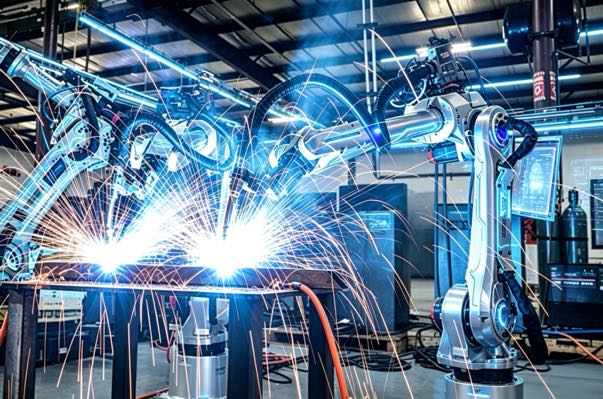
Arc welding tolerates a wobble; laser welding does not. A focused beam with a tiny spot demands the seam sit in the focal plane—flat and centered—for the whole pass. The positioner becomes the accuracy device, not just the rotator. Heat input is low, so distortion is low, but only if the part is held precisely, because there is no big molten puddle to forgive a misaligned joint. Speed is the point: at meters per minute, a small tracking error becomes a missed weld in milliseconds. The beam is fast; the positioner is what keeps it honest.
What a Laser-Ready Positioner Must Do
Hold the Seam Still and Flat
Laser accuracy lives or dies on the fixture and the axis. ROBOPTIX reports pose accuracy AP and pose repeatability RP per ISO 9283:1998 at your load, temperature, and speed—because a number without conditions is a half-truth. For thin gauge we verify with a laser tracker before shipment; a tolerance without measured proof is a brochure claim.
Move at Constant TCP Speed
The robot and servo positioner must move as one kinematic chain so the beam meets the seam at constant speed and standoff. The positioner is declared as an external axis and coordinated through the controller; the 7th Axis Robot Rail System extends reach and the Robot Base / Robot Pedestal sets the stable base frame.
Dissipate Heat, Avoid Drift
Stiffness and thermal drift are the hidden specs. A compliant frame flexes under clamping and creeps as it warms, walking the seam out of focus. ROBOPTIX sizes structure and drive for the overturning moment, not just the catalog load.
The Speed–Accuracy Trade-off
Laser welding tempts you to crank feed rate. The limit is not the beam—it is the positioner’s ability to track. At a target seam speed v with a positioner following error e, the standoff deviation scales with e; stay inside the depth-of-focus window or the weld loses penetration. For a 0.5 mm focal depth, a following error above about ±0.2 mm at speed drops you out of spec. So we state the accuracy condition at the real feed rate, per ISO 9283:1998—not at a slow bench test. Speed you can hold beats speed you cannot. The cheaper-rated axis is the expensive weld when it cannot keep the focal plane.
Which Positioner Family for Laser
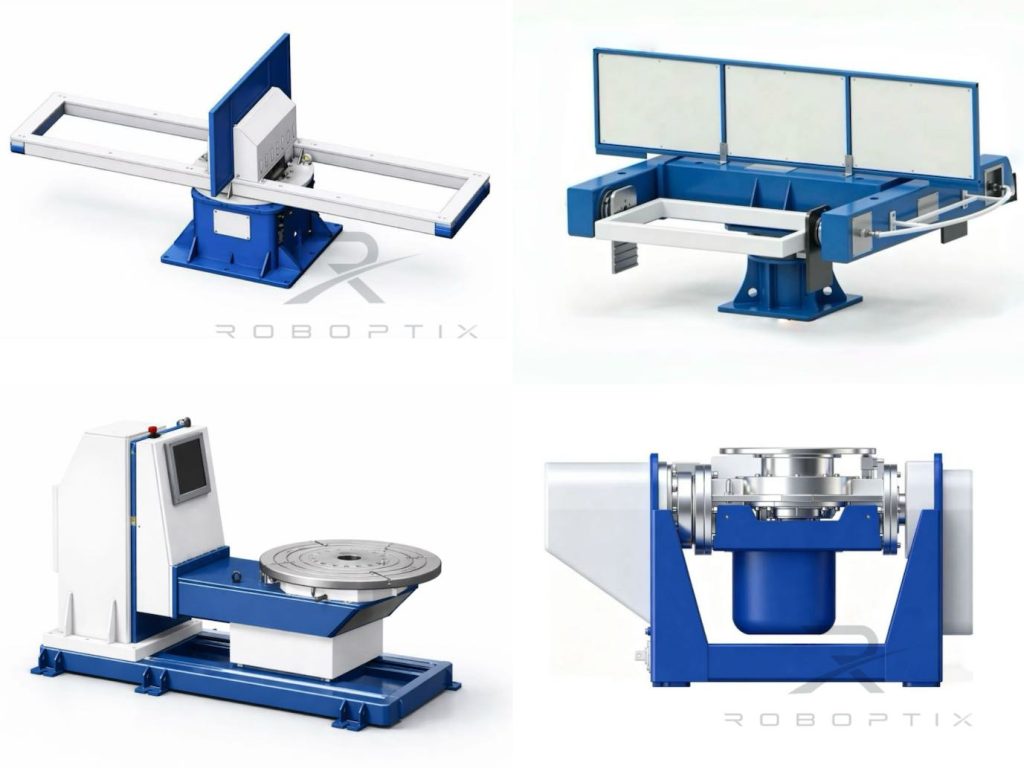
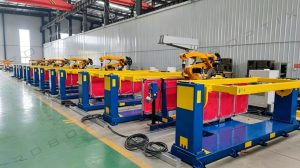
Match geometry first. Thin plates and small boxes suit an L-Type Welding Positioner; round and rotational parts suit a Single Axis Rotary Positioner; complex mixed seams suit a Horizontal 3-Axis Rotary Positioner; large irregular frames suit a U-Type Welding Positioner; long rotational seams suit a Headstock Tailstock Positioner; heavy plate for tilting suits a Vertical Tilting Positioner . For hands-off operation on variable parts, a No-Programming Robotic Welding Cell can present and path the seam; for a fixed part, a turnkey workstation ships ready to weld—both on the same laser-ready platform.
Worked Example
Thin-Gauge Enclosure Maker (robot + L-Type Welding Positioner)
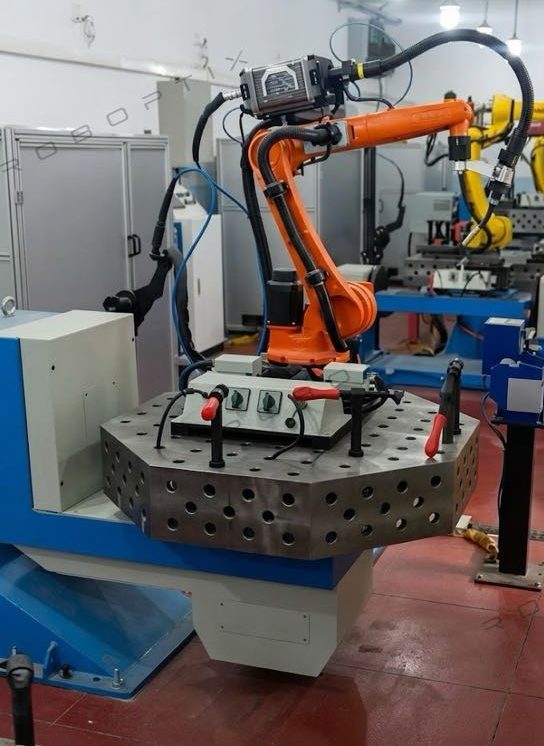
A shop welding 1.0 mm stainless enclosures kept burning through corners with arc. On a laser-ready cell—robot with an L-Type Welding Positioner declared as an external axis—the seam was held flat at constant TCP speed and verified to ±0.15 mm RP per ISO 9283:1998 at the real feed rate. Burn-through dropped to near zero, and throughput rose because the beam ran at full speed without stopping to correct. The positioner, not the laser, was the upgrade that mattered.
Laser vs Arc: Where Laser Wins
| Factor | Laser positioner | Arc positioner |
| Seam tolerance | Tight (focus-dependent) | More forgiving |
| Heat input | Low, low distortion | Higher |
| Best for | Thin gauge, heat-sensitive | Thick, fill-intensive |
| Positioner demand | High (hold focal plane) | Moderate |
When a Laser Welding Positioner Isn’t the Answer
Laser is not universal. Thick sections needing deep penetration, joints with wide gaps, or parts that need filler metal often fit arc better. The positioner still matters, but the beam is not the bottleneck. Audit any supplier before committing—factory visit and bench test beat a spec sheet —and weigh five-year total cost of ownership against the sticker. Pay for laser where it pays; keep arc where it wins.
When NOT to choose it
If your work is thick-plate or gap-tolerant, a coordinated arc cell is the honest call; for a unique one-off, the custom program. A laser-ready platform earns its cost on thin, precise, repeatable seams—not on every weld.
ROBOPTIX Builds the Laser-Ready Platform
Every ROBOPTIX laser-ready answer is an assembly, not a single SKU: a 7th Axis Robot Rail System that extends reach, a Robot Base / Robot Pedestal that defines the stable base frame, and servo positioners—Headstock Tailstock Positioner, L-Type Welding Positioner, U-Type Welding Positioner, Horizontal 3-Axis Rotary Positioner, Vertical Tilting Positioner, or Single Axis Rotary Positioner—declared as external axes. For hands-off operation, the same hardware ships as a No-Programming Robotic Welding Cell; for a fixed part, as a turnkey workstation; and for non-standard geometries, through the custom program. The laser-ready platform is the same coordinated architecture, built to hold the focal plane.
Frequently Asked Questions
Q: What makes a positioner ‘laser-ready’?
A: It holds the seam flat and centered in the focal plane at speed: servo axes with RP verified per ISO 9283:1998, coordinated external-axis motion with the robot, and a stiff frame that does not drift as it warms.
Q: Can any of the six positioner families take a laser?
A: Yes—match geometry: L-Type for thin plates and boxes, Single Axis Rotary for round parts, 3-Axis for complex seams, U-Type for large frames, Headstock Tailstock for long rotational seams, Vertical Tilting for heavy plate.
Q: Why does speed stress the positioner?
A: At meters per minute, a small following error walks the seam out of the focal depth in milliseconds; the limit is tracking, not the beam. We state accuracy at the real feed rate, not a slow bench test.
Q: Is laser better than arc for thin gauge?
A: Usually—lower heat, less distortion, higher throughput on thin, precise seams. But thick sections, wide gaps, or filler needs often fit arc better.
Q: When should I NOT buy a laser-ready cell?
A: For thick-plate or gap-tolerant work, a coordinated arc cell; for a one-off, the custom program. Audit the supplier first and compare five-year TCO.
Q: Does ROBOPTIX certify the accuracy?
A: ROBOPTIX is ISO 9001-certified and reports positioner accuracy using ISO 9283:1998-aligned metrics, with laser-tracker verification before shipment.
A laser welding positioner is the accuracy device, not just the rotator: it must hold a thin seam flat and centered in the focal plane at speed, coordinated as one kinematic chain with the robot. ROBOPTIX is ISO 9001-certified and verifies RP per ISO 9283:1998 at your real feed rate, not a slow bench test.
Send us your part and tolerance and we will spec the laser-ready platform
—before your competitor’s beam walks off the seam
About the Author
Experience & Credentials
Robotic welding system integration specialist with 12+ years of direct project experience focused on Robot Positioner selection and integration. Has provided consulting to 300+ factories across North America, Europe, and Asia. All specification data in this article is drawn from actual H / B / L / U series product datasheets.
Company background: 26+ years of welding automation engineering, 40+ active patents, 1,500+ completed projects globally, approximately 70% involving Robot Positioner integration.
Certifications
High-Tech Enterprise — Cert. No. GR202341000595 (Issued Nov. 2023)
ISO 9001: 2015 (GB/T 19001-2016) — Quality Management System
GJB 9001C-2017 — Military/Weapon Equipment Quality Management System
EU CE — Machinery Directive 2006/42/EC (Cert. No. M.2026.206.C134866)
References
[1] International Organization for Standardization. (1998). ISO 9283:1998, Manipulating Industrial Robots — Performance Criteria and Related Test Methods.
[2] Park, J.-H., Kim, S.-H., Moon, H.-S., & Kim, M.-H. (2019). Influence of Gravity on Molten Pool Behavior and Analysis of Microstructure on Various Welding Positions in Pulsed Gas Metal Arc Welding. Applied Sciences, 9(21), 4626.
[3] Liu, J., Jiang, F., Chen, S., Xu, B., Zhang, G., Cheng, W., & Ma, X. (2023). Mechanisms of Gravitational Influence on Weld Pool Behavior and Weld Bead Performance in Variable Polarity Plasma Arc Welding across Different Welding Position. Materials, 16(19), 6457.
RELATED POSTS

6 Common Challenges in Robotic Laser Welding and How to Solve Them
Installation & Maintenance Guide for Robotic Laser Welding Systems: A Practical Roadmap
Fixture-Free Fabrication: When a Welding Positioner Replaces Complex Jigs, Tack Welds, and Crane Time
7th Axis Robot Track System Maintenance & Troubleshooting Guide
2026 Welding Automation Pain Points: Why Competitive Factories Are Choosing a Robot Positioner