Custom Robot Workstations And Laser Systems Manufacturer


Turnkey Welding Workstation: From Drawing to Production-Ready Cell
You searched “welding positioner for sale” and now face a second, heavier question: who makes it actually weld? A turnkey welding cell removes that burden—it arrives commissioned, programmed, and validated, not as loose hardware you must integrate yourself. This guide is about deployment, not theory: what turnkey includes, how ROBOPTIX stands a cell up, and—honestly—where a DIY build still wins. If you have not picked a positioner family, start with type selection; for the six-family comparison, see the table .
Why a Turnkey Cell Beats a DIY Integration
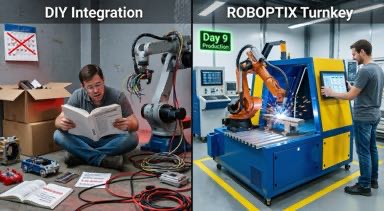
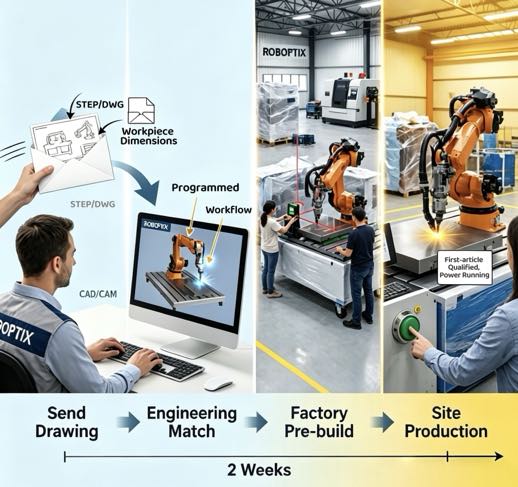
A do-it-yourself integration means you own the robot, the positioner, the controller, and the weeks of controls engineering to make them shake hands. Most shops underestimate that step: the weld is the easy part; the commissioning is the project . A turnkey Welding Robot Cell arrives as one commissioned system—robot, servo positioner, safety, and a proven process—so the first good part comes in days, not months. ROBOPTIX pre-verifies the kinematic chain before it ships.
What “Turnkey” Actually Includes
A true turnkey scope is a checklist, not a pile of crates.
Mechanical Integration
ROBOPTIX ships the 7th Axis Robot Rail System that extends reach , a Robot Base / Robot Pedestal that defines the stable base frame, and one of the six servo positioner families—each declared as an external axis so the controller solves the whole chain . Frames are aligned at build, not in your bay.
Controls & External-Axis Commissioning
The positioner is commissioned as an external axis inside the robot controller, with external-axis interpolation verified before shipment. The coordinate frame is set so the robot and positioner move as one kinematic chain—the coordinated motion a production cell needs.
First-Article Acceptance
Before it leaves, the cell is run against your part and verified to the stated tolerance with a laser tracker, per ISO 9283:1998 conditions. You receive proof, not a promise. Without that acceptance, a “turnkey” claim is just a shipping date.
The Deployment Math
The number that decides buy-vs-build is production lost during stand-up. A DIY integration typically burns 8–12 weeks of controls and rework before the first good part; a ROBOPTIX turnkey cell ships pre-commissioned and goes live in about 2 weeks. At 40 parts/day, the 6–10 week gap is roughly 240–400 parts of output you never recover—often more than the turnkey premium costs. Turnkey trades a higher sticker for a shorter, predictable ramp; DIY trades a lower sticker for a longer, riskier one. The cheaper quote is the expensive machine if it ships late.
Engineering note: verified, not assumed
Commissioning is only trustworthy with stated conditions. ROBOPTIX reports pose accuracy AP and pose repeatability RP per ISO 9283:1998 at your load, temperature, and speed—because a number without conditions is a half-truth. The cell is accepted on measured data, so the spec you sign off on is the spec you weld with.
Which Shops a Turnkey Cell Fits
Pick the positioner family from your part geometry first : long rotational seams suit a Headstock Tailstock Positioner; beams and boxes suit an L-Type Welding Positioner; large irregular frames suit a U-Type Welding Positioner. Turnkey pays off hardest where the part is stable and volumes are real—you want the cell running, not sitting in your bay while an integrator learns your fixtures. For high-mix, frequent-change work, a No-Programming Robotic Welding Cell may fit better; for tight tolerance and rare fixtures, a coordinated cell.
Turnkey Cost Breakdown: Where the Premium Goes
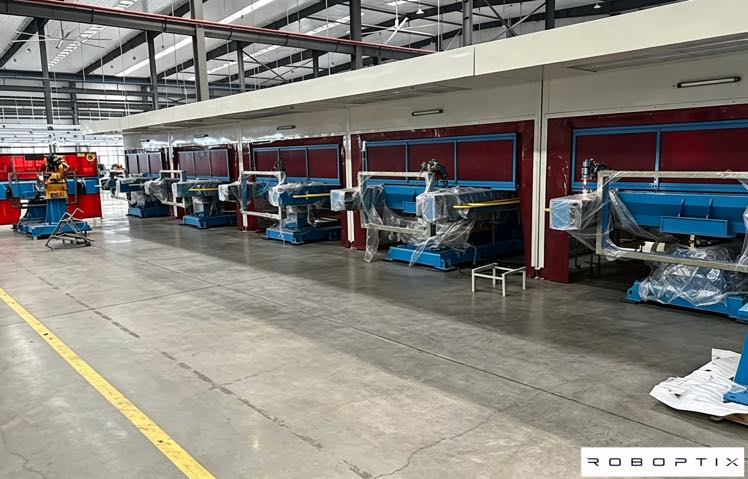
A turnkey premium is not a markup—it is prepaid engineering you would otherwise do on your own clock. When you search “welding positioner for sale” and compare a bare robot-plus-positioner quote against a turnkey cell, the gap is not margin—it is the integration, commissioning, and acceptance work moved off your floor and onto ours. Understanding the line items is how you judge the number honestly.
What you are actually buying, line by line
Three things dominate the cost. First, mechanical integration of the 7th Axis Robot Rail System and Robot Base / Robot Pedestal—alignment and wiring that a DIY shop relearns on every build. Second, external-axis commissioning inside the robot controller, including the coordinated motion proof. Third, first-article laser acceptance per ISO 9283:1998, with a signed tolerance report you can hand to your own QA. A vendor quoting a bare machine ‘cheap’ has simply deferred those costs onto your timeline.
The ramp is the real asset
The least visible line item is certainty. A turnkey cell gives you a commissioning date you can plan production against; a DIY build gives a best-case estimate that slips week after week. At 40 parts/day, each slipped week is 200 lost parts—so the premium is often smaller than the output you protect. Buy the ramp where it pays; do not pay twice for the same lesson.
Worked Example
Pressure-Vessel Supplier (robot + Headstock Tailstock Positioner)
A supplier quoting pressure-vessel shells needed a coordinated cell but had no controls engineer. A DIY path would have meant a 10-week integration; the turnkey cell—robot with a Headstock Tailstock Positioner as an external axis—arrived commissioned and laser-verified to the procedure-qualification tolerance . The cell held the seam flat at constant TCP speed and was welding production in nine days. The avoided integration window was worth more than the turnkey premium.
Turnkey vs DIY Integration
| Dimension | Turnkey (ROBOPTIX) | In-House DIY |
| Time to first good part | ~2 weeks (pre-commissioned) | 8–12 weeks of controls work |
| Who owns integration risk | ROBOPTIX | Your team / integrator |
| Acceptance evidence | Laser-tracker, ISO 9283:1998 | Often none until you build it |
| Best for | Stable volumes, fast ramp | Unique one-off, deep in-house skill |
When a Turnkey Cell Isn’t the Answer
Turnkey is not universal. For a one-off, highly bespoke part best served by a custom program , or a shop that already runs robot cells and wants to own the stack, a coordinated build or custom program may be the honest choice. Audit any supplier before committing—factory visit and bench test beat a spec sheet—and weigh five-year total cost of ownership against the sticker. Pay for the ramp where it pays; own the build where you can.
When NOT to choose it
If your part is a one-off, highly bespoke build, choose the custom program . If you already run robot cells and want to own the stack, a coordinated build is the honest call. Judgment, not a default, protects the budget—audit the supplier first .
ROBOPTIX Builds the Turnkey Welding Robot Cell
Every turnkey cell is an assembly, not a single SKU: a 7th Axis Robot Rail System that extends reach , a Robot Base / Robot Pedestal that defines the stable base frame, and servo positioners—Headstock Tailstock Positioner, L-Type Welding Positioner, U-Type Welding Positioner, Horizontal 3-Axis Rotary Positioner, Vertical Tilting Positioner, or Single Axis Rotary Positioner—declared as external axes. For hands-off operation, the same hardware ships as a No-Programming Robotic Welding Cell ; for laser processes, on a laser-ready platform ; and for non-standard geometries, through the custom program. The turnkey Welding Robot Cell is the delivered, commissioned version of the same coordinated architecture.
Frequently Asked Questions
Q: What does turnkey welding mean?
A: It means the cell arrives commissioned, programmed, and validated to your part—not loose hardware. ROBOPTIX pre-verifies the external-axis chain and accepts it with a laser tracker before shipping.
Q: How long until the first good part?
A: A ROBOPTIX turnkey cell typically goes live in about 2 weeks versus 8–12 weeks for a DIY integration, because the kinematic chain is commissioned before it ships. The recovered production usually exceeds the turnkey premium .
Q: Which positioner family is in a turnkey cell?
A: Whichever matches your geometry: Headstock Tailstock for long rotational seams, L-Type for beams/boxes, U-Type for large irregular frames, 3-Axis for complex mixed seams, Vertical Tilting for heavy plate, Single Axis Rotary for round parts.
Q: Is turnkey the same as no-programming?
A: Not necessarily. Turnkey is about delivery; No-Programming Robotic Welding Cell is a usability layer on top. A turnkey cell can be taught or vision-guided—the point is it ships ready to weld, not the programming method.
Q: When should I NOT buy turnkey?
A: For a unique one-off part, choose the custom program ; for a shop with deep in-house robot skill, a coordinated build ; always audit the supplier first and compare five-year TCO.
Q: Can I add no-programming later?
A: Yes. The same coordinated hardware ships as a No-Programming Robotic Welding Cell ; the vision layer is software on top of the external-axis cell, so a turnkey cell can be upgraded to hands-off operation without rebuilding the base machine. Start turnkey, add vision when the part mix demands it.
Q: What about spare parts and operator training?
A: ROBOPTIX ships a documented spare-part list and trains your operators during commissioning, so the cell is yours to run on day one. Audit the supplier’s support model before you commit—a factory visit still beats a spec sheet.
A turnkey welding cell is the fastest path from drawing to production: commissioned, validated, and ready to weld—not a pile of crates you must integrate. ROBOPTIX is ISO 9001-certified, builds it from the 7th Axis Robot Rail System, Robot Base / Robot Pedestal, and servo positioners, and accepts it per ISO 9283:1998 with laser-tracker proof. Send us your drawing and tolerance band and we will deliver the Welding Robot Cell—before your competitor ships theirs.
About the Author
Experience & Credentials
Robotic welding system integration specialist with 12+ years of direct project experience focused on Robot Positioner selection and integration. Has provided consulting to 300+ factories across North America, Europe, and Asia. All specification data in this article is drawn from actual H / B / L / U series product datasheets.
Company background: 26+ years of welding automation engineering, 40+ active patents, 1,500+ completed projects globally, approximately 70% involving Robot Positioner integration.
Certifications
High-Tech Enterprise — Cert. No. GR202341000595 (Issued Nov. 2023)
ISO 9001: 2015 (GB/T 19001-2016) — Quality Management System
GJB 9001C-2017 — Military/Weapon Equipment Quality Management System
EU CE — Machinery Directive 2006/42/EC (Cert. No. M.2026.206.C134866)
References
[1] International Organization for Standardization. (1998). ISO 9283:1998, Manipulating Industrial Robots — Performance Criteria and Related Test Methods.
[2] Park, J.-H., Kim, S.-H., Moon, H.-S., & Kim, M.-H. (2019). Influence of Gravity on Molten Pool Behavior and Analysis of Microstructure on Various Welding Positions in Pulsed Gas Metal Arc Welding. Applied Sciences, 9(21), 4626.
[3] Liu, J., Jiang, F., Chen, S., Xu, B., Zhang, G., Cheng, W., & Ma, X. (2023). Mechanisms of Gravitational Influence on Weld Pool Behavior and Weld Bead Performance in Variable Polarity Plasma Arc Welding across Different Welding Position. Materials, 16(19), 6457.
RELATED POSTS
What Is a Robotic Welding Cell? 2026 Beginner’s Guide | 37 Shop Data
Laser Welding Positioner: Accuracy and Speed for Thin-Gauge Welds
ROI of a No-Programming Robotic Welding Cell: A Practical Guide for Structural Steel Applications
How to Choose the Right Robotic Welding Cell for Your Shop? Single-Station vs. Two-Station (2026 Complete Guide)
How to Install and Integrate a 7th Axis Robot: Step-by-Step Guide & Best Practices