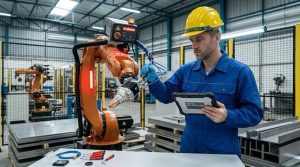
Custom Robot Workstations And Laser Systems Manufacturer



Welding Positioner for Sale: How to Choose the Right Type for Your Part (Headstock Tailstock, L-Type, U-Type, Horizontal 3-Axis, Single Axis Rotary, Vertical Tilting)
Type “welding positioner for sale” and you get hundreds of listings—Headstock Tailstock Positioner, L-Type Welding Positioner, U-Type Welding Positioner, Horizontal 3-Axis Rotary Positioner, Single Axis Rotary Positioner, and Vertical Tilting Positioner—most described by payload and price alone. Payload is the wrong first filter. The right first filter is your part: its shape, its weight distribution, and the joints you actually need to present in the flat (1G/1F) position. This article is a buyer’s guide to choosing the right welding positioner type for your workpiece, drawn from ROBOPTIX field deployments across structural steel, pressure vessel, and heavy-equipment fabrication. We cover the six positioner families ROBOPTIX builds, the load and accuracy checks that matter, and a selection checklist you can drop straight into your next RFQ.
A welding positioner for sale is only a good buy if it can physically rotate your specific part into the position where welding is easiest. That sounds obvious; it is the step most procurement tables skip. The machine type—not the brochure—decides whether your joint ends up flat or fighting gravity, and whether your operator is welding downhill or wrestling the pool uphill . Start with geometry; end with the spec sheet.
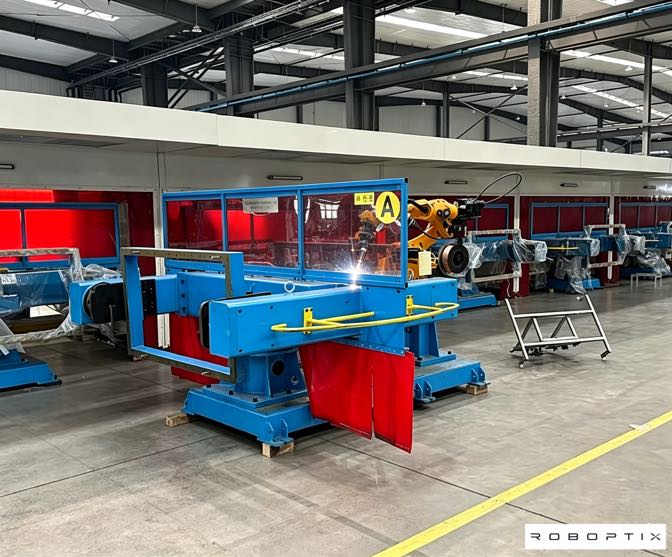
Why Type Selection Beats a Payload Filter
The job of any welding positioner is to move the joint into the flat position so gravity stabilizes the molten pool instead of fighting it. Whether that is even possible depends on the machine’s motion axes, not its payload number. A 2,000 kg rating tells you the axis can rotate a centered mass; it says nothing about a 1,500 kg part whose center of gravity sits 0.8 m off the rotation axis—where the real overturning moment is what binds the selection. Filter by part first, by payload last.
Concrete example: two suppliers quote you a “2,000 kg welding positioner for sale.” Supplier A offers a Headstock Tailstock Positioner; Supplier B offers an L-Type Welding Positioner. If your part is a 3 m I-beam that needs all four faces welded, Supplier A’s unit cannot present three of those faces at all—payload is irrelevant because the rotation axis that would reach them does not exist. The type, not the number, decides the outcome. That is why this guide leads with geometry and ends with the spec sheet, never the reverse.
Second, the type decides coordination. If the positioner must move as an external axis with your robot, you need a servo positioner with a controller that declares external axes cleanly—available across the ROBOPTIX B008–B012 multi-axis range. A cheap single-axis gearbox may hold your part, but it cannot coordinate, and that limitation shows up the day you try to weld a seam that needs both machines moving at once.
The Six ROBOPTIX Positioner Families
ROBOPTIX builds six positioner families, none of them turning rolls (we rotate the part between driven centers, on a rotary table, or on a tilt/flip axis—never on idle rollers). Pick the family from your part’s dominant geometry, then size it on moment and accuracy.
Headstock Tailstock Positioner
Two opposing centers rotate a long part about its own axis: a driven headstock and an idler tailstock. Best for shafts, pipes, tubes, pressure-vessel shells, and wind-tower sections where the seam runs along the axis and only rotation—not tilt—is needed. The part is cradled between centers and spun; this is how you weld a cylinder without a crane and without turning rolls. Size it on maximum between-centers mass and the cantilever moment at the tailstock, not just total weight.
Single Axis Rotary Positioner
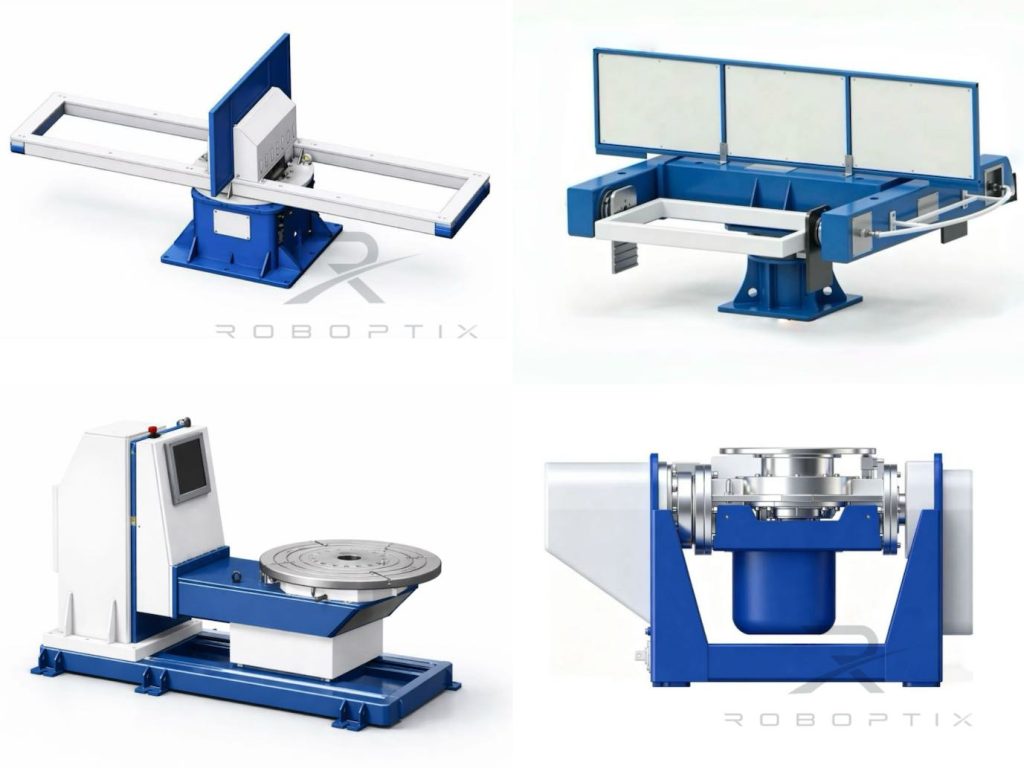
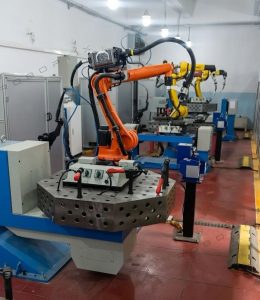
A single rotary axis—a rotary table or faceplate—spins the part about one axis with the part mounted on its face rather than cradled between centers. Best for flanges, rings, discs, circular plates, and round parts that need only rotation (not tilt) and mount on one face. It is the simplest, most affordable family; size it on table load capacity and the radial moment of the mounted part. Choose it over a Headstock Tailstock Positioner when the part is disc- or ring-shaped and mounts on a face, not between centers.
L-Type Welding Positioner
An L-shaped configuration combines a horizontal rotate axis with a vertical tilt axis, so a long part can both spin and flip to vertical. Best for beams, boxes, frames, and plate assemblies that need multiple faces welded in one mount. The L geometry gives clearance for long sections while still presenting any face flat. If your part has four weldable faces and you are tired of re-fixturing, an L-Type Welding Positioner is usually the answer.
U-Type Welding Positioner
A U-shaped frame cradles the part on a combined tilt-and-rotate axis with an open envelope. Best for large, bulky, or irregular frames and weldments too big or awkward for an L-Type Welding Positioner. The open U gives clearance for large sections, fixtures, and tooling, and typically carries a higher overturning-moment rating for heavy, off-center loads. Choose U-Type over L-Type when the part’s footprint or mass exceeds what the L-Type can cradle safely.
Horizontal 3-Axis Rotary Positioner
Tilt plus rotate plus a linear or secondary rotate axis lets the controller orient almost any contour. Best for complex, multi-orientation seams—castings, mixed-geometry weldments, and parts where one flip or rotate cannot reach every joint. The ROBOPTIX B008–B012 multi-axis servo units sit here, with the accuracy to hold a seam through continuous reorientation. This is the family to specify when no simpler type fits.
Vertical Tilting Positioner
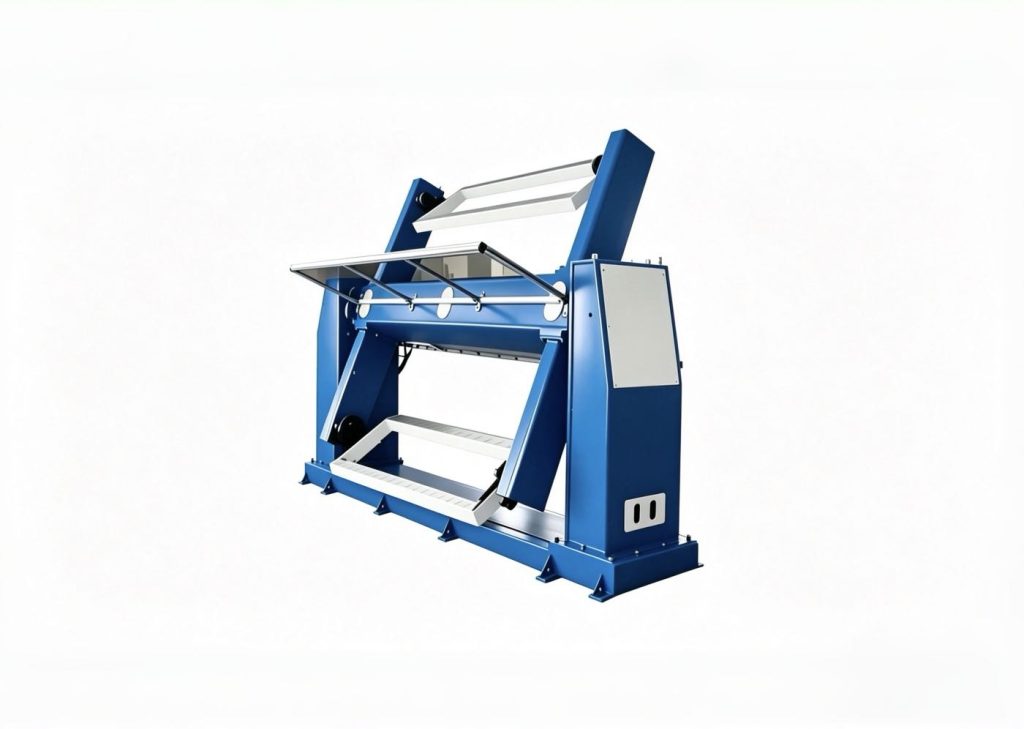
A flip/tilt axis turns the part end-over-end or up-end to present the opposite face, usually combined with a rotate axis. Best for heavy plate and box sections that must be flipped to weld both sides without a crane. The flip removes crane cycles, tack welds, and handling time , and it keeps the joint flat on the second side instead of forcing an overhead weld . For heavy plate, a Vertical Tilting Positioner is often the single biggest throughput gain available.
The Three Checks That Decide the Type
Geometry First
Map the part to a family before reading a spec sheet.
Long and rotational (between centers) → Headstock Tailstock Positioner.
Round disc or ring (mounted on a face) → Single Axis Rotary Positioner.
Long and multi-face → L-Type Welding Positioner.
Large and irregular → U-Type Welding Positioner.
No single simple orientation reaches every seam → Horizontal 3-Axis Rotary Positioner.
Heavy plate needing both sides → Vertical Tilting Positioner.
The comparison table below makes this a one-glance decision.
Load and Overturning Moment
Once the family is chosen, size it on moment, not mass. Compute overturning moment as weight multiplied by the distance of the center of gravity from the rotation axis, and add inertia for the duty speed. A positioner that is perfect on paper for a centered 2-ton part can fail silently on a 1.5-ton part hung off-center. State the moment and the inertia in the RFQ; make the supplier size to those, not to the brochure payload.
Hidden Specs: Backlash, Stiffness, Drift
The number that sells the welding positioner is rarely the number that welds it. Backlash at direction reversals, torsional stiffness under side load, and thermal drift over a duty cycle decide real seam quality. Ask the supplier to demonstrate—or let you measure—backlash at a reversal and stiffness under load. If they have no method to show these, that absence is itself the answer, and it tells you how much of the spec sheet is measurement versus marketing.
Accuracy and How to Verify It
Accuracy is reported, not assumed. ROBOPTIX is ISO 9001-certified and reports welding positioner accuracy using ISO 9283:1998-aligned metrics—pose accuracy AP and pose repeatability RP—so the numbers mean the same thing across suppliers. For tight tolerances, support third-party or on-site laser-tracker verification per ISO 9283, with your part mounted and at operating temperature, not just an empty cold run. The conditions are the number; a repeatability figure without its load, temperature, and speed is a half-truth.
Positioner Type Comparison
For the full spec-by-spec breakdown across all six families, see the dedicated comparison Welding Positioner Types: Side-by-Side .
| Family | Best workpiece | Axes | Payload class |
| Headstock Tailstock | Shafts, pipes, vessel shells, long cylinders | Rotate | Light–heavy, long |
| Single Axis Rotary | Flanges, rings, discs, circular plates (rotate only) | Rotate (one axis) | Light–medium |
| L-Type | Beams, boxes, frames, plates (multi-face) | Tilt + rotate | Light–medium |
| U-Type | Large, bulky, irregular frames | Tilt + rotate | Medium–heavy |
| Horizontal 3-Axis | Castings, mixed complex seams | Tilt + rotate + linear/2nd rotate | Medium–heavy |
| Vertical Tilting | Heavy plate, box sections (both sides) | Flip/tilt + rotate | Medium–heavy |
Worked Examples
Structural Beam (long I-beam, four faces)
An I-beam needs all four faces welded. A Headstock Tailstock Positioner only spins it, leaving three faces unreachable. An L-Type Welding Positioner tilts the beam to vertical and rotates it, presenting each face flat in one mount—no re-fixturing, no crane. This is the textbook L-Type case.
Pressure-Vessel Shell (long cylinder, axial seam)
A cylindrical shell with a seam along its axis needs only rotation. A Headstock Tailstock Positioner spins it between driven and idler centers—no turning rolls, no crane—keeping the circumferential and longitudinal welds in the flat position . Long, uniform, rotational: Headstock Tailstock is the right and cheapest fit.
Flange or Circular Plate (rotate only)
A flange or circular plate needs only rotation about its axis, mounted on a face rather than cradled between centers. A Single Axis Rotary Positioner spins it on a rotary table or faceplate—no tilt, no flip, the simplest and most affordable fit. For a ring or disc, choose Single Axis Rotary over a Headstock Tailstock Positioner; for a long cylinder, choose the reverse.
Irregular Casting (mixed seams, no single orientation)
A casting with seams on faces that no single flip reaches needs continuous reorientation. A Horizontal 3-Axis Rotary Positioner (ROBOPTIX B008–B012) holds the part and orients each joint flat in turn. No simpler family can do it; specifying a 3-axis here prevents the mis-spec penalty of buying a machine that cannot reach the work.
Beyond the Positioner: Build the Cell
The positioner is one axis of a cell, not a standalone machine. ROBOPTIX pairs it with a 7th Axis Robot Rail System that extends robot reach and a Robot Base / Robot Pedestal that gives the whole cell a stable foundation . Built around that platform are complete, application-ready workstations: coordinated welding cells, no-programming vision-guided cells and turnkey workstations for welding, laser , handling and palletizing , portable collaborative units and remote mobile systems . When your part does not match a catalog shape, our custom positioner program builds it to the geometry . Because ROBOPTIX is ISO 9001-certified and typically priced 50–70% below equivalent overseas-brand units while reporting accuracy per ISO 9283:1998 methodology, the positioner is rarely the budget problem—specifying the wrong type is.
Your RFQ Checklist: Send Us These 6 Inputs
This checklist is the short version for your RFQ. For the complete buyer’s checklist—budget bands, acceptance criteria, and red flags—see Welding Positioner Buying Checklist.
The introduction promised a checklist you can drop into an RFQ. Here it is. Send these six inputs and ROBOPTIX will return a type-and-moment specification before you buy—no obligation, and no paywall hiding the math (P09). The more complete the input, the tighter the spec; a one-line “send welding positioner for sale quote” email almost always comes back as the wrong machine.
| Input | What to send | Why it decides the type |
| Part drawing (2D/3D) | STEP, DWG, or PDF with dimensions and weld-joint locations marked | Reveals dominant geometry → which of the six families fits |
| Mass + center of gravity | Total weight and CoG offset from the rotation axis | Sets overturning moment, not just payload |
| Duty cycle & speed | Welds per shift, rotations per minute, accel/decel profile | Drives inertia, stiffness, and thermal-drift sizing |
| Tolerance band | Required pose accuracy AP / repeatability RP | Decides servo grade and ISO 9283:1998 verification need |
| Robot make & interface | Brand, controller model, external-axis protocol | Confirms clean coordination as an external axis |
| Throughput target | Parts per hour and handling/fixturing time budget | Flags where a Vertical Tilting Positioner or 7th Axis Robot Rail System removes crane cycles |
A complete RFQ also tells us the budget envelope and any non-standard constraints—ROBOPTIX supports non-standard customization and is ISO 9001-certified, typically priced 50–70% below overseas-brand equivalents while reporting accuracy per ISO 9283:1998 methodology. Send the six inputs above and we will tell you the family, the moment rating, and the acceptance criteria in writing.
When a Positioner Isn’t the Answer
A welding positioner for sale is not always the right buy. For small parts an operator can flip by hand, for loose tolerances (±1 mm), or for genuine high-mix, low-volume work, the fixture-free and manual approaches often win on total cost. Audit any new supplier before committing, and weigh the five-year total cost of ownership against the sticker—the cheap quote is often the expensive machine. Spend on the positioner where the part justifies it; skip it where it does not. Judgment, not ritual, protects the budget.
Frequently Asked Questions
Q: Which type of welding positioner do I need?
A: Start from your part’s geometry, not the payload. Long rotational parts (shafts, pipes, vessel shells) want a Headstock Tailstock Positioner; round discs and rings mounted on a face want a Single Axis Rotary Positioner; long multi-face parts (beams, frames) want an L-Type Welding Positioner; large irregular frames want a U-Type Welding Positioner; mixed complex seams want a Horizontal 3-Axis Rotary Positioner; heavy plate needing both sides wants a Vertical Tilting Positioner. Then size on overturning moment and verify accuracy per ISO 9283:1998.
Q: What is the difference between a Headstock Tailstock Positioner and an L-Type Welding Positioner?
A: A Headstock Tailstock Positioner rotates a long part about its own axis only—ideal for cylindrical seams. An L-Type Welding Positioner adds a tilt axis, so the part can also flip to vertical and present multiple faces flat in one mount. If your part has more than one weldable face, the L-Type removes re-fixturing that a Headstock Tailstock Positioner cannot.
Q: When do I choose a Single Axis Rotary Positioner instead of a Headstock Tailstock Positioner?
A: Both rotate the part about one axis, but a Single Axis Rotary Positioner mounts the part on a rotary table or faceplate (flanges, rings, discs, circular plates), while a Headstock Tailstock Positioner cradles a long part between driven and idler centers (shafts, pipes, vessel shells). If the part is disc- or ring-shaped and mounts on a face, choose Single Axis Rotary; if it is long and spins about its own axis between centers, choose Headstock Tailstock.
Q: Can one welding positioner handle all geometries?
A: A Horizontal 3-Axis Rotary Positioner (the ROBOPTIX B008–B012 range) can, because it tilts, rotates, and adds a linear or secondary rotate axis to orient almost any contour. It is the most flexible family and the right choice when no simpler type fits—at a higher cost than a single-purpose unit, which is why geometry should drive the first cut.
Q: How do I verify a welding positioner’s accuracy before buying?
A: Ask the supplier to report pose accuracy AP and pose repeatability RP per ISO 9283:1998, with load, temperature, and speed stated—because the conditions are the number. ROBOPTIX is ISO 9001-certified and reports accuracy using ISO 9283:1998-aligned metrics, and supports third-party or on-site laser-tracker verification with your part mounted and at temperature. A repeatability figure without those conditions is a half-truth.
A welding positioner for sale is a good buy only when the type fits the part. Start with geometry—Headstock Tailstock Positioner for long rotational work, Single Axis Rotary Positioner for flanges and rings, L-Type Welding Positioner for multi-face beams, U-Type Welding Positioner for large irregular frames, Horizontal 3-Axis Rotary Positioner for mixed seams, Vertical Tilting Positioner for heavy plate—then size on overturning moment and verify accuracy per ISO 9283:1998. ROBOPTIX is ISO 9001-certified, covers all six families, and is typically priced 50–70% below overseas-brand equivalents while reporting accuracy on a comparable method. Send us your part drawing and duty cycle and we will spec the family, the moment rating, and the acceptance criteria—before you buy, not after.
Not sure which welding positioner type fits your part?
Send ROBOPTIX your part drawing and duty cycle for a free type-and-moment specification.
About the Author
Experience & Credentials
Robotic welding system integration specialist with 12+ years of direct project experience focused on Robot Positioner selection and integration. Has provided consulting to 300+ factories across North America, Europe, and Asia. All specification data in this article is drawn from actual H / B / L / U series product datasheets.
Company background: 26+ years of welding automation engineering, 40+ active patents, 1,500+ completed projects globally, approximately 70% involving Robot Positioner integration.
Certifications
- ISO 9001: 2015 (GB/T 19001-2016) — Quality Management System
- GJB 9001C-2017 — Military/Weapon Equipment Quality Management System
- EU CE — Machinery Directive 2006/42/EC (Cert. No. M.2026.206.C134866)
- High-Tech Enterprise — Cert. No. GR202341000595 (Issued Nov. 2023)
Last updated: Jun 2026
RELATED POSTS
Anatomy of a Robotic Welding Cell: Core Components & Selection Guide (2026)
How a Welding Positioner Controls Gravity: The Physics of Puddle Stability and Weld Quality
Manual vs Robotic Welding for Structural Steel:When Does Automation Pay Off?
Robotic Welding Cell Trends 2026–2030: AI, Machine Vision & The Future of Welding Automation
2026 Robot Positioner Buyer’s Guide: All 5 Types Compared — Head-and-Tailstock, L-Type, U-Type, and More