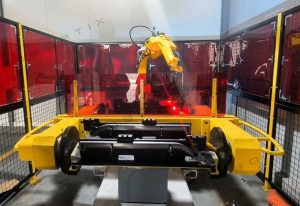
कस्टम रोबोट वर्कस्टेशन और लेजर सिस्टम निर्माता



रोबोट पोजिशनर्स के लिए संपूर्ण शुरुआती मार्गदर्शिका: सब कुछ जो आपके लिए जानना ज़रूरी है
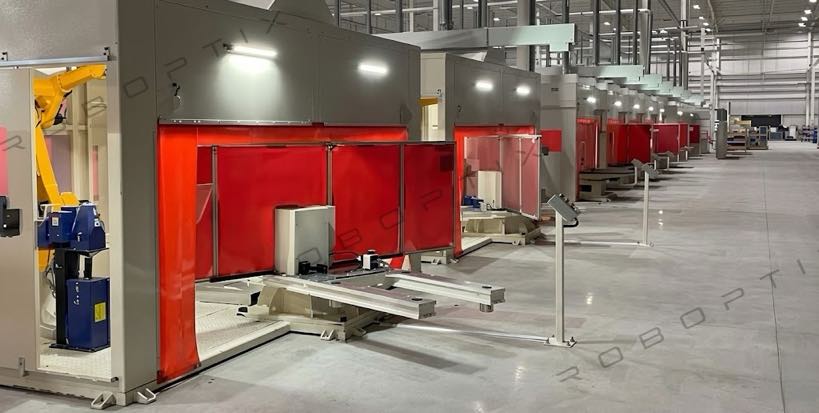
A Plain-Language Guide to Robot Positioners — No Background Required
If you are just starting to explore welding automation, आपने शायद 'रोबोट पोजिशनर' शब्द सुना होगा’ without being entirely sure what it is, how it works, or how it relates to a welding robot. This guide is written specifically for you.
Whether you are a factory owner evaluating your first automation investment, a purchasing engineer responsible for equipment selection, or a technical professional new to this field, by the end of this article you will understand:
- What a Robot Positioner is and what problem it solves
- How it works and what its core functions are
- The main types available and how they differ
- The real operational value it delivers to a factory
- The key specifications to understand before buying — and the most common selection mistakes
We will not pile on technical jargon. Every concept is explained in terms you can grasp immediately. If you have follow-up questions about a specific product after reading, there is a free consultation link at the end.
रोबोट पोजिशनर क्या है??
The One-Sentence Definition
A Robot Positioner is a servo-driven precision rotation device that automatically adjusts the spatial orientation of a workpiece during welding or assembly, so that the welding robot can always access every joint at the optimal angle.
If that still sounds abstract, here is a simple way to think about it:
| Everyday analogy: Imagine cooking meat on a rotisserie — you continuously rotate the spit so every side gets even heat. A Robot Positioner does exactly the same thing: it continuously rotates and tilts the workpiece so the welding torch always faces the easiest side to weld, rather than forcing the robot to reach into awkward corners. |
How a Robot Positioner Relates to a Welding Robot
A common first question is: a six-axis welding robot is already highly flexible — why would you need another piece of equipment?
The answer is that robot flexibility solves the question of where the torch goes. A Robot Positioner solves the question of how the workpiece is oriented. They have different jobs, and combining them is what unlocks the full performance potential of a robotic welding cell.
| आयाम | वेल्डिंग रोबोट | रोबोट पद |
| Primary role | Controls torch path and welding parameters | Controls workpiece spatial orientation |
| What it moves | The torch | The workpiece |
| Problem it solves | Weld path accuracy | Weld position (समतल / खड़ा / उपरि) |
| Used alone | हाँ, but efficiency is limited | Typically paired with a welding robot |
| Used together | ✅ Coordinated axis control — efficiency and quality both maximized | ✅ Workpiece always in the optimal welding attitude |
When the two work together in coordinated axis control mode, the Robot Positioner rotates the workpiece while the welding robot simultaneously adjusts the torch position — the two axes move in real-time synchronization, with no arc interruption. The core advantage of this mode: the robot always welds in the flat or horizontal position — the position where physics makes it easiest to achieve a high-quality weld.
How a Robot Positioner Works: 3 Core Motions
Understanding a Robot Positioner comes down to three fundamental motions:
Motion 1: Rotation — Spinning the Workpiece
Continuous rotation around the primary axis, with a typical range of unlimited ±360° rotation. This is most commonly used for cylindrical or elongated workpieces — pressure vessel shells, shaft components, circular flanges. The workpiece rotates while the torch holds a fixed position and welds continuously. This is the so-called ‘workpiece moves, torch stays’ mode, which increases arc-on time from the manual welding average of 35% को 85% या उच्चतर.
Motion 2: पलटना / Tilt — Changing Workpiece Orientation
Rotation around a horizontal or inclined axis, आम तौर पर ±90° to ±135°, to bring different weld faces to the upward or horizontal position. For multi-face workpieces such as square frames or equipment housings, the flip function means every weld face can be presented to the torch in the flat welding attitude, completely eliminating vertical and overhead welding.
Motion 3: Precision Positioning — Lock and Hold
Both rotation and flip motions are servo-driven through precision gearboxes, achieving positional repeatability of ±0.03 mm to ±0.075 mm depending on model. The system locks automatically once the target position is reached, ensuring that every time the welding robot strikes an arc, the workpiece is in a repeatable, traceable position — eliminating weld seam offset from positional variation.
| Key concept: The Robot Positioner’s rotation speed and angle are fully synchronized with the welding robot’s motion through real-time position signal exchange between controllers. This means the arc does not need to stop during repositioning — the workpiece moves, welding continues, and production efficiency increases substantially. |
Robot Positioner Types: A Plain-Language Overview
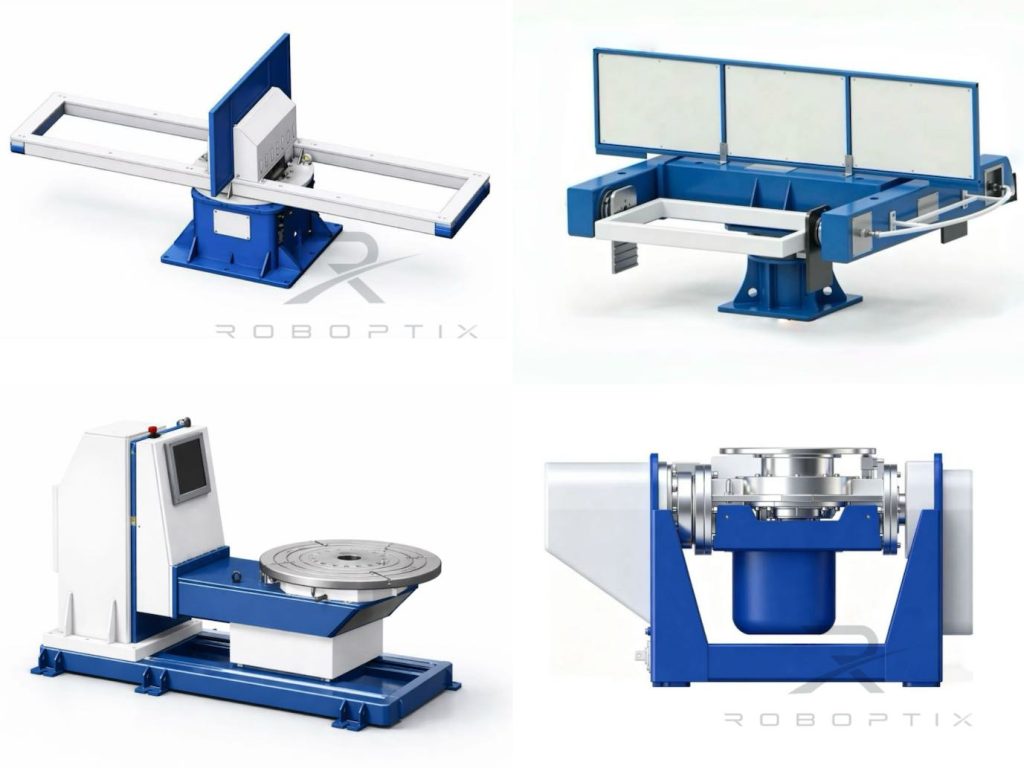
Robot Positioners are available in five structural categories, each suited to different workpiece shapes, weights, and welding process requirements. Here is a straightforward introduction to each type — if you are not yet sure which one you need, read through all five and then refer to the selection guidance at the end.
| हेड-एंड-टेलस्टॉक रोबोट पोजिशनर | बी सीरीज| 500-5,000 किग्रा |
| The workpiece is supported at both ends: one end by a servo-driven head, the other by a passive tailstock. The workpiece is mounted between them like a rotisserie and rotates freely along its primary axis, while the welding robot welds along the workpiece’s length.Best suited for long, ट्यूबलर, or axially symmetric workpieces. For circumferential welds (ring seams, अनुदैर्ध्य सीम), this configuration allows continuous arc contact as the workpiece rotates — the highest arc-on time of any Robot Positioner type.Typical applications: दबाव पोत गोले, large shaft components, पवन टरबाइन टॉवर अनुभाग, engineering machinery arms, pipe assemblies| पेलोड: 500-5,000 किग्रा (एमआरके-बी001 / B002 / बी004) |
| एच-टाइप सर्वो रोटेशन टेबल | एच सीरीज| 300-2,000 किग्रा |
| A horizontally mounted circular table that rotates around a vertical axis. The workpiece is fixed to the table surface, and the table rotates to bring the workpiece to the correct welding angle. Simple structure, intuitive operation — the easiest Robot Positioner type to get started with.Well-suited to disc-shaped, अंगूठी के आकार का, or planar workpieces, and to assemblies requiring indexed positioning after assembly. Standard table diameters range from 600 मिमी से 2,500 मिमी, covering a wide range from light to heavy workpieces.Typical applications: Flange welding, गोलाकार फ्रेम, मोटर आवास, EV battery tray welding| पेलोड: 300-2,000 किग्रा (MRK-H001–H005) |
| एल-टाइप डुअल-एक्सिस रोबोट पोजिशनर | एल सीरीज| 300-1,500 किग्रा |
| An L-shaped frame design with two independent servo axes: a horizontal rotation axis (tooling axis) and a vertical flip axis. The workpiece can first be rotated to the correct orientation on the horizontal axis, then tilted to the optimal angle by the flip axis — two-axis coordination for more flexible workpiece attitude control.Suited to medium-sized workpieces that require welding from multiple directions, and commonly used at combined welding and assembly stations to eliminate fixture changeover time.Typical applications: ईवी बैटरी पैक फ्रेम, मोटरसाइकिल फ्रेम, aluminum weldments, medium equipment housings| पेलोड: 300-1,500 किग्रा (एमआरके-एल001 / L002) |
| यू-टाइप डुअल-एक्सिस रोबोट पोजिशनर | यू सीरीज| 300-1,000 किग्रा |
| A U-frame design with J1 flip axis (±90°) और J2 घूर्णन अक्ष (±200°). The two axes work in coordinated motion to tilt any face of the workpiece to the upward flat welding position. सघन पदचिह्न, high repeatability (up to ±0.05 mm), and well-suited to space-constrained welding cells.The highest automation integration level among entry-level dual-axis Robot Positioners, particularly suited to batch production of multi-face welded components.Typical applications: ऑटोमोटिव संरचनात्मक कोष्ठक, उपकरण पैनल फ्रेम, standard robotic welding cell configurations| पेलोड: 300-1,000 किग्रा (एमआरके-U001 / U002) |
| Three-Axis Servo Robot Positioner | B008-B012 श्रृंखला| 300-2,000 किग्रा |
| Three coordinated servo axes: a rotation axis, एक टूलींग अक्ष (ROTATION), and a large-diameter swing. This configuration handles the most geometrically complex workpieces. No matter how many weld faces a component has or how widely distributed the seams are, three-axis coordination brings each one to the flat position in sequence without any manual reorientation.The definitive solution for complex heavy weldments, most widely used in construction machinery, wind energy equipment, and heavy structural steel fabrication.Typical applications: Excavator boom arms, crane slewing rings, पवन टरबाइन नैकेले फ्रेम, multi-face heavy structural weldments| पेलोड: 300-2,000 किग्रा (MRK-B008–B012) |
What Value Does a Robot Positioner Deliver to a Factory?
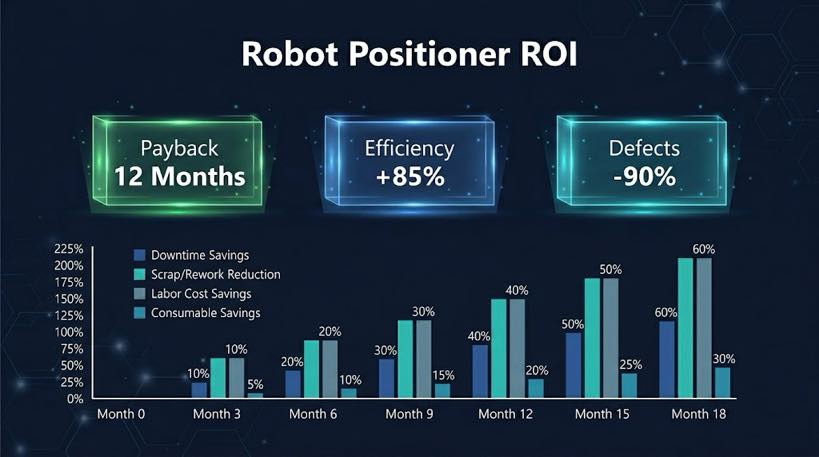
The most common question from factory owners considering a Robot Positioner is straightforward: is this investment worth it? The following breaks down the answer across four dimensions, all supported by real data.
1. Efficiency: 50–100% Capacity Increase
मैनुअल वेल्डिंग परिचालन में, the percentage of working hours actually spent welding (आर्क-ऑन समय) averages just 35%. The rest is consumed by workpiece repositioning, crane lifting, and waiting. After Robot Positioner integration:
- Workpiece repositioning time: from 15–25 minutes per event → 5–10 seconds
- आर्क-ऑन समय: से 35% → 78–88%
- Single station output: equivalent to 2–3 manual welding stations
| Project data: हमारे उस पार 1,500+ completed installations, factories report average production capacity increases of 50-100% with the same headcount. On large workpiece welding operations, some installations exceed 130% capacity increase. |
2. गुणवत्ता: 40–88% Defect Rate Reduction
The root cause of quality improvement is simple: every weld is completed in the flat or horizontal position rather than compromised in overhead or vertical positions. समतल स्थिति में, गुरुत्वाकर्षण, परिरक्षण गैस, and arc force all work together — the physics of the position itself ensures weld quality.
- सरंध्रता घटना: average reduction of 80%
- काटकर अलग कर देना / कम भरना: average reduction of 90%
- समग्र दोष दर: average reduction of 40–60%, peak results exceeding 85%
- प्रथम-पास निरीक्षण पास दर: from a typical 65–75% → 95%+
3. सुरक्षा: 80–90% Reduction in Workpiece Handling Incidents
Manual repositioning of large workpieces is among the most hazardous operations in a welding shop — overhead cranes, गोफन, swinging loads. Every repositioning event is a discrete safety exposure.
- After Robot Positioner installation, workpiece rotation is controlled by servo motors with no manual intervention
- Workpiece handling incidents (including minor injuries) decrease by 80–90%
- Workers transition from physical labor roles to equipment monitoring roles, with significantly lower occupational injury rates
- Safety audit pass rates improve; कार्यकर्ता’ compensation premiums decrease in many cases
4. लागत: 8–16 Month Payback Period
The cost savings from a Robot Positioner come from multiple stacked sources:
| Cost Saving Source | Typical Saving |
| Reduced rework and repair labor | Annual savings of $30,000–$150,000 (depends on original defect rate) |
| Reduced overtime costs | Average overtime hours reduced by 60% |
| Lower workers’ compensation and insurance | Premiums decrease as handling incidents fall |
| Extended productive careers for skilled welders | Reduced hidden cost of early retirement from occupational injury |
| Lower recruitment and training costs | 1 Robot Positioner replaces output of 2–3 manual welders |
| Payback reference: Small shops (annual revenue $1M–$5M): investment $45,000–$75,000, payback 8-14 महीने. Medium shops ($5M–$20M): investment $100,000–$250,000, payback 10-16 महीने. Figures based on documented customer installation data. |
What You Need to Know Before Buying
Before contacting a supplier for a quotation, it is worth clarifying the following key specifications. Understanding these will help you describe your requirements accurately and avoid being guided toward an unsuitable configuration.
Key Specifications Explained
1. रेटेड पेलोड
Rated payload is the maximum workpiece weight the Robot Positioner can drive reliably, expressed in किग्रा. Important: payload = workpiece weight + fixture weight combined — do not calculate the workpiece alone. उदाहरण के लिए, an 800 kg workpiece with a 150 kg fixture requires a model rated at no less than 950 किग्रा.
The market range runs from 300 किग्रा (light duty) को 5,000 किग्रा (heavy duty). When selecting, allow a 20% margin above your actual maximum load to avoid running continuously at full capacity, which degrades precision and service life.
2. Positional Repeatability
Repeatability is the range of error when the Robot Positioner returns to the same position repeatedly, expressed in mm. Higher precision = smaller number. The practical range across current product lines:
- ±0.03 मिमी: उच्चा परिशुद्धि (B009, बी011) — for structural components with strict weld position requirements
- ±0.05 मिमी: मानक (एच सीरीज, बी001/बी002, U001) — sufficient for the large majority of industrial welding applications
- ±0.075 mm: Economy (बी004, U002 फ्लिप अक्ष, बी010) — for heavy workpieces where precision requirements are lower
For general structural welding, ±0.05 mm is fully adequate. Automotive precision components and thin-wall aluminum applications warrant ±0.03 mm.
3. Maximum Rotation Speed
Rotation speed affects how quickly the Robot Positioner repositions between weld faces, expressed in °/s or rpm. Faster speeds mean shorter repositioning wait times. तथापि: higher speed means greater rotational inertia, which places higher demands on workpiece fixturing and clamping design. For heavy workpieces, select models with controlled acceleration/deceleration (जैसे, B001: 45°/s² accel/decel) to prevent workpiece shift during high-speed repositioning.
4. मानक अवधि / Table Diameter
Span (head-and-tailstock type): the distance between the drive head and tailstock, determining the maximum workpiece length the system can accommodate. Common standard spans: 2 एम, 2.5 एम, 3 एम, 3.5 एम (बी001/बी002); 3 एम, 5 एम, 6 एम, 8 एम (B004 heavy duty).
Table diameter (एच-प्रकार / यू-प्रकार): the effective load-bearing surface diameter of the table, determining the maximum workpiece outer diameter. Confirm that your workpiece’s maximum swing diameter does not exceed the model’s allowable maximum (जैसे, H005: maximum swing diameter 3,000 मिमी).
5. Control Mode: Independent Control vs. Coordinated Axis Control
| Control Mode | विवरण | Best Suited For | Trade-offs |
| Independent Control | Robot Positioner and welding robot operate independently. Welding stops during repositioning; repositioning stops during welding. | Simple workpieces, limited budget, single-face welding | ⚪ Lower cost, but arc-on time cannot be maximized |
| Coordinated Axis Control | Robot Positioner functions as an external axis of the robot. Rotation and welding occur simultaneously with real-time coordination. | Circumferential seams, complex multi-face welding, high-efficiency requirements | ✅ Arc-on time maximized, weld quality optimized — higher integration cost |
For most factories prioritizing efficiency and quality, coordinated axis control is the recommended starting point.
Common Buying Mistakes
| Misconception 1: “Bigger payload capacity is always safer — buy the largest available.” |
| Incorrect. Oversized payload ratings mean a heavier machine, higher cost, and greater rotational inertia. Select the appropriate payload tier based on your heaviest workpiece plus fixture weight, के साथ 20% अंतर. Over-specifying wastes budget without improving performance. |
| Misconception 2: “±0.03 mm precision is the only safe choice.” |
| आवश्यक रूप से नहीं. ±0.05 mm is fully sufficient for the large majority of structural steel and engineering machinery welding applications. Only automotive precision components, thin-wall aluminum, and similar high-tolerance scenarios require ±0.03 mm. Specifying unnecessarily high precision increases purchase cost and maintenance complexity. |
| Misconception 3: “A Robot Positioner eliminates the need for skilled welders.” |
| Incomplete. A Robot Positioner is an automation support device that works in conjunction with a welding robot (or welders with a certain technical foundation). Its value is enabling the same workforce to produce higher output with better quality — not a complete replacement of welding expertise. |
| Misconception 4: “Any Robot Positioner will be compatible with my existing robot.” |
| Needs verification. All major welding robot brands (फैनुक, चिल्लाना, एबीबी, यास्कावा, वगैरह।) support coordinated axis control, but specific interface protocols and parameter configurations must be confirmed with the integrator in advance. Provide your existing robot model number at the quotation stage. |
| Misconception 5: “A larger span / bigger table is always better.” |
| Incorrect. Excessive span reduces the rigidity of the drive system’s control over the workpiece, degrading positional precision. An oversized table increases unnecessary rotational inertia. Select the specification that fits your most common workpiece dimensions, not the largest available specification. |
Still Not Sure Where to Start?
With the foundation from this guide in place, the logical next step is a workpiece-specific analysis. We offer a free Robot Positioner selection consultation:
- हमें अपने वर्कपीस का वजन बताएं, DIMENSIONS, and weld joint types
- We recommend the right Robot Positioner type and control configuration
- We provide a preliminary ROI estimate to help you evaluate the investment
- Written recommendation delivered within 24 घंटे
► Contact us for a free Robot Positioner selection consultation
लेखक के बारे में
| अनुभव & साखलेखक रोबोटिक वेल्डिंग सिस्टम एकीकरण विशेषज्ञ हैं 12+ वर्षों का प्रत्यक्ष परियोजना अनुभव, focused on Robot Positioner and coordinated-axis welding system design and implementation across automotive manufacturing, heavy machinery, दबाव वाहिकाओं, and new energy equipment. This article is written for newcomers to the field, translating 12 years of project experience into practical knowledge accessible to anyone. कंपनी बैकग्राउंड: 26+ वेल्डिंग ऑटोमेशन इंजीनियरिंग के वर्ष, 40+ सक्रिय पेटेंट, 1,500+ पूरे उत्तरी अमेरिका में परियोजनाएँ पूरी कीं, यूरोप, और एशिया, लगभग 70% of which involve Robot Positioner integration. One of the few manufacturers in the industry offering a complete H/B/L/U series Robot Positioner product line under a single manufacturer. प्रमाणन: EU CE Certification — Robot Positioner systems (प्रमाणपत्र संख्या: एम.2026.206.सी134866) अंतिम बार समीक्षा की गई और अद्यतन किया गया: मई 2026 |
संबंधित पोस्ट
8 रोबोटिक वेल्डिंग सेल तैनात करते समय महंगी गलतियाँ (और उनसे कैसे बचें) – 2026 संस्करण
2026 7वें एक्सिस रोबोट चयन गाइड: पेलोड, आघात, repeatability & ब्रांड अनुकूलता
रोबोटिक वेल्डिंग सेल आरओआई की गणना कैसे करें 2026: वास्तविक दुनिया के मामलों के साथ पूरा टेम्पलेट
विज़न-गाइडेड रोबोटिक वेल्डिंग सेल को मौजूदा फैब्रिकेशन लाइन में कैसे एकीकृत करें
रोबोट स्थिति आरओआई: मैन्युअल वेल्डिंग वास्तव में आपको कितना महंगा पड़ रहा है??