Custom Robot Workstations And Laser Systems Manufacturer


Robotic Welding Cell vs Traditional Welding Line: What Actually Changes on Your Shop Floor
Walk into two structural steel fabrication shops on the same afternoon. Both are producing the same kind of work — H-beams, columns, connection plates, base plates. On paper, the output looks identical. But inside the building, almost nothing about how the work happens is the same.
One shop runs a traditional welding line: parts move between stations, welders work independently, and the floor manager schedules around whichever station is slowest that day. The other has integrated a robotic welding cell. The parts barely move. The people in the building are doing different jobs than they were six months ago. The quality reports look different. Even the way the shop responds to a rush order looks different.
If you’ve read our beginner’s guide to what a robotic welding cell actually is, you already understand the basic components — the robot, the positioner, the safety enclosure, the welding power source.
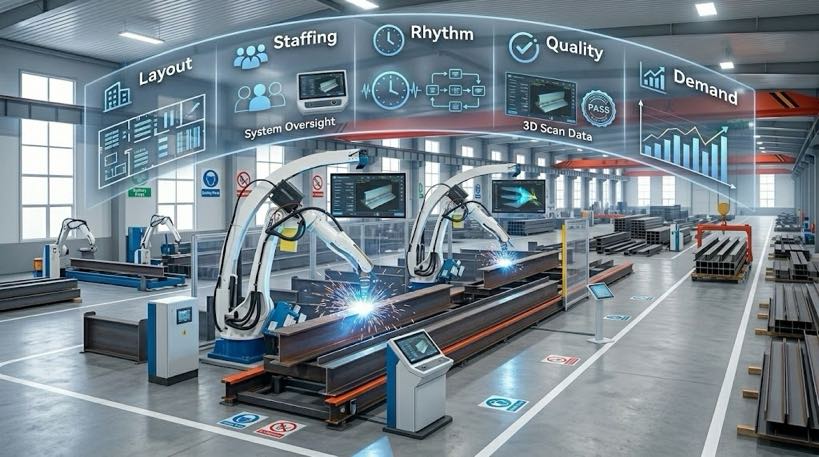
What this article answers is the question that comes next: what does it actually feel like to run a shop after this change? This article walks through five areas where the difference is concrete and immediate — floor layout, staffing, daily production rhythm, quality control, and how the shop absorbs demand swings — so you can build an accurate picture before you commit capital.
| New to robotic welding cells? If you haven’t yet, start with our companion guide: “What Is a Robotic Welding Cell? 2026 Beginner’s Guide | 37 Shop Data.” This article assumes you understand the basic setup and focuses on what changes operationally once that setup is running on your floor. |
1. Shop Floor Layout: From a Production Line to a Welding Island
How a traditional line is laid out
A traditional welding line follows the sequence of operations: cutting, fit-up, tack welding, welding, inspection — each in its own station. Parts travel between stations on a crane or forklift, and each station operates somewhat independently of the others.
Optimizing this kind of layout is a balancing act. Material utilization can’t be treated in isolation from machine utilization, labor utilization, work-in-progress control, and on-time delivery — which is why shops with mature traditional lines typically run on a finite-capacity schedule produced by dedicated scheduling software, monitored and adjusted throughout the day.
How a robotic cell changes the layout
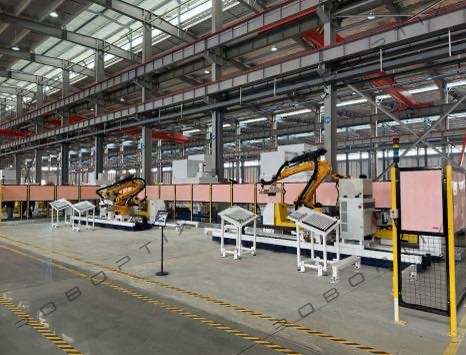
A robotic welding cell consolidates welding, positioning, and often inspection into a single integrated island. The practical effect is fewer trips across the floor for each part.
Operations that used to require flipping a part for access, repositioning it for a different face, and re-clamping it for each step can now happen inside a single clamping sequence. That consolidation reduces dependence on the crane and on operator coordination between stations — and it simplifies the floor layout overall, because fewer standalone stations are needed to produce the same part.
For shops running contract fabrication with frequent changeovers, the most common physical layout is a double-station shuttle, sometimes called an H-frame configuration: while the robot welds on one side, an operator loads or unloads the other side. This is the layout that shows up most often in real installations because it keeps the robot working continuously rather than waiting on the operator.
What this means for your shop
The shift isn’t “add one robot to the existing line.” It’s a rethink of the entire physical path a part takes from arrival to shipping. Before committing to a cell, map the full sequence: raw material arrival, cutting and drilling, fit-up, tacking, robotic welding, inspection, correction if needed, and outbound staging. Every handoff in that sequence affects how much of the robot’s theoretical capacity you actually capture.
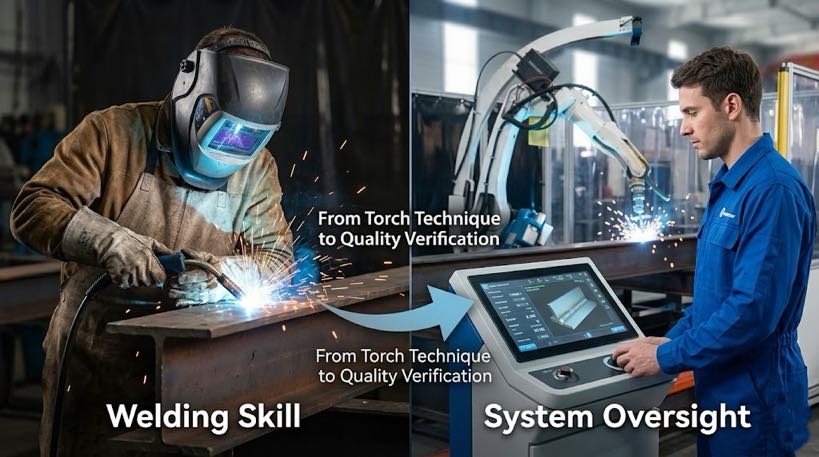
2. Staffing: From Welding Skill to System Oversight
Staffing on a traditional line
On a traditional line, welders are distributed across stations, each responsible for a stage of the process. The core skill is hands-on: torch technique, current and voltage adjustment by feel, and judgment calls based on material thickness and condition that come from years of practice.
Staffing around a robotic cell
Automation doesn’t simply remove labor — it changes where that labor is applied. Where several operators previously focused on manual cutting, grinding, and welding, the skill emphasis shifts toward programming oversight, quality verification, and coordinating the welding step with assembly downstream.
This transition isn’t automatic. The skill set automation requires is genuinely different from traditional welding, and training programs in many regions haven’t fully caught up with demand yet. Shops that invest in structured operator training tend to see faster ramp-up and more consistent output from the new equipment — the gap between “installed” and “productive” is largely a training gap, not an equipment gap.
Where the bigger shift is happening
Here’s where it’s worth being precise about what kind of robotic cell we’re talking about, because this is where the staffing story diverges sharply depending on the technology.
The conventional assumption is that running a robotic welding cell means someone on staff needs to program the robot — walking it through each joint with a teach pendant, or building and validating programs offline before the part ever reaches the floor. That assumption is exactly why many structural steel shops have hesitated on automation: their work is too varied, and dedicating someone to programming every new part configuration doesn’t pencil out.
| The shift toward no-programming robotic welding cells changes this equation. In a vision-guided system, the operator’s role moves from “teaching the robot how to weld this part” to “confirming that the weld plan the robot generated from its scan is correct.” That’s a fundamentally different skill threshold — closer to quality verification than to robot programming. We cover exactly how this works in our companion article, No-Programming Robotic Welding Cell: How Vision-Guided Systems Eliminate Teach Pendants. |
3. Daily Production Rhythm: From Sequential Stations to Cell Takt Time
The rhythm of a traditional line
On a traditional line, the day’s output is set by whichever station is slowest — the bottleneck station determines the overall pace. Manual welding capacity is often constrained less by the welding itself and more by fit-up time, tack time, crane availability, inspection delays, and the availability of experienced welders, all of which vary day to day.
The rhythm of a robotic cell
In a robotic cell, the pace is set by the coordination between the robot’s welding time and the operator’s load/unload time. In a dual-station layout, what determines total output is how well loading speed and welding takt time are synchronized — not the speed of any single welder’s hands.
This coordination requirement cuts both ways. If the robot is ready but the part isn’t, capacity sits idle. If the crane is occupied elsewhere, the cell waits. If operators spend too much time searching for parts, staging, flipping pieces, or correcting fit-up issues, the cell can’t deliver the throughput its specifications promise. A robotic cell, in practice, raises the bar on how tightly the upstream and downstream steps need to be choreographed — more than a traditional line does, where slack between stations is more forgiving.
The structural steel complication
Structural steel fabrication is inherently high-mix. A shop producing custom building frames or bespoke trusses can encounter dozens of distinct weld joint configurations in a single week — which runs directly against the repeatability that makes robots most efficient in the first place.
This is precisely the gap that early teach-free systems, which use 3D scanning to automatically generate weld paths for each new part, were built to close. It remains an area where careful system selection matters — not every “vision-guided” system handles high-mix structural work equally well, which is why we go deeper on the underlying technology in our companion articles on 3D vision seam tracking and scan-to-weld systems, and on the specific challenge of large, non-repetitive parts like transformer tanks.

4. Quality Control: From After-the-Fact Inspection to In-Process Data
Quality control on a traditional line
On a traditional line, quality control typically happens after welding is complete — visual inspection plus spot checks. The problem with this sequencing is timing: defects are caught late, and rework on structural components is expensive, often requiring re-cranage and re-clamping to access the joint again.
Quality control in a robotic cell
Robotic welding cells increasingly come with integrated 3D measurement and quality control systems that provide real-time analysis and automated inspection throughout the process — not just at the end. An integrated laser measurement system can check positional dimensions and tolerances as the material is loaded, with scanning happening as one continuous cycle that supports both automated and manual workflows.
The numbers behind this shift are significant for structural work: properly specified six-axis robotic welding cells can achieve defect rates below 1% on qualified procedures, while depositing weld metal at three to five times the rate of a skilled manual welder.
What this means for your shop
Quality data stops being a report generated after the fact and becomes a continuous record produced during production. For shops working to structural welding codes such as AWS D1.1 or EN 1090, this in-process data isn’t just a quality improvement — it becomes part of the documentation that supports certification and inspection requirements.
5. Responding to Demand Swings: From Overtime to Reprogramming Speed
How a traditional line absorbs a spike in orders
When order volume increases on a traditional line, the typical response is overtime or bringing in additional welders. But experienced welders are a genuinely scarce resource in most regions — which means this lever has a hard ceiling, and it’s a ceiling that’s getting lower as the workforce ages out faster than it’s replaced.
How a robotic cell absorbs a spike in orders
A single robot can switch between different part types — but how quickly it can switch depends entirely on the underlying programming approach, and this is where the technology choice has the biggest operational consequence.
Offline programming approach
With offline programming, even the best simulation differs slightly from physical reality. Whoever loads a new job typically still needs to touch up the program to account for those variances — which means a changeover still consumes skilled time, just less than fully manual teaching would.
Vision-guided / scan-to-weld approach
In a scan-to-weld system, a camera mounted on the robot scans reference points on the part, the system reconciles the digital model against the actual workpiece, and welding begins — with no manual programming required, either on the floor or offline.
Where this matters most: large, non-repetitive parts
Transformer tanks are one of the clearest examples of where the offline-programming approach breaks down. Each tank can differ slightly in dimensions and fitting locations, which means offline programming for each new tank can amount to nearly reprogramming from scratch. This is exactly the problem that scan-to-weld robotic systems are designed to solve — a topic we cover in detail in our article on transformer tank welding automation.
The Bigger Picture
A robotic welding cell isn’t “a traditional line plus one machine.” It’s a shift in how the whole operation runs: the physical layout changes, the skills your team needs change, what determines your daily output changes, how quality data gets generated changes, and the lever you pull when demand spikes changes too.
For structural steel fabricators specifically, the historic tension has been between high-mix production and the repeatability robots depend on. That tension is exactly what the current generation of vision-guided robotic welding workstations is built to resolve — and it’s why the technology choice within “robotic welding cell” matters as much as the decision to automate at all.
| Curious whether a no-programming robotic welding cell fits your shop’s mix of parts? Share your typical workpiece range and production volumeour engineering team will map out what would change on your floor, and what wouldn’t, within 24 business hours. |
Frequently Asked Questions
What’s the main difference between a robotic welding cell and a traditional welding line?
A traditional line moves parts sequentially between independent stations, with output limited by the slowest station. A robotic welding cell consolidates welding, positioning, and often inspection into a single integrated unit, with output determined by how well load/unload time and robot welding time are coordinated.
Do I need to hire robot programmers to run a robotic welding cell?
It depends on the technology. Traditional offline-programmed cells need someone with robot programming experience to build, simulate, and fine-tune weld programs for each new part. No-programming, vision-guided cells shift the operator’s role to confirming a weld plan the system generates automatically from a 3D scan — a quality-verification skill set rather than a programming one.
How much floor space does a robotic welding cell need compared to a traditional line?
It varies by layout, but a robotic cell often requires less total floor space than the equivalent traditional line, because consolidating multiple operations into one clamping sequence reduces the number of standalone stations needed. The most common layout for contract fabrication is a double-station shuttle (H-frame) configuration.
Can a robotic welding cell handle high-mix structural steel production?
It depends heavily on the programming approach. Conventional offline-programmed robots struggle with high-mix work because every new part configuration requires new programming. Vision-guided, scan-to-weld systems are specifically designed to address this by generating weld paths automatically from a 3D scan of each part.
What changes for quality inspection when switching to robotic welding?
Inspection shifts from an after-the-fact, end-of-line check to continuous, in-process measurement. Many robotic cells include integrated 3D measurement systems that check dimensions and tolerances as parts are loaded and during welding, producing data that can support code compliance documentation as well as quality control.
About the Author
Experience & Credentials
Robotic welding system integration specialist with 12+ years of direct project experience focused on Robot Positioner selection and integration. Has provided consulting to 300+ factories across North America, Europe, and Asia. All specification data in this article is drawn from actual H / B / L / U series product datasheets.
Company background: 26+ years of welding automation engineering, 40+ active patents, 1,500+ completed projects globally, approximately 70% involving Robot Positioner integration.
Certifications
- ISO 9001: 2015 (GB/T 19001-2016) — Quality Management System
- GJB 9001C-2017 — Military/Weapon Equipment Quality Management System
- EU CE — Machinery Directive 2006/42/EC (Cert. No. M.2026.206.C134866)
- High-Tech Enterprise — Cert. No. GR202341000595 (Issued Nov. 2023)
Last updated: Jun 2026
RELATED POSTS
2026 Welding Automation Pain Points: Why Competitive Factories Are Choosing a Robot Positioner
No-Programming Robotic Welding Cell:How Vision-Guided Systems Eliminate Teach Pendants
Robotic Welding Cell Maintenance Guide: Best Practices, Schedule & Troubleshooting 2026
Why Vision Systems Are Essential for Robotic Laser Welding
3D Vision Laser Seam Tracking Explained:From Point Cloud to Weld Path in Seconds