Custom Robot Workstations And Laser Systems Manufacturer


Robotic Welding Cell Maintenance Guide: Best Practices, Schedule & Troubleshooting 2026
Good Maintenance Extends Equipment Life by 30%+
A robotic welding cell is a precision machine — not a “set it and forget it” black box.
Based on tracking data from 100+ actual deployment projects,properly maintained equipment has an average service life 30-50% longer than neglected equipment. With the same $100,000 investment, well-maintained equipment lasts 8-10 years, while neglected equipment may fail within 3-5 years.
This guide provides a complete maintenance system: daily/weekly/monthly/quarterly/annual checklists, critical component care, common fault troubleshooting, and maintenance cost budgets.
1. Maintenance Checklists
Daily (Every Shift): Check contact tip wear, nozzle spatter, collision sensor looseness, torch cleaner operation, safety fencing/light curtain integrity, e-stop button function, wire liner condition, and welding cable condition.
Weekly: Check wire feed roller wear and debris, wire spool tangles/rust, coolant system level/leaks, positioner tooling pin/clamp wear, robot arm exterior, and control cabinet cooling fan operation.
Monthly: Check gearbox oil level/leaks (J1-J3 and J4-J6 axes), robot battery low voltage alarm, safety relay indicator lights, cable carrier wear/binding, and ground connection tightness.
Quarterly: Change gearbox oil (J4-J6 axes), check axis limit stops, clean power source and control cabinet dust, and tighten safety fencing bolts.
Annually: Change gearbox oil (J1-J3 axes), perform robot precision calibration (TCP and coordinate systems), calibrate power source, inspect safety system, and replace critical consumables based on service life.
2. Critical Component Care
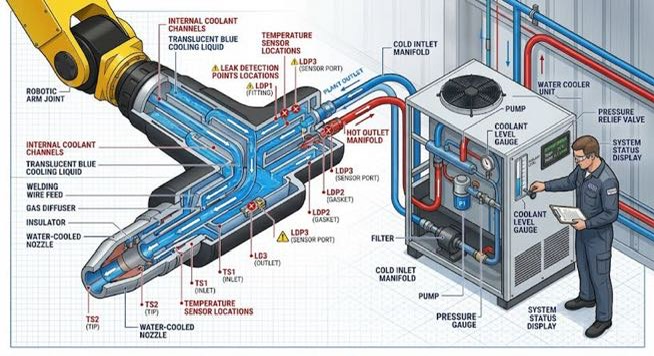
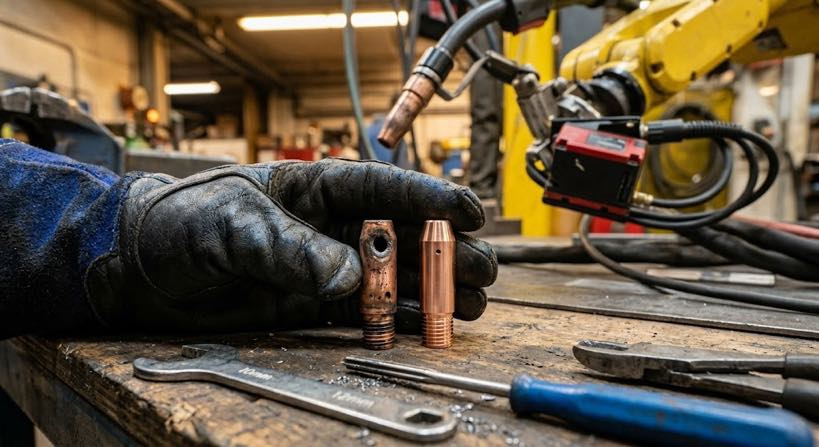
Torch System: Contact tip normal life is 8-16 hours of continuous welding. Replace when bore enlarges, wire feeding becomes difficult, or arc becomes unstable. Nozzle normal life is 40-80 hours. Replace when spatter buildup is heavy or deformation occurs. Test collision sensor trigger function monthly. After torch replacement, trigger force must be recalibrated.
Wire Feeding System: Check wire feed roller weekly. Replace when grooves wear or slipping occurs. Different wire diameters require different groove profiles. Check wire liner every two weeks. Replace when kinked or inner wall wear is present. Aluminum wire requires Teflon liner. For push-pull systems (aluminum welding), check pull motor gear wear monthly.
Positioner: Change gearbox oil every 2,000-3,000 hours. Investigate unusual noise or abnormal temperature rise. Check bearings quarterly. Replace if binding or excessive play is found. Check tooling locating pins weekly. Wear exceeding 0.2mm affects robot seam finding accuracy.
Robot Arm: Change gearbox oil for J1-J3 axes every 2,000-3,000 hours. Change for J4-J6 axes every 1,000-1,500 hours. Use manufacturer-specified oil only. Replace battery every 1-2 years. When low voltage alarm appears, replace with power on. Check seals quarterly. Oil stains or drips indicate leakage.
3. 10 Common Faults and Quick Troubleshooting
| # | Fault Symptom | Possible Cause | Troubleshooting |
| 1 | “Low battery voltage” alarm | Battery life expired | Replace battery with power on, recalibrate zero point |
| 2 | Unstable arc, frequent arc break | Worn contact tip/poor wire feeding/poor ground | Replace contact tip, check liner, tighten ground |
| 3 | Weld seam position shift | Inaccurate TCP/part positioning drift/positioner drift | Recalibrate TCP, check fixture, calibrate positioner zero |
| 4 | “Servo overload” alarm | Overload/path interference/gearbox binding | Check load, slowly jog to find interference point |
| 5 | Excessive spatter | Low gas flow/incorrect parameters/blocked nozzle | Check gas cylinder, adjust parameters, clean nozzle |
| 6 | Wire feeder motor not running | Jammed feed roller/motor failure/signal loss | Check feed roller, test motor, check wiring |
| 7 | Poor robot repeatability | Gearbox wear/encoder failure/mechanical looseness | Check gearbox, calibrate encoder, tighten bolts |
| 8 | Gas flow alarm | Low cylinder pressure/line leak/sensor failure | Replace cylinder, leak check, check sensor |
| 9 | Safety fence triggered, cannot reset | Safety relay not reset/light curtain blocked | Clear obstruction, press safety relay reset button |
| 10 | Torch won’t return after collision | Collision sensor not reset/mechanical binding | Manually reset sensor, check torch for deformation |
4. Preventive Maintenance Best Practices
ISO Standards Reference: ISO 10218-1:2025 requires regular safety function checks and maintenance logs. ISO 10218-2:2011 requires safety verification after maintenance. ISO 13287 specifies inspection and test methods for robot maintenance.
Six Best Practices:
- Maintain a maintenance log: Record date, content, replaced parts, and abnormalities for each maintenance activity.
- Set maintenance reminders: Use calendar or CMMS system — don’t rely on “memory.”
- Train operators for daily maintenance: Teach them basic “look, listen, feel” methods. Operators detect anomalies earlier than anyone.
- Establish minimum spare parts inventory:
| Spare Part | Recommended Stock | Notes |
| Contact tips | 50-100 | Daily consumable |
| Nozzles | 10-20 | Weekly consumable |
| Wire feed rollers | 2-3 sets | One per wire diameter |
| Collision sensor | 1 | Backup |
| Robot battery | 1-2 | Backup |
| E-stop button | 2 | Backup |
| Relays | 2-3 | Common types |
- Annual precision calibration: Hire a professional or use a laser tracker annually. Costs $1,000-3,000 but prevents quality issues from precision loss.
- Post-fault review: Record cause and solution after each fault. The same fault occurring three times indicates a systemic issue.
5. Maintenance Cost Budget Reference
Based on a standard single-station ($70,000 initial investment):
| Category | Annual Cost (USD) | Notes |
| Consumables (tips, nozzles, feed rollers) | 800-1,500 | Depends on weld hours |
| Lubricants, coolant | 300-600 | Based on change intervals |
| Replacement parts (battery, relays, etc.) | 200-500 | Based on service life |
| Professional service (if needed) | 500-2,000 | 1-2 times per year |
| Precision calibration (annual) | 1,000-3,000 | Optional but recommended |
| Total Annual Budget | 2,800-7,600 | ~4-11% of initial investment |
Maintenance Budget Ratio by Equipment Age:
| Equipment Age | Annual Maintenance Budget (% of Initial Investment) |
| Years 1-3 | 3-5% |
| Years 4-6 | 5-8% |
| Years 7-10 | 8-12% |
Maintenance cost percentage increases with equipment age. However, even in year 10, maintenance costs are far lower than purchasing new equipment.
6. Treat the Robot as Precision Equipment, Not a Disposable Tool
A robotic welding cell isn’t a “set it and forget it” black box. Treat it as precision equipment, and it will reward you with 8-10 years of stable production. Neglect it, and it will fail when you need it most.
Three core principles:
- Regular maintenance is much cheaper than emergency repair: One gearbox failure ($20,000-50,000) could buy 10 years of lubricating oil.
- Operators are the best sensors: Train them to detect abnormalities (unusual noise, smell, vibration). Many faults can be caught before becoming major problems.
- Maintenance is not a cost — it’s an investment: Every $1 spent on preventive maintenance saves $3-5 in emergency repairs and production losses.
Data Sources
- Maintenance records from 100+ robotic welding cell deployment projects (2024-2026)
- ISO 10218-1:2025, ISO 10218-2:2011
- ABB, Fanuc, Yaskawa, KUKA maintenance specifications
Related Reading
- 8 Costly Mistakes When Deploying a Robotic Welding Cell (And How to Avoid Them)
- How to Calculate Robotic Welding Cell ROI? Complete Template
- Robotic Welding Cell Core Components & Selection Guide
Author Identification
This article is based on the International Federation of Robotics (IFR) World Robotics Report 2025, American Welding Society (AWS) workforce data, and major manufacturer technology roadmaps.
Author:
An expert in robotic welding system integration with over 12 years of industry experience. My company has over 26 years of professional experience, holds more than 40 patented technologies, and has successfully completed over 1,500 projects worldwide (approximately 70% of which involved robotic welding cells, totaling more than 1,000 units). The company holds EU CE certification (Certificate No.: M.2026.206.C134866) and complies with the EN 60204-1:2018 and EN ISO 12100:2010 standards. I have assisted numerous manufacturing companies throughout the entire process of robotic welding workstation implementation, from selection to production launch.
Updated: May 2026
RELATED POSTS
5 Reasons Large Workpiece Welding Is Inefficient — and How a Robot Positioner Solves Each One
Fixture-Free Fabrication: When a Welding Positioner Replaces Complex Jigs, Tack Welds, and Crane Time
Robotic Laser Welding: Principles, Advantages, and Applications (2026 Complete Guide)
3D Vision Laser Seam Tracking Explained:From Point Cloud to Weld Path in Seconds

A Comprehensive Comparison of Robotic Laser Welding vs. MIG and TIG Welding: Which One Is Right for You?