Stasiun Kerja Robot Khusus Dan Produsen Sistem Laser


Bagaimana Welding Positioner Mengontrol Gravitasi: Fisika Stabilitas Genangan Air dan Kualitas Las
Understanding the science behind why rotating your workpiece transforms weld outcomes
Every welder knows the feeling. Anda membuat busur pada sambungan horizontal dan genangan air mengalir seperti madu — mulus, predictable, exactly where you want it. Then you move to an overhead pass and suddenly that same puddle becomes a battle. Gravity, which was your ally a moment ago, is now pulling molten metal toward your face shield.
This is not a skill problem. It is a physics problem. And it is one that a welding positioner solves at the root cause — by reorienting the workpiece so that gravity always works in your favor.
While most discussions of welding positioners focus on productivity metrics and payload capacities, this article takes a different approach. We go beneath the surface — literally — to examine the physics of what happens when you rotate a weldment, and why that rotation can mean the difference between a defect-free weld and a costly repair.
Wawasan utama: A welding positioner is not just a material handling device. It is a gravity-control tool that fundamentally changes the thermodynamics and fluid dynamics of the welding process.
1. The Physics Problem: Gravity Is Not Neutral in Welding
To understand why a positioner matters, we must first understand what gravity does to a weld pool. In fusion welding processes — whether GMAW, GTAW, FCAW, or SAW — the molten weld pool is a fluid subject to multiple competing forces:
- Surface tension: The dominant force at small scales. Surface tension pulls the molten pool into a coherent shape and resists deformation. In flat-position welding (1G/1F), surface tension helps contain the puddle within the joint.
- Gravity: Exerts a body force proportional to the mass of the molten metal. Dalam posisi datar, gravity pushes the puddle into the root of the joint — beneficial. In overhead position (4G/4F), gravity pulls the puddle away from the joint — destructive.
- Arc pressure: The force exerted by the plasma jet on the pool surface. Arc pressure can help or hinder depending on travel angle and position.
- Lorentz force (electromagnetic): Current flowing through the pool generates its own magnetic field, creating a stirring effect and influencing penetration.
- Marangoni convection: Surface tension gradients driven by temperature differences cause fluid flow within the pool, affecting bead shape and penetration profile.
The balance of these forces determines everything about your weld: penetration depth, bead profile, fusion at the toes, spatter generation, and susceptibility to defects like lack of fusion, melemahkan, and slag inclusions.
In out-of-position welding — vertical (3G), atas (4G), and inclined positions — gravity shifts from a stabilizing force to a destabilizing one. The heavier the weldment and the larger the molten pool (as in high-deposition processes), the more pronounced this effect becomes.
1.1 The Flat-Position Advantage in Numbers
Research published in the Welding Journal has demonstrated that welds made in the flat position (1G) consistently outperform out-of-position welds across multiple quality metrics. In one study comparing GMAW fillet welds on structural steel, flat-position welds showed:
- 23% deeper penetration than vertical-up welds at the same heat input
- 40% reduction in porosity compared to overhead welds
- Significantly lower spatter levels, reducing post-weld grinding time by up to 60%
- More consistent toe angles, critical for fatigue-loaded structures
These differences are not marginal. For a pressure vessel requiring 100% radiographic inspection, the difference between a flat-position weld and an overhead weld can mean the difference between passing on the first attempt and multiple repair cycles.
2. How a Positioner Transforms the Physics: Rotation = Gravity Realignment
A welding positioner attacks this problem at its source. Rather than forcing the welder or robot to compensate for gravity with technique — slower travel speeds, weaving patterns, lower deposition rates — a positioner rotates the workpiece so that every joint is presented in the optimal orientation.
2.1 The Kinematics of Rotation
Modern servo-driven positioners like ROBOPTIX’s B-series offer precise angular positioning with repeatability as tight as ±0.05 mm at a 350 mm radius. This means the positioner can rotate a workpiece to any angle within its working envelope and return to that exact orientation with sub-millimeter precision.
Consider a typical heavy fabrication scenario: A 2,000 mm long structural beam with welds required on four faces. Without a positioner, the operator must:
- Weld face 1 in flat position (good)
- Flip the beam with an overhead crane (5–15 minutes of non-value-added time)
- Weld face 2 in flat position
- Flip again
- Weld faces 3 Dan 4 in vertical or overhead positions (slow, defect-prone)
With a headstock-tailstock positioner, the beam is mounted once. The positioner rotates it continuously, presenting every joint in the flat position. There is no crane time, no repositioning downtime, and — critically — no out-of-position welding.
2.2 The Puddle Behavior Change
When a positioner brings a joint into the flat position, several physical changes occur simultaneously in the weld pool:
- Gravity vector alignment: The gravitational force now acts perpendicular to the joint, pushing molten metal downward into the root rather than pulling it sideways (vertikal) or away from the joint (atas). This increases penetration and improves root fusion.
- Increased tolerable weld pool size: Dalam posisi datar, the pool can be larger before gravity-induced sagging (the “drop-out” effect) occurs. This enables higher deposition rates — more metal per minute — without compromising quality.
- Stable Marangoni flow: Temperature gradients across the pool surface remain symmetrical when the pool is horizontal. In out-of-position welding, asymmetric cooling creates unbalanced surface tension forces that distort bead shape.
- Reduced arc deflection: In overhead welding, the rising plume of shielding gas and metal vapor can deflect the arc. Dalam posisi datar, this plume rises naturally without interfering with the arc path.
Practical takeaway: When gravity is aligned with the joint, you can weld faster, with higher current, and achieve deeper penetration — all while reducing defect rates. The positioner is the tool that makes this alignment possible for every joint on a complex workpiece.
3. Why Robot Integration Amplifies the Physics Advantage
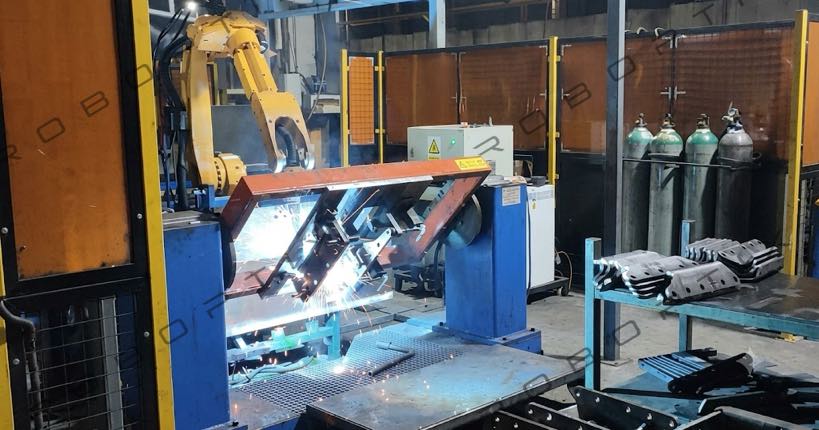
The physics benefits of positioners become even more significant when the positioner is integrated as a robot external axis — a configuration ROBOPTIX positioners support through standard EtherCAT and controller interfaces.
Dalam gerakan terkoordinasi, the robot and positioner move simultaneously. The welding torch and workpiece rotate in synchronization, maintaining the optimal torch-to-joint relationship at every point along the weld path. This enables:
3.1 Pengelasan Berkelanjutan pada Bagian Silinder
For cylindrical workpieces such as pipes, cangkang bejana tekan, and wind tower sections, coordinated rotation allows a single continuous weld seam. The positioner rotates the cylinder while the robot holds the torch stationary at the optimal 12-o’clock position. The result is a perfectly consistent weld with:
- Uniform penetration around the entire circumference
- Consistent bead appearance — no stop-start irregularities
- Elimination of positional variations in weld chemistry and microstructure
3.2 The Torch Angle Equation
In manual and semi-automatic welding, torch angle is maintained by the skill of the operator. On complex geometries, maintaining the correct work angle and travel angle becomes nearly impossible when the welder is also fighting gravity. A positioner + robot combination solves this by:
- Rotating the part to maintain the joint in the horizontal plane
- Allowing the robot to execute precise, repeatable torch angles programmed once
- Eliminating the operator variability that is the leading cause of weld defects in out-of-position joints
4. The Metallurgical Consequences: What the Physics Means for Weld Integrity
The effects of positioner-enabled flat-position welding extend beyond the visible bead profile and into the metallurgical structure of the weld.
4.1 Cooling Rate Consistency
Weld cooling rate is a primary determinant of microstructure, hardness, and mechanical properties. In flat-position welding, the cooling rate is more uniform because:
- The weld pool geometry is symmetrical, resulting in even heat extraction through the base metal
- The shielding gas coverage is consistent, providing uniform convective cooling
- There is no preferential direction of heat flow (as there is in vertical-up welding, where heat rises into previously deposited metal)
For quenched and tempered steels used in structural applications (S690, S960, A514), controlled cooling is essential to avoid martensite formation in the HAZ. Flat-position welding with a positioner provides the most predictable thermal cycle for these sensitive materials.
4.2 Fusion Zone Integrity
Lack of sidewall fusion is one of the most common defects in out-of-position welding — and one of the most dangerous, as it creates crack-like discontinuities that can propagate under fatigue loading. The mechanism is straightforward: in vertical and overhead positions, the molten pool tends to sag away from the upper sidewall, reducing fusion at that location.
Dalam posisi datar, with gravity pushing the pool symmetrically into both sidewalls, the fusion zone is balanced. This is especially critical for:
- Full-penetration butt joints subject to radiographic or ultrasonic inspection
- T-joints and fillet welds in dynamically loaded structures
- Multi-pass welds where incomplete fusion between passes can create buried defects
5. Selecting a Positioner for Physics-Driven Welding
If you accept that gravity control is the primary function of a welding positioner, then the selection criteria shift from “what size machine do I need?” to “what positioning capability will deliver consistently flat-position welds on my parts?”
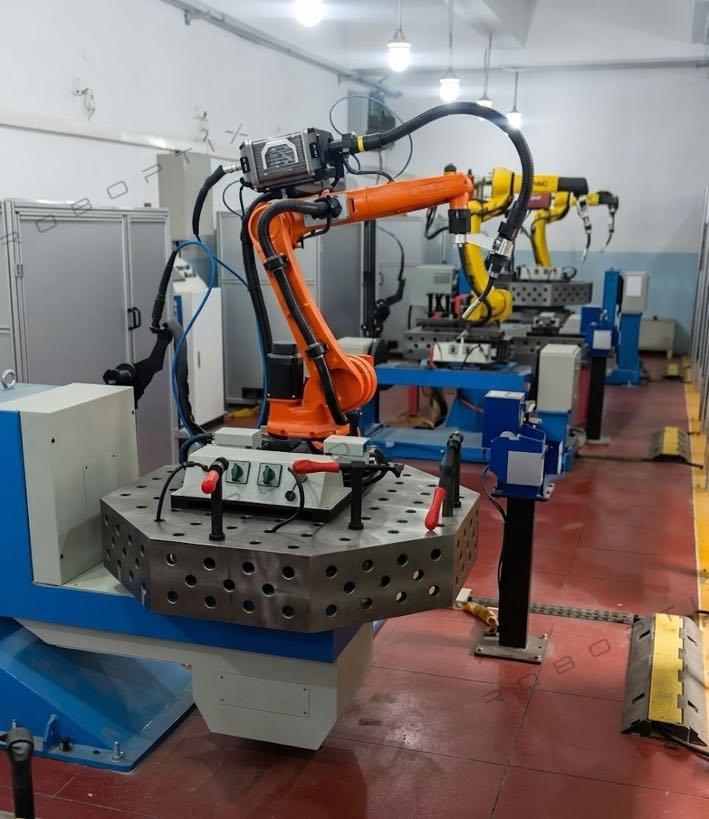
5.1 Key Specification: Akurasi Posisi, Not Just Payload
Many buyers focus exclusively on load capacity. But if your goal is to control the physics of the weld pool, positioning accuracy is equally important. A positioner that can rotate a 2,000 kg part but cannot hold precise angular positions defeats the purpose.
ROBOPTIX positioners achieve positioning accuracy of 0.05 mm at R350 — which translates to angular precision of approximately 0.008 derajat. At this level of precision, the joint is held at the optimal angle throughout the weld, ensuring consistent gravity alignment.
5.2 Speed Range: The Overlooked Parameter
Weld pool behavior is also influenced by rotational speed during continuous welding. Too slow, and the arc outruns the optimal torch position on a cylindrical part. Too fast, and centrifugal effects can begin to influence the puddle.
A positioner with a wide speed range — from slow creep for tacking and setup to 90°/s for rapid repositioning between welds — gives you the flexibility to optimize for both quality (slow, controlled rotation during welding) and productivity (fast repositioning between passes).
5.3 Konfigurasi: Matching Geometry to Your Parts
The right positioner configuration depends on your workpiece geometry:
- Headstock-tailstock: Ideal for long, beam-like parts. Provides rotation about a single horizontal axis. ROBOPTIX B001/B002 serve 500–3,000 kg payloads with spans up to 3.5 M.
- tipe-L (single-column tilt-turn): Best for plate-type workpieces requiring both rotation and tilt. Allows access to multiple faces without re-fixturing.
- Tipe U (dual-column): Designed for very large, heavy fabrications where both ends of the workpiece need support. Common in wind energy and pressure vessel manufacturing.
- Trunnion / multi-axis servo: For complex geometries requiring coordinated multi-axis positioning synchronized with the robot — the ROBOPTIX B008–B012 series covers this range.
6. The Bottom Line: Physics Pays
The return on investment for a welding positioner is usually calculated in terms of labor savings and throughput. But the physics-driven benefits — reduced defect rates, fewer repairs, higher first-pass yield — often outweigh the labor savings alone.
Consider these typical outcomes from shops that have integrated positioners into their robotic welding cells:
| Metrik | Without Positioner | With Positioner |
| First-pass weld yield | 70–85% | 95–98% |
| Repair rate | 15–30% | 2–5% |
| Arc-on time per shift | 35–45% | 65–80% |
| Deposition rate (kg/hr) | Base rate only | 1.3–1.8× base rate |
| Crane moves per shift | 15–30 | 1–3 |
These numbers reflect a fundamental truth: when you control gravity, you control quality. And quality — measured in fewer repairs, less rework, and higher throughput — is what pays for the positioner.
7. Rethinking the Positioner
A welding positioner is often viewed as a material handling accessory — a convenient way to move heavy parts. That perspective undersells the technology. A welding positioner is, at its core, a gravity-management system that transforms the physical conditions under which fusion welding occurs.
By rotating the workpiece so that every joint is presented in the optimal orientation, a positioner:
- Aligns gravity with the joint, improving penetration and fusion
- Stabilizes the weld pool, reducing defect rates
- Enables higher deposition rates without compromising quality
- Provides consistent thermal conditions for predictable metallurgical outcomes
- Eliminates the non-value-added time of crane-dependent repositioning
For shops considering their first positioner — or upgrading from manual to servo-driven systems — the physics argument is compelling. The difference between a vertical-up weld and a flat-position weld is not cosmetic. It shows up in X-ray films, in mechanical test results, and ultimately in the reliability of the finished product.
ROBOPTIX positioners, from the B001 light-duty headstock-tailstock through the multi-axis B008–B012 series, are engineered to deliver the precision and repeatability required for physics-driven welding. With positioning accuracy of 0.05 mm and seamless robot integration via standard external axis interfaces, they enable the gravity-controlled welding that modern fabrication demands.
Ready to see what physics-driven welding can do for your shop?
Kontak ROBOPTIX for a customized positioner selection analysis, including 3D layout drawings and integration support for all major robot brands.
Tentang Penulis
Pengalaman & Kredensial
Spesialis integrasi sistem pengelasan robot dengan 12+ pengalaman proyek langsung selama bertahun-tahun yang berfokus pada pemilihan dan integrasi Robot Positioner. Telah memberikan konsultasi kepada 300+ pabrik di seluruh Amerika Utara, Eropa, dan Asia. Semua data spesifikasi dalam artikel ini diambil dari H / B / L / Lembar data produk seri U.
Latar belakang perusahaan: 26+ tahun teknik otomasi pengelasan, 40+ paten aktif, 1,500+ menyelesaikan proyek secara global, sekitar 70% melibatkan integrasi Robot Positioner.
Sertifikasi
- ISO 9001: 2015 (GB/T 19001-2016) — Sistem Manajemen Mutu
- GJB 9001C-2017 — Sistem Manajemen Mutu Peralatan Militer/Senjata
- EU CE — Petunjuk Mesin 2006/42/EC (Sertifikat. TIDAK. M.2026.206.C134866)
- Perusahaan Teknologi Tinggi — Sertifikat. TIDAK. GR202341000595 (Dikeluarkan pada bulan November. 2023)
Terakhir diperbarui: Juni 2026
POSTINGAN TERKAIT
Jenis Pengelasan Positioner Dibandingkan: Stok kepala, Tipe-L, Tipe-U, 3-Sumbu & Lagi
6 Tantangan Umum dalam Pengelasan Laser Robot dan Cara Mengatasinya
5 Pertanyaan untuk Ditanyakan Sebelum Membeli Sel Las Robot untuk Baja Struktural
Perhitungan Muatan Pemosisian Robot dan Pemilihan Aman: Panduan Teknik Lengkap
Apa Itu Sel Pengelasan Robot? 2026 Panduan Pemula | 37 Data Toko