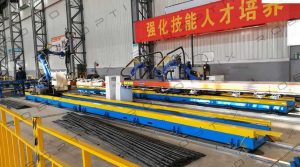
Özel Robot İş İstasyonları ve Lazer Sistemleri Üreticisi


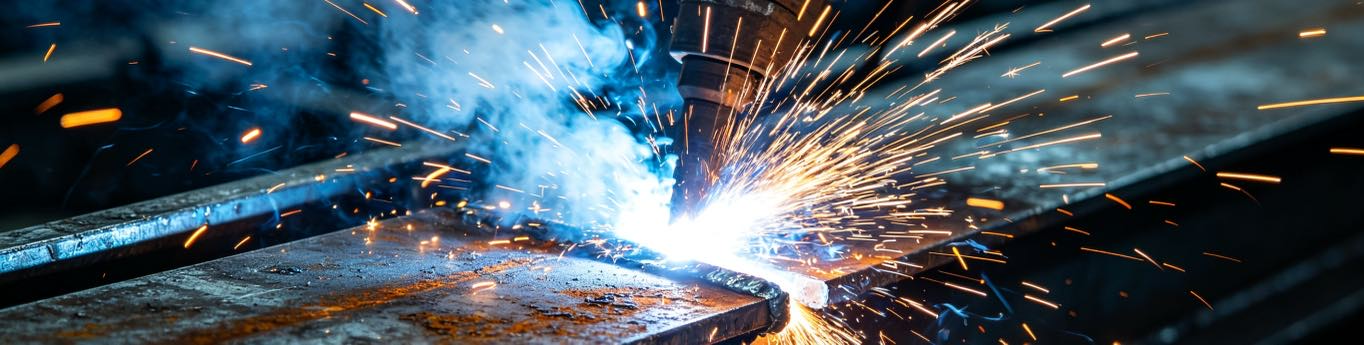
Anahtar Teslim Kaynak İş İstasyonu: Çizimden Üretime Hazır Hücreye
"Satılık kaynak pozisyoneri" diye arama yaptınız ve şimdi ikinci bir sorunla karşı karşıyasınız, daha ağır soru: onu gerçekten kaynak yapan kim? Anahtar teslimi bir kaynak hücresi bu yükü ortadan kaldırır; devreye alınır, programlanmış, ve doğrulandı, not as loose hardware you must integrate yourself. This guide is about deployment, not theory: what turnkey includes, how ROBOPTIX stands a cell up, and—honestly—where a DIY build still wins. If you have not picked a positioner family, tür seçimiyle başlayın; için altı aile karşılaştırması, tabloyu gör .
Why a Turnkey Cell Beats a DIY Integration
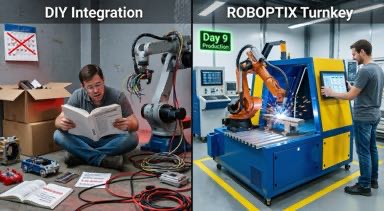
A do-it-yourself integration means you own the robot, konumlayıcı, the controller, and the weeks of controls engineering to make them shake hands. Most shops underestimate that step: the weld is the easy part; the commissioning is the project . A turnkey Welding Robot Cell arrives as one commissioned system—robot, servo positioner, emniyet, and a proven process—so the first good part comes in days, not months. ROBOPTIX pre-verifies the kinematic chain before it ships.
What “Turnkey” Actually Includes
A true turnkey scope is a checklist, not a pile of crates.
Mechanical Integration
ROBOPTIX ships the 7th Axis Robot Rail System that extends reach , bir Robot Tabanı / Sabit taban çerçevesini tanımlayan Robot Kaidesi, and one of the six servo positioner families—each declared as an external axis so the controller solves the whole chain . Frames are aligned at build, not in your bay.
Controls & External-Axis Commissioning
The positioner is commissioned as an external axis inside the robot controller, with external-axis interpolation verified before shipment. The coordinate frame is set so the robot and positioner move as one kinematic chain—the coordinated motion a production cell needs.
First-Article Acceptance
Before it leaves, the cell is run against your part and verified to the stated tolerance with a laser tracker, ISO için 9283:1998 conditions. You receive proof, bir söz değil. Without that acceptance, a “turnkey” claim is just a shipping date.
The Deployment Math
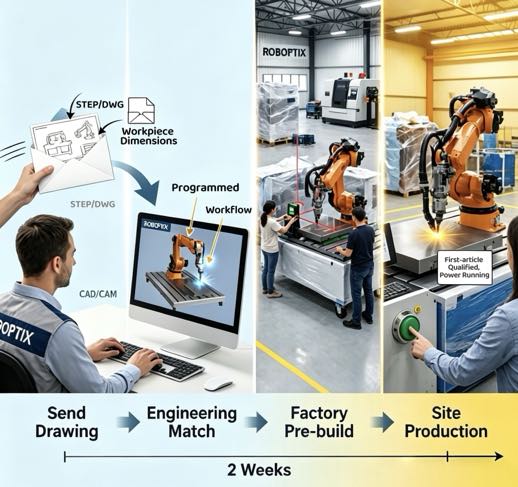
The number that decides buy-vs-build is production lost during stand-up. A DIY integration typically burns 8–12 weeks of controls and rework before the first good part; a ROBOPTIX turnkey cell ships pre-commissioned and goes live in about 2 haftalar. Şu tarihte: 40 parça/gün, the 6–10 week gap is roughly 240–400 parts of output you never recover—often more than the turnkey premium costs. Turnkey trades a higher sticker for a shorter, predictable ramp; DIY trades a lower sticker for a longer, riskier one. The cheaper quote is the expensive machine if it ships late.
Engineering note: verified, varsayılmadı
Commissioning is only trustworthy with stated conditions. ROBOPTIX raporları ISO başına doğruluk AP'si ve tekrarlanabilirlik RP'si oluşturur 9283:1998 senin yükün altında, sıcaklık, ve hız—çünkü koşulsuz bir sayı yarı doğrudur. The cell is accepted on measured data, so the spec you sign off on is the spec you weld with.
Which Shops a Turnkey Cell Fits
Pick the positioner family from your part geometry first : uzun dönme dikişleri Mesnetli Punta Konumlandırıcıya uygundur; beams and boxes suit an L-Type Welding Positioner; large irregular frames suit a U Tipi Kaynak Pozisyoneri. Turnkey pays off hardest where the part is stable and volumes are real—you want the cell running, not sitting in your bay while an integrator learns your fixtures. Yüksek karışım için, frequent-change work, a No-Programming Robotic Welding Cell may fit better; for tight tolerance and rare fixtures, a coordinated cell.
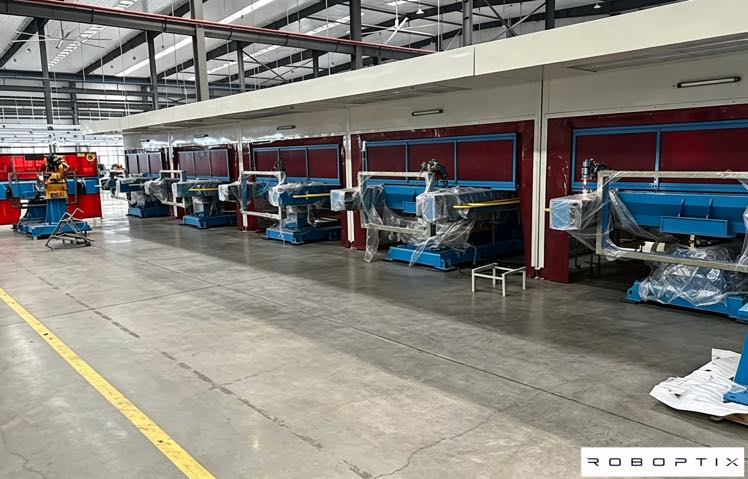
Turnkey Cost Breakdown: Where the Premium Goes
A turnkey premium is not a markup—it is prepaid engineering you would otherwise do on your own clock. When you search “welding positioner for sale” and compare a bare robot-plus-positioner quote against a turnkey cell, the gap is not margin—it is the integration, devreye alma, and acceptance work moved off your floor and onto ours. Understanding the line items is how you judge the number honestly.
What you are actually buying, line by line
Three things dominate the cost. Birinci, mechanical integration of the 7th Axis Robot Rail System and Robot Base / Robot Pedestal—alignment and wiring that a DIY shop relearns on every build. Saniye, external-axis commissioning inside the robot controller, including the coordinated motion proof. Üçüncü, first-article laser acceptance per ISO 9283:1998, with a signed tolerance report you can hand to your own QA. A vendor quoting a bare machine ‘cheap’ has simply deferred those costs onto your timeline.
The ramp is the real asset
The least visible line item is certainty. A turnkey cell gives you a commissioning date you can plan production against; a DIY build gives a best-case estimate that slips week after week. Şu tarihte: 40 parça/gün, each slipped week is 200 lost parts—so the premium is often smaller than the output you protect. Buy the ramp where it pays; do not pay twice for the same lesson.
Çalışılan Örnek
Pressure-Vessel Supplier (robot + Mesnetli Punta Konumlandırıcı)
A supplier quoting pressure-vessel shells needed a coordinated cell but had no controls engineer. A DIY path would have meant a 10-week integration; the turnkey cell—robot with a Mesnetli Punta Konumlandırıcı as an external axis—arrived commissioned and laser-verified to the procedure-qualification tolerance . The cell held the seam flat at constant TCP speed and was welding production in nine days. The avoided integration window was worth more than the turnkey premium.
Turnkey vs DIY Integration
| Boyut | Anahtar teslimi (ROBOPTIX) | In-House DIY |
| Time to first good part | ~2 weeks (pre-commissioned) | 8–12 weeks of controls work |
| Who owns integration risk | ROBOPTIX | Your team / integrator |
| Acceptance evidence | Laser-tracker, ISO 9283:1998 | Often none until you build it |
| Şunun için en iyisi: | Stable volumes, fast ramp | Unique one-off, deep in-house skill |
When a Turnkey Cell Isn’t the Answer
Turnkey is not universal. For a one-off, highly bespoke part best served by a custom program , or a shop that already runs robot cells and wants to own the stack, a coordinated build or custom program may be the honest choice. Audit any supplier before committing—factory visit and bench test beat a spec sheet—and weigh five-year total cost of ownership against the sticker. Pay for the ramp where it pays; own the build where you can.
Ne zaman SEÇİLMEMELİ
If your part is a one-off, highly bespoke build, choose the custom program . If you already run robot cells and want to own the stack, a coordinated build is the honest call. Yargı, varsayılan değil, protects the budget—audit the supplier first .
ROBOPTIX Builds the Turnkey Welding Robot Cell
Every turnkey cell is an assembly, tek bir SKU değil: Erişimi genişleten 7. Eksen Robot Ray Sistemi , bir Robot Tabanı / Sabit taban çerçevesini tanımlayan Robot Kaidesi, ve servo konumlayıcılar—Mesnetli Punta Konumlandırıcı, L Tipi Kaynak Pozisyoneri, U Tipi Kaynak Pozisyoneri, Yatay 3 Eksenli Döner Konumlandırıcı, Dikey Devirme Konumlandırıcı, veya Tek Eksenli Döner Konumlandırıcı—harici eksenler olarak beyan edilir. El değmeden çalıştırma için, Programlamasız Robotik Kaynak Hücresi ile aynı donanım gönderilir ; Lazer işlemleri için, lazere hazır bir platformda ; ve standart dışı geometriler için, özel program aracılığıyla. The turnkey Welding Robot Cell is the delivered, commissioned version of the same coordinated architecture.
Sıkça Sorulan Sorular
Q: What does turnkey welding mean?
A: It means the cell arrives commissioned, programlanmış, and validated to your part—not loose hardware. ROBOPTIX pre-verifies the external-axis chain and accepts it with a laser tracker before shipping.
Q: How long until the first good part?
A: A ROBOPTIX turnkey cell typically goes live in about 2 weeks versus 8–12 weeks for a DIY integration, because the kinematic chain is commissioned before it ships. The recovered production usually exceeds the turnkey premium .
Q: Which positioner family is in a turnkey cell?
A: Whichever matches your geometry: Uzun rotasyonel dikişler için Mesnetli Punta, Kirişler/kutular için L Tipi, Büyük düzensiz çerçeveler için U Tipi, 3-Karmaşık karışık dikişler için eksen, Ağır plaka için Dikey Devirme, Yuvarlak parçalar için Tek Eksenli Döner.
Q: Is turnkey the same as no-programming?
A: Mutlaka değil. Turnkey is about delivery; No-Programming Robotic Welding Cell is a usability layer on top. A turnkey cell can be taught or vision-guided—the point is it ships ready to weld, not the programming method.
Q: When should I NOT buy turnkey?
A: Benzersiz, tek seferlik bir parça için, choose the custom program ; for a shop with deep in-house robot skill, koordineli bir yapı ; always audit the supplier first and compare five-year TCO.
Q: Can I add no-programming later?
A: Evet. The same coordinated hardware ships as a No-Programming Robotic Welding Cell ; the vision layer is software on top of the external-axis cell, so a turnkey cell can be upgraded to hands-off operation without rebuilding the base machine. Start turnkey, add vision when the part mix demands it.
Q: What about spare parts and operator training?
A: ROBOPTIX ships a documented spare-part list and trains your operators during commissioning, so the cell is yours to run on day one. Audit the supplier’s support model before you commit—a factory visit still beats a spec sheet.
A turnkey welding cell is the fastest path from drawing to production: commissioned, validated, and ready to weld—not a pile of crates you must integrate. ROBOPTIX ISO 9001 sertifikalıdır, builds it from the 7th Axis Robot Rail System, Robot Tabanı / Robot Kaidesi, ve servo konumlayıcılar, and accepts it per ISO 9283:1998 with laser-tracker proof. Send us your drawing and tolerance band and we will deliver the Welding Robot Cell—before your competitor ships theirs.
Yazar Hakkında
Deneyim & Kimlik bilgileri
Robotik kaynak sistemi entegrasyon uzmanı 12+ Robot Konumlandırıcı seçimi ve entegrasyonuna odaklanan uzun yıllara dayanan doğrudan proje deneyimi. Danışmanlık yaptı 300+ Kuzey Amerika'daki fabrikalar, Avrupa, ve Asya. Bu makaledeki tüm spesifikasyon verileri gerçek H'den alınmıştır. / B / L / U serisi ürün veri sayfaları.
Şirket geçmişi: 26+ yıllarca kaynak otomasyon mühendisliği, 40+ aktif patentler, 1,500+ dünya çapında tamamlanan projeler, yaklaşık olarak 70% Robot Konumlandırıcı entegrasyonunu içerir.
Sertifikalar
Yüksek Teknoloji Kuruluşu - Sertifika. HAYIR. GR202341000595 (Kasım'da yayınlandı. 2023)
ISO 9001: 2015 (GB/T 19001-2016) — Kalite Yönetim Sistemi
GJB 9001C-2017 — Askeri/Silah Ekipmanı Kalite Yönetim Sistemi
AB CE — Makine Direktifi 2006/42/EC (Sertifika. HAYIR. M.2026.206.C134866)
Referanslar
[1] Uluslararası Standardizasyon Örgütü. (1998). ISO 9283:1998, Endüstriyel Robotların Manipüle Edilmesi - Performans Kriterleri ve İlgili Test Yöntemleri.
[2] Park, J.-H., kim, S.-H., Ay, H.-S., & kim, M.-H. (2019). Yerçekiminin Erimiş Havuz Davranışı Üzerindeki Etkisi ve Darbeli Gazaltı Metal Ark Kaynağında Çeşitli Kaynak Pozisyonlarında Mikro Yapının Analizi. Uygulamalı Bilimler, 9(21), 4626.
[3] Liu, J., Jiang, F., Çen, S., Xu, B., Zhang, G., Cheng, W., & anne, X. (2023). Farklı Kaynak Pozisyonlarında Değişken Polariteli Plazma Ark Kaynağında Kaynak Havuzu Davranışı ve Kaynak Boncuk Performansı Üzerindeki Yerçekimi Etkisinin Mekanizmaları. Malzemeler, 16(19), 6457.
İLGİLİ YAZILAR
Yer Pisti ve Tepegöz 7. Eksen Robotu: Kurulum, Emniyet & Seçim Kılavuzu
5 Büyük İş Parçası Kaynağının Verimsiz Olmasının Nedenleri ve Robot Konumlandırıcı Her Sorunu Nasıl Çözer?
7. Eksen Robotunun Kurulumu ve Entegrasyonu: Adım Adım Kılavuz & En İyi Uygulamalar
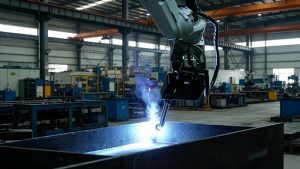
3D Vision Lazer Dikiş Takibi Açıklaması:Saniyeler İçinde Nokta Bulutundan Kaynak Yoluna
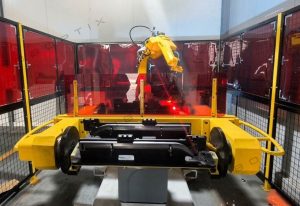
Robotik Kaynak Kusurları Nasıl Oluşur ve Robot Konumlandırıcı Ne Kadar Düzeltilebilir??