कस्टम रोबोट वर्कस्टेशन और लेजर सिस्टम निर्माता



वेल्डिंग पोजिशनर का पांच साल का टीसीओ: छिपी हुई लागतों की गिनती करना भूल गए उद्धरण
Return on investment tells you when a वेल्डिंग पोजीशनर pays for itself. Total cost of ownership tells you what it actually costs to own it for five years—and the two numbers routinely point at different machines. लागत पर लाभ (the subject of our companion piece on payback) answers “how fast do I break even?” TCO answers a harder, more honest question: “how expensive are the costs this quote forgot?” A welding positioner quoted $10,000 below the next bid can easily cost six figures more across five years once downtime, पुनः कार्य करना, ऊर्जा, and spare parts are counted. This article builds a five-year TCO model for a welding positioner, quantifies the hidden costs the quote leaves out, and shows why the cheap bid is so often the expensive one.
The TCO lens matters most precisely because the purchase price is the smallest, most visible part of the story. Everything that happens after the invoice—every hour the cell is stopped, every weld you cut out and redo, every service call—compounds quietly. By the time a mis-specified or under-built welding positioner has cost you a missed shipment, those hidden costs dwarf the saving that won you the order.
टिप्पणी: The TCO model reflects रोबोप्टिक्स field cost data across fabrication cells and is consistent with the accuracy (सटीकता-सत्यापन लेख), समन्वय (the coordinated-motion article), भार (the eccentric-loading article), and geometry (the geometry-matching article) principles in this series. वेल्डिंग-गुणवत्ता लिंकेज को सहकर्मी-समीक्षा अनुसंधान के साथ क्रॉस-रेफ़र किया गया है (पार्क एट अल., 2019; लियू एट अल., 2023).
1. ROI Tells You When You Break Even. TCO Tells You What It Costs.
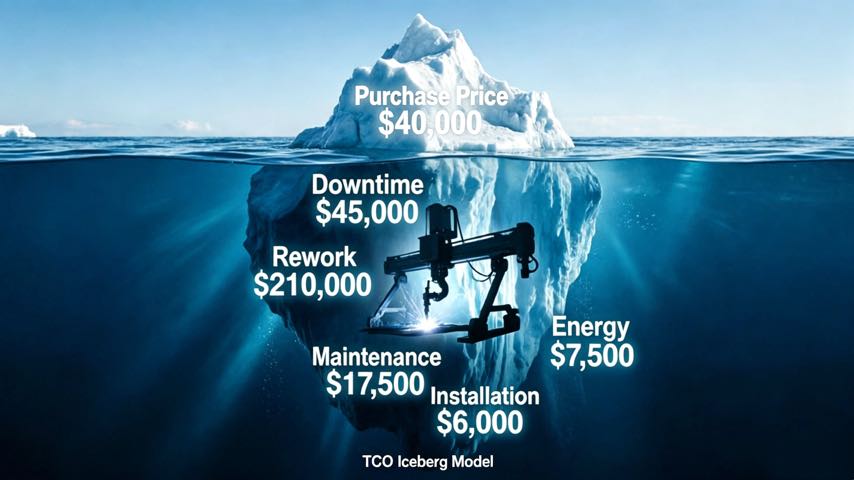
ROI and payback answer the buyer who asks “when do I get my money back?”—usually from labor saved versus manual repositioning. That is a fair question, and for a well-specified welding positioner the payback is often under a year. But ROI is blind to the costs that follow: it treats the purchase price as the cost and the labor saving as the benefit, and stays silent on what happens when the machine is down, when the weld is wrong, or when the spare part ships from the other side of the world. TCO refuses that silence. It adds every cost of owning the welding positioner across its life—the visible and the hidden—and lets you compare two bids on the only basis that survives contact with production: total cost, not sticker price.
2. What TCO Actually Includes
A five-year TCO for a welding positioner is the sum of every cost tied to owning and running it. Splitting the buckets makes the hidden ones visible.
2.1 Purchase Price vs Life-Cycle Cost
Purchase price is the number on the quote. Life-cycle cost is everything else—and for a welding positioner run two shifts for five years, life-cycle cost typically dwarfs the purchase price. Treating the quote as “the cost” is the single most common budgeting error in this category, and it is why two bids that look $10,000 apart on paper can be $100,000 apart in reality.
2.2 The Obvious Costs
- Acquisition: The welding positioner price plus freight, duties, and taxes—real but visible, and the only line most buyers actually compare.
- इंस्टालेशन & कमीशन: Foundations, anchoring, विद्युतीय, and the integration work to make it talk to your robot (the coordinated-motion article). Cheaper machines often cost more here because they arrive less integrated and less documented.
- प्रशिक्षण: Operator and maintenance training; usually modest and routinely underestimated in the budget.
2.3 The Hidden Costs
- Downtime: Hours the cell is stopped for faults, adjustments, or waiting on parts. This is usually the largest hidden cost and the one ROI ignores entirely.
- Rework and scrap: Welds you cut out and redo, or parts you scrap, because the positioner drifted, sagged, or presented the weld badly—directly tied to the accuracy (सटीकता-सत्यापन लेख) and geometry choices made upstream.
- Energy and consumables: बिजली, परिरक्षण गैस, तार, and wear items; small per hour, large over five years of running.
- Maintenance and spare parts: Planned service plus unplanned repairs; depends heavily on build quality and how fast you can get parts.
- Integration and mis-spec penalties: The cost of discovering, after delivery, that the welding positioner cannot hold your part (the eccentric-loading article) or cannot coordinate with your robot (the coordinated-motion article)—the exact failure a pre-purchase audit exists to prevent.
3. A Worked Five-Year TCO Model
Models need assumptions, so state them. Below: one welding positioner, single-shift, 2,000 production hours per year, five years (10,000 hours total), and a burdened cost of a stopped or wasted welding hour of $150 (श्रम, उपरि, and lost output). We compare a low-cost welding positioner at $40,000 against a quality welding positioner at $52,000—a $12,000 gap that looks decisive on the quote. The reject base is 20,000 welds per year at roughly $35 per rejected weld in labor and consumables.
| Five-year cost line | Cheap welding positioner ($40के) | Quality welding positioner ($52के) |
| Purchase price | $40,000 | $52,000 |
| Install & कमीशन | $6,000 | $3,000 |
| प्रशिक्षण | $2,000 | $2,000 |
| Downtime (3% बनाम 0.6% का 10,000 h × $150) | $45,000 | $9,000 |
| पुनः कार्य करें & कतरन (6% बनाम 2% reject) | $210,000 | $70,000 |
| Energy & उपभोग्य (premium) | $7,500 | $0 |
| रखरखाव & स्पेयर पार्ट्स | $17,500 | $10,000 |
| Five-year TCO total | $328,000 | $146,000 |
The cheap welding positioner “saves” $12,000 up front and costs roughly $182,000 more over five years. The deciding numbers are not the purchase prices—they are downtime and rework, the two costs ROI never counts. Your assumptions will differ; the structure will not. Run it with your own hours, reject rates, and burden rate and the cheap bid will almost always lose.
4. The Hidden Costs, Quantified
4.1 Downtime
Downtime is the silent killer of TCO. ए वेल्डिंग पोजीशनर that faults once a week for two hours—at a $150 burdened rate—costs $15,600 a year in stopped output alone, before any repair bill. Multiply across five years and a “minor” reliability gap becomes a six-figure line. Cheap machines concentrate downtime in weak gearboxes, poor thermal stability (सटीकता-सत्यापन लेख), and controllers nobody local can service.
4.2 पुनः कार्य और स्क्रैप
Every rejected weld carries the original labor plus the rework labor, उपभोग्य, and the risk of damaging the part. पर 6% बनाम 2% reject on 20,000 welds a year, the gap is 800 extra bad welds a year—4,000 over five years—each one a small tax that, summed, decides the TCO. Rework is where poor accuracy (सटीकता-सत्यापन लेख) और wrong geometry quietly bill you, weld after weld, long after the quote was forgotten.
4.3 Energy and Consumables
Individually trivial—a few dollars of gas and wire per hour—but over 10,000 hours the welding positioner that runs hotter or less efficiently adds thousands. Include it; it is easy to measure and hard to ignore in aggregate, and it is one line a cheap bid cannot argue away.
4.4 Maintenance and Spare Parts
Build quality sets the planned-maintenance cost; supply chain sets the unplanned one. A welding positioner whose bearings, servo, or controller must be imported on a four-week lead time turns a $500 repair into a $15,000 downtime event. Local support and documented spares are TCO line items, not afterthoughts, and they are exactly what a pre-purchase audit checks for.
4.5 Integration and Commissioning
A welding positioner that does not coordinate cleanly with your robot or that fails a pre-purchase audit adds integration hours and, worse, delays startup. Every week of delayed production is a week of the burdened rate with nothing to show. The audit that costs one site visit is cheap insurance against this line—and against the mis-spec penalty below.
4.6 The Cost of a Mis-Specified Machine
Specify the wrong welding positioner—under-rated for your load, wrong geometry for your part , or unable to hold your tolerance (सटीकता-सत्यापन लेख)—and the TCO penalty is structural: you own a machine that cannot make your part well, and the fix is a second machine. This is the most expensive line in the model and the most avoidable, because it is decided during selection, बाद में नहीं. A one-page part profile and an ISO 9283 acceptance clause cost almost nothing and prevent it.
5. How to Build Your Own TCO Model
You do not need our numbers; you need our structure. Build a one-page TCO sheet for every welding positioner bid with these lines, and fill them with your own data:
- Purchase price; freight & duty; the visible acquisition cost, stated fully.
- Install & कमीशन; प्रशिक्षण; the cost to make the welding positioner productive and your people competent.
- Annual downtime hours × your burden rate; the largest hidden line—estimate honestly from the supplier’s reliability record.
- Reject rate × weld volume × rework cost; the second largest hidden line, tied directly to accuracy and geometry.
- Energy premium; five-year maintenance & बचाया; the slow, measurable drags.
- Mis-spec contingency; a reserve for the structural penalty if the welding positioner cannot hold your part.
Total each bid on the whole sheet, not the first line. The bid that wins on sticker price will usually lose on the sheet—and now you can show your controller exactly why, with numbers instead of opinion.
6. फ़ील्ड उदाहरण: The $12,000 Saving That Cost $180,000

ए रोबोप्टिक्स customer compared two welding positioners for a structural frame cell: a low-cost import at $40,000 and a ROBOPTIX unit at $52,000. The $12,000 gap looked decisive to procurement, and the cheap unit won. Within a year, the pattern the TCO model predicts appeared: weekly faults (poor thermal stability and a gearbox near its limit), ए 6% reject rate on heavy seams (the eccentric-loading article), and a four-week wait for an imported servo. By year two they had effectively paid the $12,000 saving back in downtime and rework, and by year five the total cost of owning the “cheap” welding positioner—modeled at roughly $328,000 बनाम $146,000 for the quality unit—exceeded the quality option by about $180,000. They replaced it with the ROBOPTIX welding positioner they should have bought first. The saving was real for one afternoon; the cost compounded for five years.
7. When TCO Favors the Cheaper Machine
TCO does not automatically condemn the lower bid. If the application is light—loose tolerances, low duty, a standard welding positioner you have run successfully before, from a supplier you have audited (the pre-purchase-audit article)—the hidden costs shrink and the cheap bid can legitimately win on total cost. TCO is a tool for surfacing hidden costs where they are large, not a formula that always picks the premium machine. Use it hardest exactly where the risk lives: कड़ी सहनशीलता, भारी या अनियमित भाग (the geometry-matching article), coordinated cells, and first-time suppliers. Where the risk is small, a simple price comparison is fine—and honesty about that is what keeps the analysis credible rather than ideological.
अक्सर पूछे जाने वाले प्रश्नों
क्यू: What is the total cost of owning a welding positioner over five years?
ए: Far more than the purchase price. A five-year TCO adds installation, प्रशिक्षण, downtime, पुनः कार्य करना और स्क्रैप करना, energy and consumables, and maintenance and spare parts. For a welding positioner run in production, these life-cycle costs usually exceed the sticker price several times over, which is why the quote alone is a poor basis for the decision.
क्यू: Why does a cheap welding positioner cost more in the long run?
ए: The lower bid usually hides higher downtime (weaker drive, poor thermal stability), higher rework (अभिप्राय, sag, wrong geometry), and slower, costlier spare parts. Those hidden costs compound for five years and routinely outweigh the up-front saving by an order of magnitude or more—the pattern our worked model quantifies.
क्यू: How do I build a TCO model for a welding positioner?
ए: List every cost line—purchase, freight/duty, install, प्रशिक्षण, annual downtime hours × your burden rate, reject rate × weld volume × rework cost, energy premium, and five-year maintenance—and total them per bid. Score bids on the total, not the first line, using your own hours, reject rates, and rates. The structure matters more than the exact numbers.
क्यू: When is the cheaper welding positioner the right choice?
ए: When the application is light: ढीली सहनशीलता, low duty, a standard welding positioner you have run before, from an audited supplier. Then hidden costs shrink and the lower bid can win on true total cost. Reserve the full TCO scrutiny for tight tolerances, भारी या अनियमित भाग, coordinated cells, and first-time suppliers, where the hidden costs are large enough to decide the outcome
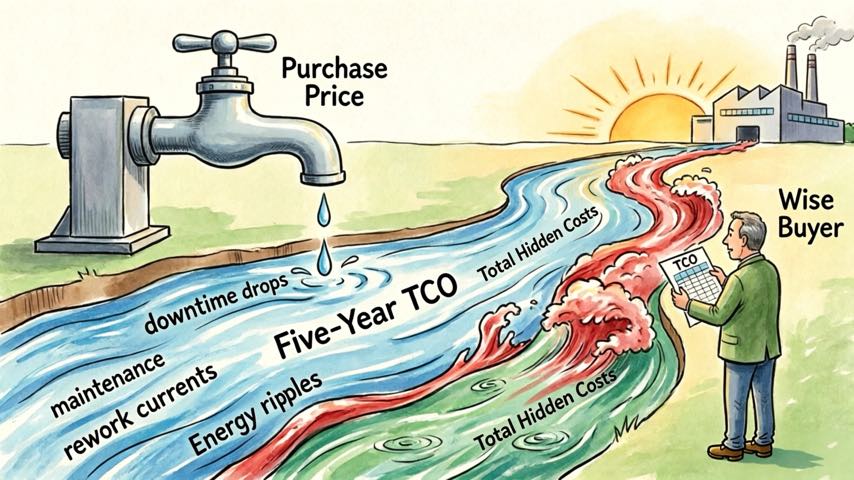
A welding positioner is not a purchase; it is a five-year cost stream, and the quote shows you only the first drop. ROI tells you when you break even; TCO tells you what the whole stream costs—including the downtime, पुनः कार्य करना, ऊर्जा, and spare parts the cheap bid forgot. Build the model, fill it with your own numbers, and the machine that wins on sticker price will usually lose on total cost, often by more than the rest of the specification combined. Buy the welding positioner whose five-year cost is lowest, not the one whose quote is shortest.
ROBOPTIX welding positioners are specified to minimize life-cycle cost: ISO 9283-verified accuracy (सटीकता-सत्यापन लेख) that holds rework down, coordinated external-axis integration that avoids startup delays, भार- and geometry-correct sizing (the geometry-matching article) that prevents mis-spec penalties, और auditable supply that keeps spare-part lead times short. This is the final article in the series—from the physics of gravity through position, फिक्स्चर, hidden specs, भार, समन्वय, verification, ज्यामिति, audit, and now cost, the thread has been constant: specify the welding positioner you can actually weld with, and the total cost takes care of itself.
पूछना रोबोप्टिक्स for a five-year TCO comparison on your own duty cycle—before the cheap quote becomes the expensive machine.
लेखक के बारे में
अनुभव & साख
रोबोटिक वेल्डिंग सिस्टम एकीकरण विशेषज्ञ के साथ 12+ रोबोट पोजिशनर चयन और एकीकरण पर केंद्रित वर्षों का प्रत्यक्ष परियोजना अनुभव. को परामर्श प्रदान किया है 300+ उत्तरी अमेरिका भर में कारखाने, यूरोप, और एशिया. इस आलेख में सभी विनिर्देशन डेटा वास्तविक एच से लिया गया है / बी / एल / यू सीरीज उत्पाद डेटाशीट.
कंपनी बैकग्राउंड: 26+ वेल्डिंग ऑटोमेशन इंजीनियरिंग के वर्ष, 40+ सक्रिय पेटेंट, 1,500+ विश्व स्तर पर पूर्ण की गई परियोजनाएँ, लगभग 70% रोबोट पोजिशनर एकीकरण शामिल है.
प्रमाणपत्र
- आईएसओ 9001: 2015 (जीबी/टी 19001-2016) - गुणवत्ता प्रबंधन प्रणाली
- GJB 9001C-2017 - सैन्य/हथियार उपकरण गुणवत्ता प्रबंधन प्रणाली
- ईयू सीई - मशीनरी निर्देश 2006/42/ईसी (प्रमाणपत्र. नहीं. एम.2026.206.सी134866)
- हाई-टेक एंटरप्राइज - सर्टिफिकेट. नहीं. GR202341000595 (नवंबर में जारी. 2023)
संदर्भ
[1] पार्क, जे.-एच., किम, श।, चंद्रमा, एच.-एस., & किम, एम.-एच. (2019). पिघले हुए पूल व्यवहार पर गुरुत्वाकर्षण का प्रभाव और स्पंदित गैस मेटल आर्क वेल्डिंग में विभिन्न वेल्डिंग स्थितियों पर माइक्रोस्ट्रक्चर का विश्लेषण. अनुप्रयुक्त विज्ञान, 9(21), 4626.
[2] लियू, जे।, जियांग, एफ।, चेन, एस।, जू, बी।, झांग, जी।, चेंग, डब्ल्यू, & एमए, एक्स. (2023). विभिन्न वेल्डिंग स्थितियों में परिवर्तनीय ध्रुवता प्लाज्मा आर्क वेल्डिंग में वेल्ड पूल व्यवहार और वेल्ड बीड प्रदर्शन पर गुरुत्वाकर्षण प्रभाव के तंत्र. सामग्री, 16(19), 6457.
[3] इंटरनैशनल ऑर्गनाइज़ेशन फॉर स्टैंडर्डाइज़ेशन. (1998). आईएसओ 9283:1998, औद्योगिक रोबोटों में हेरफेर - प्रदर्शन मानदंड और संबंधित परीक्षण विधियाँ.
संबंधित पोस्ट
रोबोटिक वेल्डिंग सेल क्या है?? 2026 शुरुआती मार्गदर्शिका | 37 दुकान डेटा
रोबोटिक लेजर वेल्डिंग: सिद्धांत, लाभ, और अनुप्रयोग (2026 संपूर्ण गाइड)
गोल बनाम आयताकार बनाम अनियमित: वर्कपीस ज्योमेट्री के साथ वेल्डिंग पोजिशनर कॉन्फ़िगरेशन का मिलान
7वां एक्सिस रोबोट क्यों जोड़ें?? 5 उत्पादकता बढ़ाने के शक्तिशाली तरीके & लागत में कटौती करें 2026
शुरुआती लोगों के लिए रोबोटिक वेल्डिंग सेल प्रोग्रामिंग: चरण-दर-चरण मार्गदर्शिका 2026