Custom Robot Workstations And Laser Systems Manufacturer


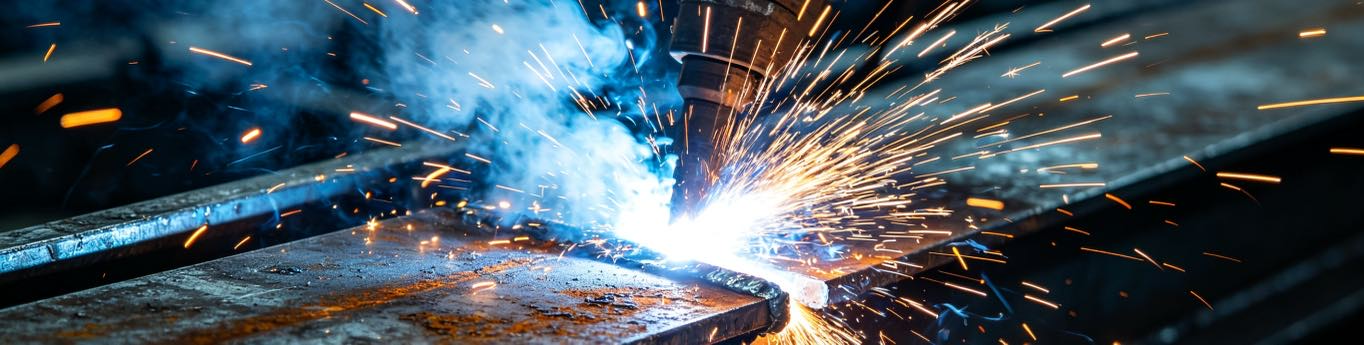
Fixture-Free Fabrication: When a Welding Positioner Replaces Complex Jigs, Tack Welds, and Crane Time
The most expensive part of many welds is the part you never weld — the fixture
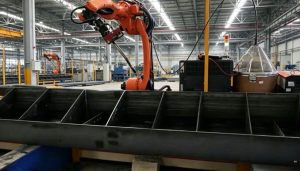
Walk onto almost any fabrication floor and you will find the real bottleneck is rarely the arc. It is the setup: a custom weld fixture sitting in a corner, a tack welder hunched over a joint, and an overhead crane idle while an operator waits to flip a 2-ton frame. Across ROBOPTIX positioner deployments in structural steel, pressure vessel, and heavy-equipment manufacturing, we repeatedly see the same pattern — shops invest thousands in fixtures and hours in tacking, when a single servo positioner could eliminate both.
This article explains the fixture-free fabrication model: how a welding positioner lets you rotate the workpiece instead of building a jig around it, why it removes tack welding from the process, and how it deletes crane-dependent repositioning entirely. The result is shorter lead times, lower tooling cost, and — as the underlying physics shows — better welds.
Note: Cost figures and cycle-time improvements below are drawn from ROBOPTIX positioner integrations and cross-referenced with peer-reviewed research on gravity-driven weld-pool behavior (Park et al., 2019, Applied Sciences; Liu et al., 2023, Materials).
1. The Hidden Tax of Fixtures and Jigs
A weld fixture is any device that holds, supports, or aligns a part during welding. Jigs locate and clamp; fixtures support. Both solve the same problem a positioner solves — presenting the joint in the right place — but they solve it with steel and lead time rather than motion. The cost is rarely counted on a single line item, which is exactly why it escapes scrutiny.
1.1 What a Custom Fixture Actually Costs
- Design engineering: A one-off fixture starts with CAD, FEA for rigidity, and tolerance analysis — often 20–80 hours of engineering before a single plate is cut.
- Machining and welding: Fixture bodies are fabricated from structural steel, machined for locating surfaces, and stress-relieved. For a mid-size frame, material plus labor commonly runs $2,000–$15,000.
- Storage and inventory: Fixtures are floor-space parasites. A shop running 200 SKUs may hold 150 active fixtures occupying prime square footage near the welding cells.
- Changeover downtime: Switching a cell from one part to another means swapping, re-aligning, and re-qualifying the fixture — 15–60 minutes of non-productive time per changeover.
- Obsolescence: When the part revises, the fixture often cannot follow. Dead fixtures accumulate like driftwood.
None of these costs appear in a weld-cost calculation, yet together they frequently exceed the labor saved by the weld itself. A positioner attacks the problem structurally: instead of building a new holding device for every part shape, you buy one device that holds every part shape by rotating it.
1.2 The Fixture-to-Changeover Death Spiral
The hidden cost compounds through a pattern we call the fixture-to-changeover death spiral. A new part arrives; engineering quotes a fixture; procurement waits on steel; the cell sits idle until the fixture lands; the part runs; then the next variant needs its own fixture, and the cycle repeats. Each iteration adds lead time the customer feels but the shop rarely invoices for. High-mix shops — the ones running dozens of distinct brackets, mounts, and frames per month — are most exposed, because their fixture count grows faster than any single fixture pays back. A servo positioner breaks the spiral by making the holding device a reusable asset rather than a per-part liability.
2. Rotate the Part, Don’t Build the Jig
The core insight of fixture-free fabrication is substitution. A fixture exists to hold a joint at a workable angle. A positioner does the same thing by moving the workpiece — so the fixture becomes unnecessary.
2.1 One Device, Every Geometry
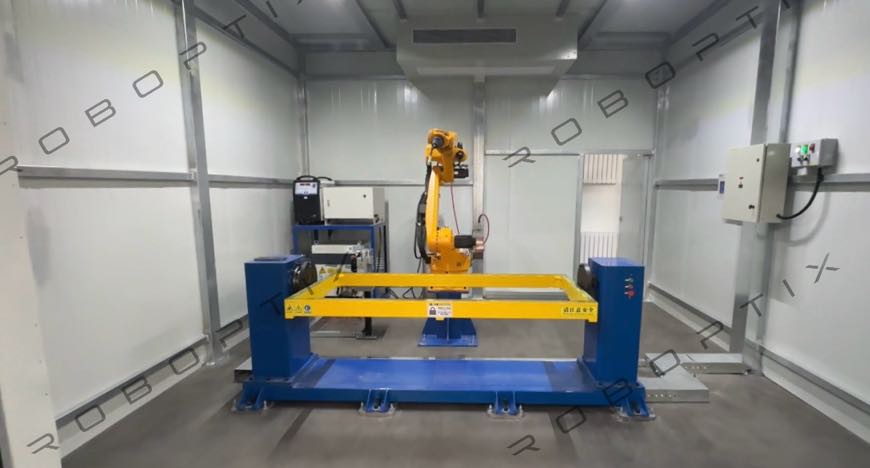
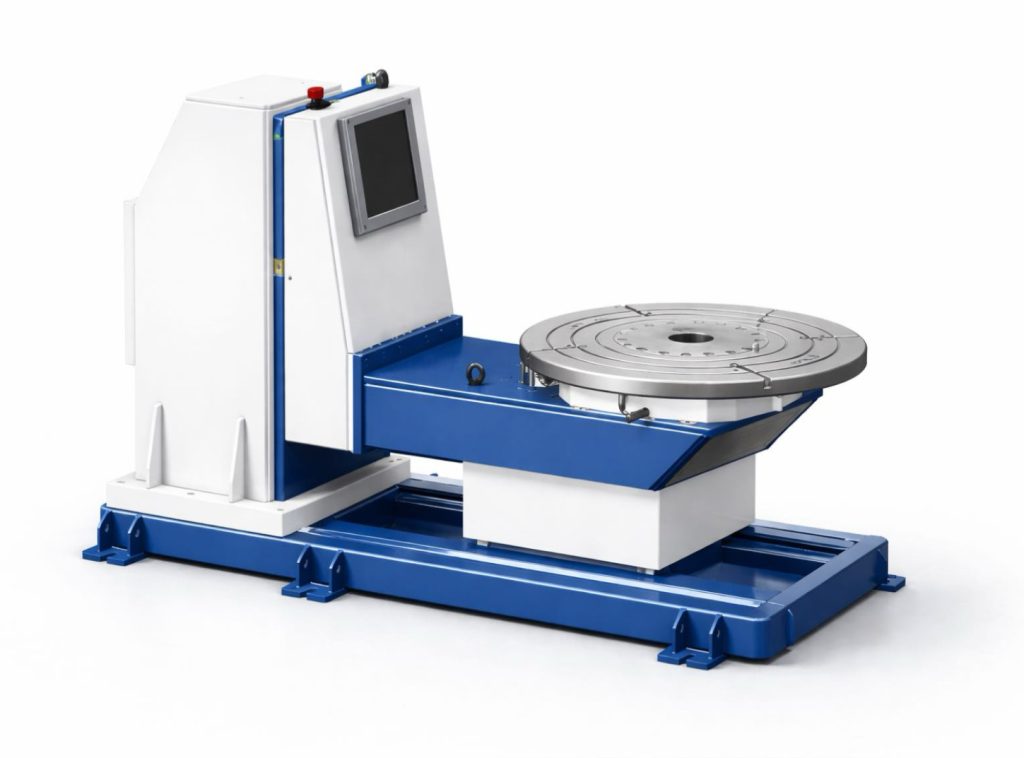
Consider a family of bracket assemblies that previously required three dedicated fixtures (one per variant). Mounted on a headstock-tailstock or L-type positioner, all three variants are simply clamped to the table and rotated to the optimal welding angle. The ROBOPTIX B001–B004 head-tail series and B008–B012 multi-axis servo positioners cover beam, plate, and irregular geometries through programmable rotation rather than custom tooling.
2.2 Why This Beats Fixturing on Quality
Rotating the part to the flat (1G/1F) position does more than save a fixture — it improves the weld. Peer-reviewed studies confirm that gravity-driven changes in molten-pool convection differ sharply by welding position: Park et al. (2019) measured penetration of 1.8 mm in flat position versus just 0.8 mm in vertical-down P-GMAW at matched heat input, while Liu et al. (2023) documented a 23.8% larger weld-center grain size in flat versus vertical plasma arc welds. By bringing every joint to flat, the positioner simultaneously removes the fixture and improves metallurgical outcomes — a double win a static jig cannot deliver.
2.3 Programming Over Tooling
The deeper shift is from tooling to programming. A fixture is a physical commitment to one part; a positioner program is a software commitment to many. Once a part family is mapped to rotation angles and clamp positions, new variants are added by editing a program, not by cutting steel. For job shops bidding on prototype-to-production contracts, this agility is itself a sales asset: you can quote a new bracket without quoting a new fixture, and you can turn the quote around in hours instead of weeks. The positioner becomes a flexible capability rather than a single-purpose jig.
Practical rule of thumb: if a fixture’s only job is to hold the part at an angle or keep it from rolling, a positioner can almost always replace it. Reserve fixtures for jobs requiring precise inter-feature locating that rotation alone cannot provide.
3. Killing the Tack Weld
Tack welding — the temporary welds that hold parts in alignment before the final pass — is a fixture substitute born of necessity. On parts too awkward to fixture, operators tack, check, re-tack, then weld. It is slow, inconsistent, and a frequent source of defects.
3.1 The Problems with Tacking
- Extra process steps: Each tack is a start-stop cycle — and every start-stop is a potential lack-of-fusion or inclusion site.
- Distortion risk: Tacks lock in fit-up stress. When the final pass melts them, residual stress can shift the joint and cause warpage.
- Inconsistent fit-up: Hand tacking varies operator to operator, so the robot or welder sees a different part each time.
A positioner with integrated clamping and synchronized motion removes the need for tacks. The part is held rigidly by the positioner’s chucks or table, the robot executes a single continuous pass, and there is no tack-to-final transition to fail. For code work under AWS D1.1, eliminating tacks also removes a common cause of discontinuous root fusion that inspectors flag.
3.2 Continuous Welding on Cylindrical Parts
On pipes and pressure-vessel shells, coordinated positioner rotation lets the robot weld the full seam in one continuous pass at the optimal 12-o’clock position. No tacking rings, no stitch-weld sequences — just one uninterrupted, uniform bead. This is impossible to achieve by repositioning a fixed workpiece, and it is the single biggest reason tubular fabricators adopt positioners.
3.3 Tack Elimination and Distortion Control
Beyond speed, removing tacks improves dimensional accuracy. Tack welds are by definition incomplete fusion that later must be remelted; if they do not fully melt into the final pass, they leave cold-lap discontinuities. They also pre-load the joint with fit-up stress that can pull the assembly out of square as the final pass shrinks. A positioner holds the part in true alignment from first arc to last, so the completed weld relaxes into the designed geometry instead of a tack-distorted one. For assemblies with tight flatness or squareness callouts, this distinction is the difference between a part that ships and a part that gets reworked.
4. Deleting Crane Time
The third cost a positioner removes is the most visible: crane-dependent repositioning. A large frame welded in mixed positions is flipped with an overhead crane between faces — adding 5–15 minutes of non-welding downtime per flip, plus the safety briefing, rigging, and crane-availability wait that surround it.
4.1 One Mount, Continuous Rotation
With a positioner, the part is mounted once. The headstock and tailstock rotate it through every required angle — all four faces of a beam, both sides of a plate, the full circumference of a shell — without a single crane call. ROBOPTIX servo positioners hold angular position to ±0.05 mm at R350 (roughly 0.008°), so each rotation lands the joint precisely where the program expects it.
Field result: Shops converting crane-dependent repositioning to single-mount positioner rotation typically cut setup-and-flip downtime by 60–70%, raising arc-on time from ~40% to ~70% of a shift.
5. The Numbers: Fixture-Free ROI
The combined effect of eliminating fixtures, tacks, and crane time is measurable. Typical outcomes from ROBOPTIX installations:
| Cost Driver | With Fixtures + Crane | Fixture-Free (Positioner) |
| Setup time / part | 20–60 min (fixture swap) | 2–5 min (clamp + rotate) |
| Tooling cost / SKU | $2k–$15k fixture | $0 (shared positioner) |
| Tack welding | Required | Eliminated |
| Crane calls / shift | 15–30 | 1–3 |
| Arc-on time | ~40% of shift | ~70% of shift |
For a job shop running dozens of low-to-medium-volume SKUs, the tooling-elimination alone often justifies the positioner. For high-mix production, the setup-time collapse is the dominant gain.
5.1 The Tooling-Amortization Math
To quantify the tooling argument, consider a shop with 40 active SKUs each requiring a $4,000 fixture — a $160,000 tooling investment that sits idle most of the time and depreciates with every design revision. A single servo positioner in the same duty, priced in the low five figures, serves all 40 SKUs with zero per-part tooling. Even before counting labor and crane savings, the positioner replaces a six-figure asset with a single reusable one. The break-even is not a question of if, but of how many SKUs it takes — and for most high-mix shops, the answer is fewer than ten.
6. Field Example: Heavy-Equipment Brackets
A ROBOPTIX customer fabricating excavator boom brackets previously used two dedicated fixtures and tack-welded each bracket before robotic welding. Changeovers between the three bracket variants took 35 minutes and tied up the crane. After installing a B008 servo positioner, the brackets are clamped directly to the positioner table and rotated through all weld angles in one program. Fixtures were retired, tacks eliminated, and crane calls dropped from ~20 to 2 per shift. Setup time fell to under 4 minutes, and first-pass yield rose from 88% to 96% as tack-induced discontinuities disappeared.
The payback period on the positioner was under nine months — driven not by faster arcs, but by deleted fixtures, deleted tacks, and deleted crane waits.
7. When You Still Need a Fixture
Demands candor: fixture-free is a powerful model, but not universal. You may still need a fixture when:
- Precise inter-feature locating is required — e.g., holding tight positional tolerances between welded sub-assemblies that rotation alone cannot guarantee
- The part is too flexible or thin to be held only by chucks without distorting
- Extreme production volume on a single SKU makes a dedicated, optimized fixture faster than any general-purpose positioner
- Hazardous or awkward geometries make clamping to a positioner unsafe without additional support tooling
In practice, most shops find a hybrid: positioners handle the bulk of rotation and angle control, while light, simple locating aids (not full fixtures) handle the rest. The goal is to delete the expensive, single-purpose fixture — not every clamp in the building.
Frequently Asked Questions
Q: Can a welding positioner really replace all my fixtures?
A: Not all — but most. A positioner replaces any fixture whose only job is to hold a part at an angle or keep it from rotating. Fixtures needed for precise inter-feature locating or to support flexible parts may still be required, often in a much simpler form.
Q: Does eliminating tack welds hurt alignment?
A: No — it improves it. Tacks are inconsistent and can lock in distortion. A positioner holds the part rigidly and repeatably, so the robot or welder sees the same aligned part every time, with no tack-to-final transition to fail.
Q: How much setup time does a positioner save?
A: In ROBOPTIX field deployments, single-mount positioner rotation has cut setup-and-flip time by 60–70% versus crane-dependent repositioning, raising arc-on time from roughly 40% to 70% of a shift.
Q: Is fixture-free fabrication suitable for low-volume production?
A: Especially yes. Low-to-medium-volume, high-mix work is exactly where dedicated fixtures are most expensive per part. A shared positioner amortizes across every SKU with zero per-part tooling cost.
Want to retire your fixtures?
Contact ROBOPTIX for a fixture-free assessment of your current parts and a positioner recommendation.
References
[1] Park, J.-H., Kim, S.-H., Moon, H.-S., & Kim, M.-H. (2019). Influence of Gravity on Molten Pool Behavior and Analysis of Microstructure on Various Welding Positions in Pulsed Gas Metal Arc Welding. Applied Sciences, 9(21), 4626.
[2] Liu, J., Jiang, F., Chen, S., Xu, B., Zhang, G., Cheng, W., & Ma, X. (2023). Mechanisms of Gravitational Influence on Weld Pool Behavior and Weld Bead Performance in Variable Polarity Plasma Arc Welding across Different Welding Position. Materials, 16(19), 6457.
About the Author
Experience & Credentials
Robotic welding system integration specialist with 12+ years of direct project experience focused on Robot Positioner selection and integration. Has provided consulting to 300+ factories across North America, Europe, and Asia. All specification data in this article is drawn from actual H / B / L / U series product datasheets.
Company background: 26+ years of welding automation engineering, 40+ active patents, 1,500+ completed projects globally, approximately 70% involving Robot Positioner integration.
Certifications
- ISO 9001: 2015 (GB/T 19001-2016) — Quality Management System
- GJB 9001C-2017 — Military/Weapon Equipment Quality Management System
- EU CE — Machinery Directive 2006/42/EC (Cert. No. M.2026.206.C134866)
- High-Tech Enterprise — Cert. No. GR202341000595 (Issued Nov. 2023)
Last updated: Jun 2026
RELATED POSTS
Transformer Tank Welding Automation:Solving the Challenge of Large, Non-Repetitive Parts
Autonomous Trajectory Planning in Robotic Welders:What It Means for Your Production Line
Scan-to-Weld Technology:How Reverse Modeling Replaces Robot Programming
Coordinated Motion Programming: Making Your Robot and Positioner Move as One Kinematic Chain
3D Vision Laser Seam Tracking Explained:From Point Cloud to Weld Path in Seconds