Custom Robot Workstations And Laser Systems Manufacturer



Backlash, Stiffness, and Thermal Drift: The Three Hidden Specs That Define Welding Positioner Performance
The numbers on the brochure are the easy ones. The numbers that decide your weld quality are the ones they leave out.
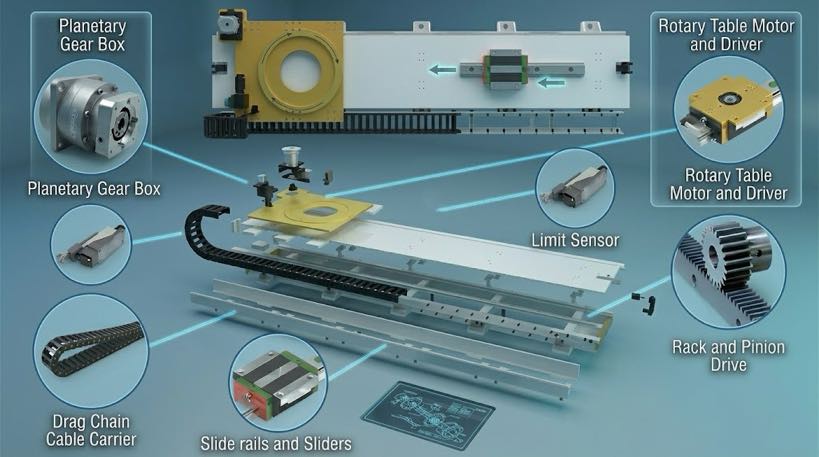
Open any welding positioner catalog and you will find the same reassuring numbers: payload in kilograms, maximum rotation speed, and a repeatability figure like ±0.05 mm. These are real, useful, and almost always measured under ideal conditions. What the brochure does not print is the set of specifications that actually determine whether your weld lands where it should — backlash, torsional stiffness, and thermal drift.
This article examines the three hidden specs that separate a positioner that holds its position from one that merely claims to. Understanding them is the difference between buying on a datasheet and buying on performance — and for synchronized robotic welding, it is the difference between a clean seam and a scrapped part.
Note: Technical claims below reflect ROBOPTIX servo positioner design practice and are cross-referenced with peer-reviewed research on positioning accuracy and gravity-driven weld-pool behavior (Park et al., 2019, Applied Sciences; Liu et al., 2023, Materials).
1. The Spec Sheet Gap
A typical positioner datasheet leads with payload, speed, and a repeatability number. Those figures answer “how big, how fast, how precise in the lab.” They do not answer “how precise under your load, after an hour of welding, when the axis reverses direction?” That is exactly where the hidden specs live.
1.1 What Datasheets Show vs. What They Hide
- Published: Payload, max speed, repeatability at a reference radius, often measured unloaded and at ambient temperature.
- Hidden: Backlash in the drive train, torsional stiffness under load, and positional drift as the servo and reducer warm up during a shift.
None of the hidden three appears on most spec sheets because each is harder to measure, less flattering to report, and highly dependent on how the positioner is actually used. Yet each directly attacks the one thing a positioner exists to provide: a joint held precisely where the program expects it.
1.2 A Buyer’s Blind Spot
The spec-sheet gap persists because catalogs are written to compare, not to qualify. A procurement spreadsheet can sort positioners by payload and price; it cannot easily sort by backlash or stiffness, because those numbers are inconsistent, method-dependent, and occasionally embarrassing. The result is a market where the most important differentiators are the least advertised. Buyers who learn to ask for the hidden specs gain an immediate edge over those who select on the printed few — often at the same budget.
2. Backlash: The Lost Motion in the Drive Train
Backlash is the clearance, or “lost motion,” between mating gear teeth in the reducer and drive components. When the axis reverses direction, the output does not move until the clearance is taken up. The positioner’s encoder may report the commanded angle, but the physical output lags by the backlash amount.
2.1 Why Backlash Ruins Welds
- Reversal error on multi-pass welds: A root pass welded clockwise and a cap pass welded counterclockwise can land on different actual positions if backlash is significant — producing a misaligned, irregular bead stack.
- Synchronized robot motion: When the positioner is a robot external axis, backlash injects a phase lag into the coordinated path. The torch and workpiece momentarily disagree about where they are, hurting seam tracking.
- Creep under load reversal: Heavy parts held near a direction-change point can drift as clearance is taken up, shifting the joint between passes.
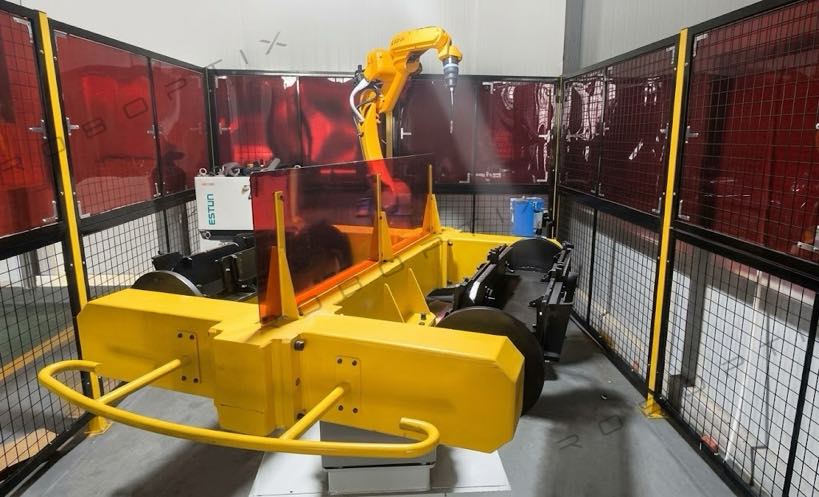
High-quality servo positioners address backlash through precision planetary or harmonic reducers with preloaded gears, and through control schemes that compensate for known clearance. The ROBOPTIX B-series servo drives pair high-resolution encoders with low-backlash reducers so that commanded and actual angles stay aligned through direction changes — critical when the same part is welded from multiple angles in one setup.
2.2 Measuring Backlash in Practice
Backlash is quantified by commanding a small bidirectional oscillation and measuring the angular dead band the output fails to follow. A well-designed servo positioner will show this band in the arc-seconds range; a loosely geared unit can exhibit several arc-minutes — hundreds of times worse. For reference, one arc-minute at a 350 mm radius equals roughly 0.10 mm of linear position error, enough to misplace a root pass relative to a cap pass. When evaluating a positioner, request the reversal test rather than trusting the headline repeatability, because repeatability is typically measured without direction changes and therefore hides the very error backlash introduces.
3. Torsional Stiffness: Holding the Load, Not Just Lifting It
Payload rating tells you how much mass a positioner can rotate. Torsional stiffness tells you how much that mass deflects the axis when welding forces, gravity, and inertia act on it. A 1,000 kg rating says nothing about whether a 1,000 kg, off-center beam will twist the output shaft a fraction of a degree under load.
3.1 Stiffness vs. Payload
Two positioners with identical payload ratings can have very different torsional stiffness. The one with a rigid, short moment arm and a stiff reducer holds the part rock-steady; the flexible one allows micro-rotation that the encoder may not fully correct in real time. Under the dynamic loads of robotic welding — especially with the torch pushing on the joint — that flex shows up as seam wander and inconsistent penetration.
Design insight: stiffness matters most for large, off-center, or cantilevered loads. A long beam mounted at one end (cantilever) stresses torsional stiffness far more than the same mass centered between head and tail stocks.
3.2 Stiffness and the Cantilever Penalty
The relationship between mass and stiffness is not linear. A load centered between head and tail stocks is supported at both ends and sees relatively little torsional demand. The same mass mounted at one end of a single-axis positioner becomes a cantilever, multiplying the torque on the output shaft by the full lever arm. This is why a positioner’s usable precision often drops sharply as the part’s center of gravity moves away from the rotation axis. Specifying a positioner purely on total payload can therefore mask a stiffness shortfall that only appears with your actual, off-center geometry — another reason to test at rated off-center load rather than trust the catalog number.
4. Thermal Drift: The Positioner That Moves While It Sits Still
Servo motors and reducers generate heat during continuous operation. As components warm, they expand microscopically, and the expansion shifts the mechanical zero. The encoder still reports the commanded angle, but the physical reference has crept. This is thermal drift — a slow, load-and-time-dependent error that no single-point repeatability test captures.
4.1 Where Drift Hurts Most
- Long single seams: A pressure-vessel shell welded in one continuous rotation can drift measurably from start to finish if the drive warms during the pass.
- Multi-shift production: A positioner running hot in the second shift may hold a different zero than the first, degrading consistency across the day.
- Tight-tolerance work: For parts with close positional callouts, even a few hundredths of a millimeter of drift breaks the spec.
Mitigation is engineering, not magic: thermal-stable reducer materials, forced cooling or temperature-compensated control, and warm-up routines that let the axis reach thermal equilibrium before critical welding. ROBOPTIX positioners incorporate temperature-aware control strategies so that drift is predicted and corrected rather than discovered in the weld.
4.2 Quantifying Drift on the Bench
Thermal drift is measured by logging the actual position of a reference mark over 30–60 minutes of continuous rotation at rated load, then recording the cumulative shift from the cold start. A positioner with poor thermal management may drift several hundredths of a millimeter — or more — across a single long pass; one with compensation holds the start and end positions essentially identical. Because this error grows with duty cycle, it is most dangerous in exactly the applications positioners are bought for: long, uninterrupted, high-duty welds. A vendor’s warm-up drift data is therefore a far better predictor of real-world accuracy than a single-point repeatability figure taken at ambient temperature.
5. Why Hidden Specs Decide Weld Quality
The connection to weld quality is direct. As the peer-reviewed record shows, weld outcomes depend heavily on holding the joint in the optimal orientation: Park et al. (2019) measured penetration of 1.8 mm in flat position versus 0.8 mm in vertical-down P-GMAW at matched heat input, and Liu et al. (2023) found a 23.8% larger weld-center grain size in flat versus vertical plasma arc welds. A positioner earns its keep by holding every joint at flat (1G). If backlash, low stiffness, or thermal drift let the part slip away from that angle — even by a fraction of a degree — the quality advantage the positioner was bought to deliver quietly evaporates.
In other words, the published repeatability is a promise about the device in isolation. Backlash, stiffness, and thermal drift are the three ways that promise is broken in your shop, under your load, on your schedule.
6. How to Evaluate Real Precision
Because the hidden specs are rarely printed, the buyer must test or ask. Practical evaluation methods:
- Loaded vs. unloaded repeatability: Request repeatability measured at rated payload and off-center, not just at the reference radius unloaded.
- Reversal (backlash) test: Command a small oscillation across a direction change and measure the dead band the output fails to follow — that is your backlash.
- Warm-up drift test: Log actual position over 30–60 minutes of continuous rotation and record how far the zero moves as the unit heats.
- Stiffness check: Apply a known off-center load and measure angular deflection; divide torque by deflection to get torsional stiffness.
A supplier who can produce these test results — or who designs explicitly for them — is worth more than one who only cites a catalog repeatability number. Ask for the bench data; if it does not exist, the hidden specs are unknown by the vendor too.
7. When Hidden Specs Matter Most
Demands honesty: not every application needs sub-arc-second precision. The hidden specs are decisive when:
- The positioner is a robot external axis requiring synchronized, phase-locked motion
- Parts are large, off-center, or cantilevered (stiffness-dominated loads)
- Welds are long, continuous, or run across multiple shifts (drift-dominated)
- The work carries tight positional or code-inspection tolerances
For occasional positioning of light, centered parts at moderate tolerance, a basic positioner is perfectly adequate — the hidden specs simply have less room to cause harm. The point is to match the spec rigor to the job, not to over-buy or under-buy blindly.
Frequently Asked Questions
Q: What is backlash in a welding positioner?
A: Backlash is the lost motion in the drive train — the clearance between gear teeth. On direction reversal, the output lags the commanded angle until that clearance is taken up. It causes misalignment on multi-pass and synchronized welds.
Q: Does payload rating tell me about stiffness?
A: No. Payload is how much mass the axis can rotate; torsional stiffness is how much that mass deflects it under load. Two positioners with the same payload can have very different stiffness, especially with off-center or cantilevered parts.
Q: Can thermal drift be corrected?
A: Yes, through engineering: thermally stable materials, cooling, warm-up routines, and temperature-compensated control that predicts and corrects drift. The key is that the supplier designs for it rather than ignoring it.
Q: How do I check a positioner’s real accuracy before buying?
A: Request loaded repeatability at rated off-center payload, a reversal (backlash) test, and a warm-up drift test over 30–60 minutes. A vendor who can show bench data for these is far more trustworthy than one citing only catalog repeatability.
The specs that sell a welding positioner are rarely the specs that decide its performance. Payload, speed, and a lab repeatability figure are necessary but insufficient; backlash, torsional stiffness, and thermal drift are the hidden variables that determine whether the part is actually held where the program believes it is. Ignore them and you inherit errors that surface only in the weld — misaligned passes, wandering seams, and drift across a long shift.
For high-precision, synchronized, or long-cycle welding, evaluating these three hidden specs is non-negotiable. Ask for loaded and warmed-up test data, understand your stiffness-dominated load, and choose a supplier whose engineering explicitly addresses backlash, stiffness, and thermal drift. ROBOPTIX servo positioners are built around low-backlash reducers, rigid structures, and temperature-aware control so that the published repeatability holds under real shop conditions — not just on the bench.
Buying on more than the brochure?
Contact ROBOPTIX for a positioner spec review against your actual load, duty cycle, and tolerance requirements.
About the Author
Experience & Credentials
Robotic welding system integration specialist with 12+ years of direct project experience focused on Robot Positioner selection and integration. Has provided consulting to 300+ factories across North America, Europe, and Asia. All specification data in this article is drawn from actual H / B / L / U series product datasheets.
Company background: 26+ years of welding automation engineering, 40+ active patents, 1,500+ completed projects globally, approximately 70% involving Robot Positioner integration.
Certifications
- ISO 9001: 2015 (GB/T 19001-2016) — Quality Management System
- GJB 9001C-2017 — Military/Weapon Equipment Quality Management System
- EU CE — Machinery Directive 2006/42/EC (Cert. No. M.2026.206.C134866)
- High-Tech Enterprise — Cert. No. GR202341000595 (Issued Nov. 2023)
Last updated: Jun 2026
References
[1] Park, J.-H., Kim, S.-H., Moon, H.-S., & Kim, M.-H. (2019). Influence of Gravity on Molten Pool Behavior and Analysis of Microstructure on Various Welding Positions in Pulsed Gas Metal Arc Welding. Applied Sciences, 9(21), 4626. https://doi.org/10.3390/app9214626
[2] Liu, J., Jiang, F., Chen, S., Xu, B., Zhang, G., Cheng, W., & Ma, X. (2023). Mechanisms of Gravitational Influence on Weld Pool Behavior and Weld Bead Performance in Variable Polarity Plasma Arc Welding across Different Welding Position. Materials, 16(19), 6457. https://doi.org/10.3390/ma16196457
RELATED POSTS
Robot Positioner Buying Guide 2026:Match Your Budget to the Right System
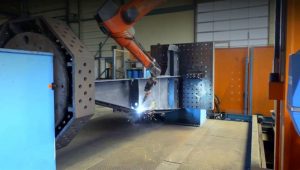
Tight Budget, Smart Choice:How Small and Mid-Size Factories Get the Most Value from a Robot Positioner in 2026

Laser Welding Positioner: Accuracy and Speed for Thin-Gauge Welds
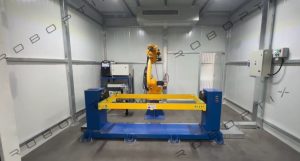
Robot Positioner Payload Calculation and Safe Selection: The Complete Engineering Guide
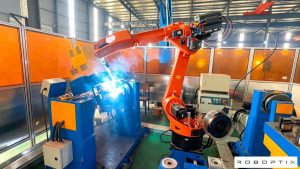
The Pre-Purchase Audit: A Factory Visit Checklist and Bench Test Protocol for Welding Positioner Buyers