Custom Robot Workstations And Laser Systems Manufacturer


5 Questions to Ask Before Buying a Robotic Welding Cell for Structural Steel
Most shops buying their first robotic welding cell ask the wrong questions first. They ask about brand, payload, and price — then discover six months later that the cell cannot handle their part mix, that programming eats every hour the robot saves, or that the positioner cannot support the weldment geometry they actually produce. The questions that determine whether a robotic welding cell succeeds or fails in structural steel fabrication are rarely on a spec sheet.
This article is for fabrication shop owners, production managers, and automation engineers evaluating a robotic welding cell purchase. The five questions below identify the failure points that vendors often do not volunteer. If you are evaluating a no-programming robotic welding cell — a system that uses 3D laser scanning and autonomous trajectory planning instead of teach pendant programming — these questions become even more critical.
Question 1: Can the Cell Handle My Part Mix — Without a Fixture for Every Part Number?
Why this question matters
A typical structural steel job shop runs 25 to 40 different part numbers per month, many in batches of 3 to 15. A traditional robotic welding cell assumes repeatable geometry: every weldment sits in a precision-machined fixture, every joint arrives within ±0.5 mm, and the robot follows a pre-taught path. This works at 5,000 identical parts per month. It breaks down at 40 different assemblies in small batches. Shops that do not ask this question end up either paying $3,000–$8,000 per part in fixture costs, or running without fixtures and watching quality drop below manual standards as part-to-part variation exceeds programmed tolerance.
What to listen for
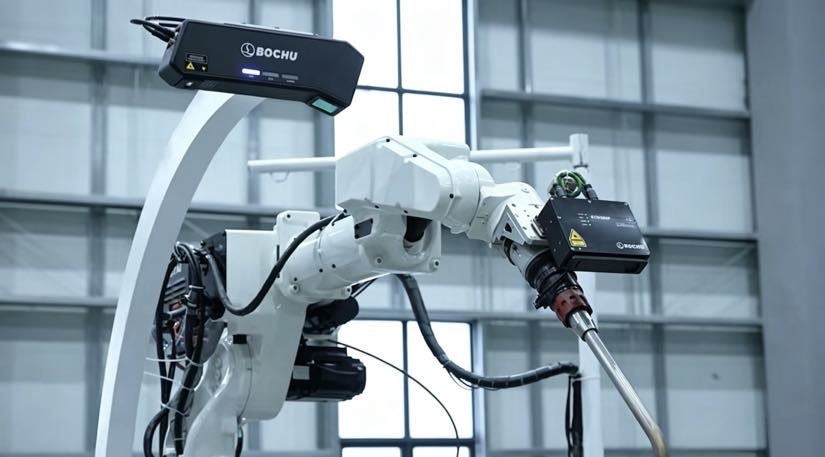
A vendor confident in structural steel will talk about adaptive fixturing and part-mix flexibility. If you are evaluating a no-programming robotic welding cell, the cell should handle mixed batches with zero fixture cost for geometry variation — the 3D scanner compensates for deviation at weld time. Ask the vendor to demonstrate a changeover between two completely different parts. Under 15 minutes is reasonable. Under 5 is excellent. Over 30 means the cell is built for repeat production, not job-shop flexibility.
| Part mix scenario | Traditional cell | No-programming cell |
| 1 part, 5,000+/month | Dedicated fixture, pre-taught path. Optimal. | Works, but scanner advantage unused |
| 8–12 parts, 200–500/month each | Fixture + program per part. High setup cost. | Modular fixturing, no programming. Strong fit. |
| 25–40 parts, batches of 3–15 | Fixture/program cost exceeds welding cost. Not viable. | Optimal use case. Scanner adapts to each part. |
| 1-of-1 custom fabrications | Programming time exceeds welding time. Not viable. | Viable if part fits cell envelope. |
If you are in the bottom two rows, a no-programming robotic welding cell is the only configuration that makes economic sense for high-mix structural steel work.
Question 2: How Does the Cell Find the Weld Joint — and What Happens When the Gap Is Wrong?
Why this question matters
Structural steel weldments do not arrive like CAD models. Plasma-cut parts have bevel variation of ±2–3°. Fit-up tolerances run ±1–3 mm. Thermal distortion opens or closes root gaps by 1–2 mm mid-weld. A robotic welding cell that trusts the drawing instead of measuring the actual joint will produce defective welds — the exact problem you bought the robot to eliminate. The cell runs perfectly on the first trial part. Then production parts arrive with a 4 mm gap instead of 2 mm, the robot deposits the same taught weld, and the result is undersized weld or burn-through.
What to listen for
Three technologies exist, and the difference matters:
• Touch sensing: Finds joint position, not gap size. Adds 2–5 seconds per joint. Insufficient for variable-gap structural steel.
• Through-arc tracking: Corrects path but not filler volume. Works for moderate fillet weld variation. Struggles with open roots and multi-pass grooves.
• 3D laser vision: Profiles gap width, root face, bevel angle, and mismatch before welding — adapts both path and parameters in real time. The only technology that handles full structural steel variation. Standard on any credible no-programming robotic welding cell.
Ask what happens when the gap measures 5 mm on a drawing that specifies 2 mm. A cell with 3D vision increases wire feed speed and slows travel to fill the volume. A cell without it either welds undersized or stops — both cost money.
Question 3: What Is the True Cycle Time — Not Just Arc-On Time?
Why this question matters
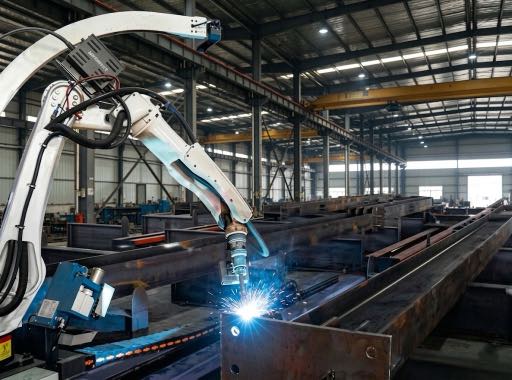
Vendors quote arc-on time because it is the most impressive number. But arc-on is typically 35–55% of total cell cycle time in structural steel. The rest is setup, loading, scanning, path generation, repositioning, and changeover. A vendor quoting 12 minutes arc-on for a part that takes 28 minutes total is not lying — but they are not telling you what you need for ROI.
What to listen for
Ask for a cycle time breakdown, not a single number:
| Cycle element | Time | Notes |
| Part load and clamp | 4–6 min | Manual or crane-assisted |
| 3D scan and path generation | 2–8 min | Proportional to joint count; 18–40 joints typical |
| Arc-on welding | 8–25 min | The number vendors quote |
| Positioner repositioning | 1–3 min | Often overlooked in quotes |
| Part unload | 3–5 min | Includes inspection |
| Total cell cycle time | 18–47 min | This drives ROI — not arc-on alone |
If the vendor cannot provide this breakdown, request a cycle time study on your representative part before purchasing. This is the most reliable vendor evaluation test.
Question 4: How Much Welding Knowledge Do I Need In-House?
Why this question matters
A robotic welding cell is not a machine tool — you cannot press start and walk away. Traditional cells need a dedicated programmer at $70K–$95K per year, a role that often did not exist before the purchase. Or shops assign their best manual welder to the cell, lose them from production, and discover that operating a robot requires a different skill set. The cell runs, but total labour cost is higher than projected.
What to listen for
| Skill requirement | Traditional programmed cell | No-programming cell |
| Robot programming | Required per part. 2–8 hrs each. Dedicated programmer needed. | Not required. Path generated from 3D scan. |
| Weld parameter tuning | Operator adjusts per joint type. Requires welding knowledge. | Auto-selected from validated weld schedule library. |
| Fixture design | Per-part fixture. 1–3 week lead time. | Modular clamping. No design lead time. |
| Daily operation | Trained operator required. | Lower training threshold. |
| Troubleshooting | Needs programmer or vendor support. | Vendor remote support typically sufficient. |
If you cannot hire a dedicated programmer, a no-programming robotic welding cell is likely the only viable path. Five-year TCO is often $250K–$475K lower than a traditional cell with equivalent hardware.
Question 5: What Does the Cell Actually Cost — Installed, Commissioned, and Running?
Why this question matters
The equipment price is the number on the quote. The installed cost determines your ROI. Installation, commissioning, fixturing, training, first-year maintenance, and site preparation all add material cost that does not appear on the equipment quote. Structural steel shops are particularly vulnerable because their parts require heavier positioners, larger cell envelopes, and more robust fume extraction.
What to ask for
| Cost item | Typical range | Why it matters |
| Equipment (robot, positioner, scanner) | $48K–$204K | Varies with payload, axes, sensor payload |
| Installation and commissioning | Site-specific | Travel, on-site engineering, acceptance testing |
| Fixturing and clamping | Modular: low | Dedicated fixtures: $3K–$8K each |
| Operator training | Included–$15K | 2–5 days on-site |
| Site preparation | Variable | Electrical, fume extraction, safety barriers |
| First-year maintenance | Included–$25K | Remote support, updates, spare parts |
| Total installed cost | Request itemised quote | This is the number for ROI — not equipment alone |
System costs range from approximately $48K for a single-station configuration to $204K for a fully-equipped large-part system with seventh-axis track and positioner. These are illustrative benchmarks; actual pricing depends on part geometry, production volume, and regional installation conditions. For a site-specific quotation, ask the vendor to include every line item.
The Pattern Behind All Five Questions
Every question asks the same thing: does this cell fit my actual production reality — not the vendor’s demo part? Part mix, joint variation, cycle time, skill base, and total installed cost determine whether a robotic welding cell succeeds or fails in structural steel. A no-programming robotic welding cell changes the answer to four of five questions in your favour: part mix handled without fixtures, joint variation measured and adapted, programming eliminated, fixture and programmer costs removed. Only cycle time remains technology-neutral — and even there, scan-and-plan is typically faster than program-and-prove for any part with more than three weld joints.
| The buying decision is not whether to automate. It is whether to automate with technology designed for high-mix structural steel reality — or with technology designed for repeat production that will be forced to adapt. Ask the five questions. The right cell answers all five honestly. The wrong cell changes the subject. |
Frequently Asked Questions
What is the difference between a robotic welding cell and a welding robot?
A welding robot is the articulated arm that moves the torch. A robotic welding cell is the complete production system: robot plus positioner, seventh-axis track, safety enclosure, fume extraction, controller, scanner, and clamping. Most structural steel applications require a full cell — a robot without a positioner cannot weld all four faces of a beam bracket without manual repositioning.
How do I know if a no-programming robotic welding cell is right for my shop?
Three indicators: you run more than 8–10 part numbers per month; more than 20% of production is in batches under 15 parts; or you cannot hire a dedicated robot programmer. If any two apply, no-programming is almost certainly the better choice. If your weldments have fit-up tolerances above ±1 mm, 3D vision seam tracking is necessary regardless of cell type.
Should I buy a single-station or dual-station cell?
Single-station is the right starting point for most first-time buyers. Dual-station makes sense when monthly volume exceeds approximately 200 parts. The throughput gain is typically 60–80%, not 100%, because the robot still repositions between stations. Run ROI on both with your actual volume.
What positioner type do I need for structural steel welding?
Long, narrow weldments (beams, columns) need a headstock-tailstock positioner rotating around the longitudinal axis. Box-shaped and irregular weldments (brackets, transformer tanks) need an L-type or three-axis positioner with tilt plus rotation. If you weld both, a three-axis positioner with 500–2,000 kg capacity covers the widest range.
How long from order to first production part?
Typically 10–18 weeks: manufacturing (6–10 weeks), shipping (1–3 weeks), site prep (2–4 weeks, overlaps), installation and commissioning (1–3 weeks). A no-programming cell reaches full productivity faster because there is no per-part programming phase — the first part uses the autonomous scan-and-plan cycle.
Next Steps
• Write down your answers to all five questions before contacting any vendor. Your part mix, joint variation, cycle time needs, skill base, and budget are your criteria — not the vendor’s spec sheet.
• Request a cycle time study on your representative part. Any credible vendor should return a detailed estimate including scan time, weld time, and changeover — not just arc-on.
• Ask for a fully-installed, itemised price. If a vendor will not break out installation, training, and support, budget them separately.
• If evaluating a no-programming robotic welding cell, ask the vendor to demonstrate a changeover between two completely different parts. The setup time determines whether the cell fits your reality.
| Related reading in this series: Blog 02 — Manual vs Robotic Welding for Structural Steel Blog 03 — No-Programming Robotic Welding Cell Blog 05 — Scan-to-Weld: How 3D Laser Scanning Replaces Robot Programming Blog 08 — ROI of a No-Programming Robotic Welding Cell |
| Talk to Our Welding Automation Engineers Tell us your part mix, joint types, and monthly volume. We will run a cycle time study on your representative part and return a detailed estimate. No commitment required. Contact Us Now → Talk to an Engineer First ✓ No commitment required ✓ Response within 24 hours ✓ Free cycle time estimate |
About the Author
Experience & Credentials
Robotic welding system integration specialist with 12+ years of direct project experience focused on Robot Positioner selection and integration. Has provided consulting to 300+ factories across North America, Europe, and Asia. All specification data in this article is drawn from actual H / B / L / U series product datasheets.
Company background: 26+ years of welding automation engineering, 40+ active patents, 1,500+ completed projects globally, approximately 70% involving Robot Positioner integration.
Certifications
- ISO 9001: 2015 (GB/T 19001-2016) — Quality Management System
- GJB 9001C-2017 — Military/Weapon Equipment Quality Management System
- EU CE — Machinery Directive 2006/42/EC (Cert. No. M.2026.206.C134866)
- High-Tech Enterprise — Cert. No. GR202341000595 (Issued Nov. 2023)
Last updated: Jun 2026
RELATED POSTS
Future Trends of Robot 7th Axis Robot in Smart Factories & Cobot Integration (2026-2030)
6 Common Challenges in Robotic Laser Welding and How to Solve Them
Robotic Welding Cell vs Manual Welding: Which Is Better for Modern Manufacturing?
Five-Year TCO of a Welding Positioner: Counting the Hidden Costs the Quote Forgot
7th Axis Robot vs Traditional Gantry: Which Is Better for Your Welding or Material Handling Line?