Custom Robot Workstations And Laser Systems Manufacturer


How to Choose the Right Robotic Welding Cell for Your Shop? Single-Station vs. Two-Station (2026 Complete Guide)
Is a Single-Station Enough? Or Should You Go Straight to Two-Station?
Under the dual pressures of welder shortages and automation upgrades, more and more small-to-medium manufacturers are considering robotic welding cells. But many face a core question at the selection stage: Is a single-station enough? Or should I go straight to a two-station?
Choose wrong, and you either waste investment with idle equipment, or fall short on capacity and need a second upgrade soon after.
This article provides a systematic selection guide based on IFR, AWS data, and experience from over 1000 actual deployment projects.
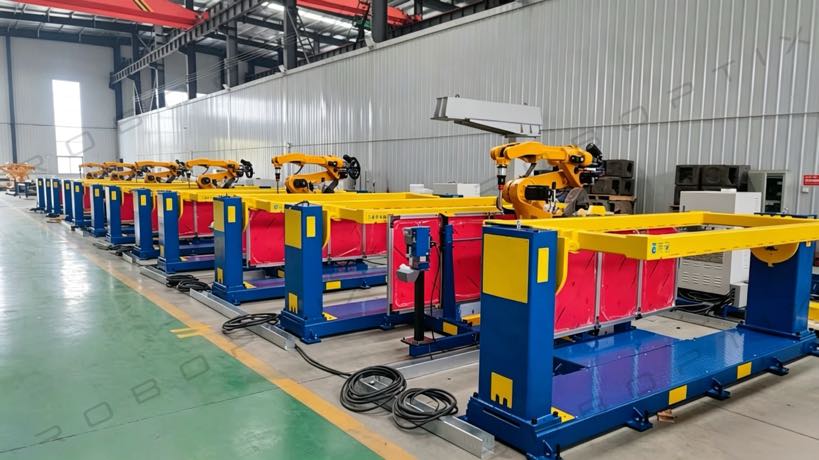
1. Single-Station vs. Two-Station: Core Comparison
| Item | Single-Station | Two-Station (Rotary Table) | Recommendation |
| Floor space | 8-12 sq m | 15-22 sq m | Single-station saves space |
| Typical investment (2026) | $130k-250k | $200k-350k | Single-station better value |
| Robot utilization | 60-75% (waiting during loading) | 85-95% (weld while loading) | Two-station significantly higher |
| Productivity gain (vs. manual) | 3-4x | 4-6x | Two-station advantage |
| Changeover flexibility | Higher | Medium | Single-station more flexible |
| Suitable production type | Large parts, low volume, high mix | Medium-high volume, short weld cycles | — |
| Payback period | 12-24 months | 10-18 months | Two-station faster |
Quick Decision Rule
–Welding cycle > 6 minutes or high-mix, low-volume → Prioritize Single Station
–Welding cycle < 3-4 minutes and stable volume → Strongly recommend Dual Station
2. Five-Point Selection Decision Framework
Based on years of delivery experience, we’ve condensed the decision process into the following five-point framework:
Point 1: Part Size and Weight
Maximum part dimensions and weight directly determine robot reach and positioner specifications.
| Part Size | Recommendation |
| < 500mm | Standard robot (1.4m reach) is sufficient |
| 500-1000mm | Long-reach robot (1.8-2.0m) or add linear track |
| > 1000mm | Single-station + track or two-station + long-reach robot |
| Weight > 500kg | Heavy-duty positioner (2+ ton capacity) |
Large structural components over 800mm typically require longer-reach single-station cells.
Point 2: Weld Cycle vs. Loading Time Ratio
This is the most critical indicator for single vs. two-station decisions.
Formula: Robot Utilization = Weld Time ÷ (Weld Time + Load Time)
| Utilization | Conclusion | Recommendation |
| > 75% | Single-station sufficient | Robot is welding most of the time |
| 65-75% | Borderline | Decide based on budget and future volume |
| < 65% | Two-station provides significant benefit | Robot waits too long — two-station adds 30-40% capacity |
Examples:
– Weld 5 min, load 2 min → Utilization 71% (borderline)
– Weld 3 min, load 2 min → Utilization 60% (strongly recommend two-station)
– Weld 10 min, load 2 min → Utilization 83% (single-station sufficient)
Point 3: Daily Output and Product Mix
| Production Pattern | Characteristics | Recommended Configuration |
| High-mix, low-volume | 10-50 part types/day, <20 each | Single-station + quick-change tooling |
| Medium-mix, medium-volume | 5-10 part types/day, 20-100 each | Either single or two-station |
| Low-mix, high-volume | 1-3 part types/day, >100 each | Two-station preferred |
For high-mix low-volume, changeover time matters more than weld time. Single-station with quick-change tooling (under 15 minutes changeover) is more practical than two-station.
Point 4: Material Type and Welding Process
Different materials and processes have different equipment requirements:
| Material | Recommended Process | Configuration Requirements |
| Carbon steel sheet (<3mm) | Standard MIG | Basic configuration sufficient |
| Carbon steel plate (3-10mm) | Pulse MIG | Pulse welding power source needed |
| Stainless steel | Pulse MIG / TIG | Pulse MIG works well; TIG for better appearance |
| Aluminum | Pulse MIG / CMT | Pulse MIG or CMT almost mandatory; push-pull wire feeder needed |
| Galvanized steel | Pulse MIG | Special parameters to reduce spatter and porosity |
Stainless steel, aluminum, or thick plates require higher-spec power sources and torches — consider these during selection.
Point 5: Future Expandability and Budget Planning
Choose modular designs that support future upgrades.
| Configuration | Expandability | Recommendation |
| Single-station (upgradable to two-station) | High | Reserve second-station interface and program space |
| Single-station (non-upgradable) | Low | Only for very low budgets with no future expansion |
| Two-station | Medium | Can further add automated loading/unloading |
Budget Allocation Recommendations:
– Equipment purchase: 70-80%
– Tooling fixtures: 5-10% ($3,000-8,000 per set)
– Installation & commissioning: 5-8% ($5,000-15,000)
– Operator training: 3-5% ($3,000-8,000)
– Contingency reserve: 15-20% (fixture iterations, process tuning, unexpected costs)
3. 2026 Real Cost Comparison: Single-Station vs. Two-Station
| Configuration | Price Range (USD) | Includes |
| Standard single-station | $130k-220k | Robot, power source, basic positioner, safety system |
| High-end single-station | $200k-250k | Standard + seam tracking + offline programming |
| Standard two-station (rotary) | $200k-280k | Rotary table, two positioners, robot, power source |
| High-end two-station | $280k-350k+ | Standard + vision system + data collection + safety PLC |
Hidden Cost Reminders
– Tooling fixtures: $3,000-8,000 per set (typically 2-4 sets needed)
– Installation & commissioning: $5,000-15,000
– Operator training: $3,000-8,000
– Fume extraction: $2,000-5,500
– Electrical & air line upgrades: $1,000-3,000
4. Practical Selection Recommendations (by Business Type)
Small-to-Medium Enterprises (First-Time Automation)
Recommended: Standard single-station
Reasons:
– Lower investment risk ($130k-220k)
– Quick results, simple operation
– Can validate automation before expanding
Configuration suggestion: 10kg robot + standard MIG power source + single-axis positioner + basic safety fencing
Mid-Sized Factories with Some Automati
Recommended: Based on weld cycle
– Weld cycle < 4 minutes → Two-station
– Weld cycle > 6 minutes → Single-station
– Borderline → Single-station with upgrade-ready interface
Configuration suggestion: Imported brand robot + pulse MIG power source + dual-axis servo positioner + offline programming
High-Mix Low-Volume Shops
Recommended: Single-station + modular quick-change tooling system
Reasons:
– Changeover time reduced from 45 minutes to 7-9 minutes
– Lower investment than two-station
– Higher flexibility
Configuration suggestion: Standard robot + quick-change tooling (dowel pins + pneumatic clamps) + offline programming
Space-Constrained Factories
Recommended: Compact single-station
Reasons:
– Only 8-12 sq m footprint
– Mobile design possible
– No complex civil construction needed
Configuration suggestion: 6kg collaborative robot or compact industrial robot + integrated controller cabinet + mobile base
5. Frequently Asked Questions (FAQ)
Q1: Is a single-station robotic welding cell really sufficient?**
Yes. For longer weld cycles (>6 minutes) or high product mix scenarios, single-station is often the most cost-effective choice. While the robot is welding, operators have ample time for loading/unloading.
Q2: Is two-station always better than single-station?**
Not necessarily. Two-station provides maximum value only when robot waiting time is excessive. If welding already accounts for >75% of total cycle time, two-station’s marginal benefit is limited.
Q3: How long is the typical payback period?**
– Single-station: typically 12-24 months
– Two-station: typically 10-18 months
Actual payback depends on productivity gains, labor savings, and utilization.
Q4: How much floor space is needed?**
– Standard single-station: ~10 sq m (including safety clearance)
– Standard two-station: ~18 sq m (including safety clearance)
Q5: Can I buy a single-station now and upgrade to two-station later?**
Yes. Choose a modular system that reserves second-station interfaces, I/O points, and program space. You can add a rotary table and fixtures later, but retrofit costs are typically 15-25% higher than buying two-station upfront.
6. Summary: How to Make Your Final Decision?
Follow this five-step process:
1. Calculate your weld cycle and load time to determine utilization range
2. Apply the five-point selection framework for comprehensive assessment
3. Provide your part drawings and production data to 2-3 professional integrators
4. Request quotes specific to your parts comparing configurations and pricing
5. Choose a partner with proven delivery experience, comprehensive training, and after-sales support
One core principle to remember: More expensive isn’t better — the right fit is better.
Recommendations for Action
If you are selecting a robotic welding cell for your shop, share the following information for preliminary recommendations:
1. Main product type (steel structure, machinery parts, metal furniture, etc.)
2. Maximum part dimensions (L×W×H) and weight
3. Typical weld cycle (minutes/part) and daily output
4. Biggest current pain point (labor shortage, low efficiency, quality instability)
Related Reading
– What Is a Robotic Welding Cell? A Beginner’s Guide
– 2026 Robotic Welding Cell Cost and ROI Analysis
– 10 Key Benefits of Implementing a Robotic Welding Cell in Your Shop
Author Identification
This article is based on the International Federation of Robotics (IFR) World Robotics Report 2025, American Welding Society (AWS) workforce data, and major manufacturer technology roadmaps.
Author:
An expert in robotic welding system integration with over 12 years of industry experience. My company has over 26 years of professional experience, holds more than 40 patented technologies, and has successfully completed over 1,500 projects worldwide (approximately 70% of which involved robotic welding cells, totaling more than 1,000 units). The company holds EU CE certification (Certificate No.: M.2026.206.C134866) and complies with the EN 60204-1:2018 and EN ISO 12100:2010 standards. I have assisted numerous manufacturing companies throughout the entire process of robotic welding workstation implementation, from selection to production launch.
Updated: May 2026
RELATED POSTS
The Pre-Purchase Audit: A Factory Visit Checklist and Bench Test Protocol for Welding Positioner Buyers
How a Welding Positioner Controls Gravity: The Physics of Puddle Stability and Weld Quality
7th Axis Robot Track System Maintenance & Troubleshooting Guide
How to Choose the Right Robotic Laser Welding System for Your Factory
2026 Robot Positioner Buyer’s Guide: All 5 Types Compared — Head-and-Tailstock, L-Type, U-Type, and More