Custom Robot Workstations And Laser Systems Manufacturer


7th Axis Robot + Robotic Positioners: Building Complete Flexible Welding Cells
“A 7th axis robot alone is powerful. Add robotic positioners, and you have a flexible welding cell that can handle complex parts, multiple weldments, and high-volume production — all with minimal operator intervention.”
This is the core insight behind modern automated welding. The combination of a 7th axis robot and robotic positioners creates a flexible welding cell that maximizes arc-on time, reduces cycle time, and adapts to changing production demands.
In this guide, I will show you:
- Why 7th axis with positioner is superior to standalone solutions
- How to design a flexible welding cell for your specific parts
- Real-world 7th axis robot + positioner integration examples
- Our proven integration capabilities
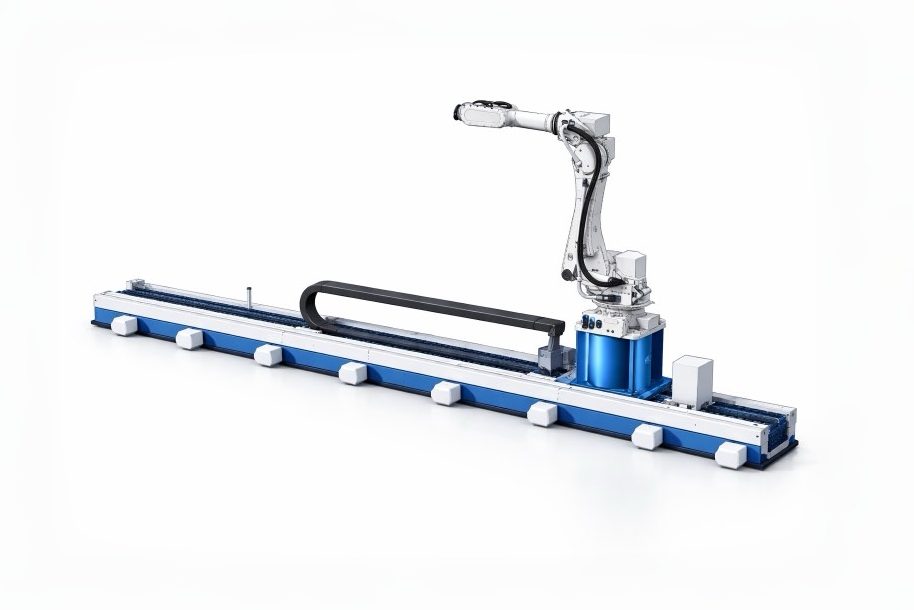
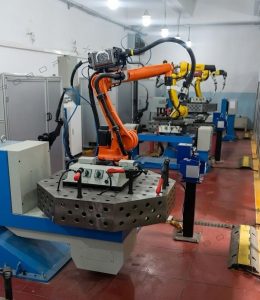
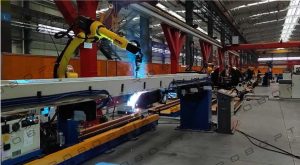
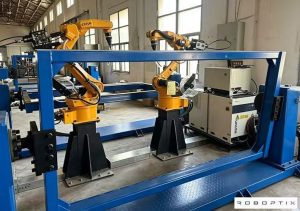
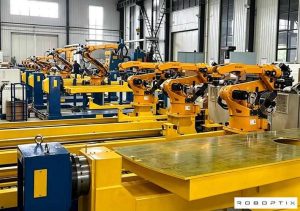
(The ground tracks shown in the image do not include the robotic arm)
Part 1: The Power of Combining 7th Axis Robot with Robotic Positioners
Why 7th axis + positioner is better than either alone:
| Capability | Standalone 7th Axis Robot | Standalone Positioner | 7th Axis + Positioner |
| Reach large parts | ✓ | ✗ | ✓✓ |
| Access all weld seams | Partial | Limited | Complete |
| Weld in optimal position | ✗ | ✓ | ✓✓ |
| Multiple stations | ✓ | ✗ | ✓✓ |
| Reduce repositioning | ✓ | ✓ | Minimum |
| Arc-on time | 60-70% | 50-60% | 85-90% |
| Part changeover flexibility | Limited | Limited | High |
The key advantages of a flexible welding cell with 7th axis and positioner:
1. Optimal weld position for every seam
A robotic positioner rotates the workpiece to the ideal welding position (flat, horizontal, or vertical down). Combined with a 7th axis robot that travels along the part, every seam can be welded in the optimal orientation.
2. Continuous welding without stops
The 7th axis robot can weld on one positioner while the operator unloads/loads another. No waiting. No downtime.
3. Complex part coverage
Large, awkward parts that require welding from multiple sides are easily handled when a 7th axis with positioner works together.
4. Flexible mix-model production
Switch between different part types without mechanical changeover. Program the 7th axis robot and positioner for each part.
5. Higher throughput
By keeping the 7th axis robot welding while the operator tenders parts, output increases by 50-100%.
Part 2: Typical Flexible Welding Cell Layouts
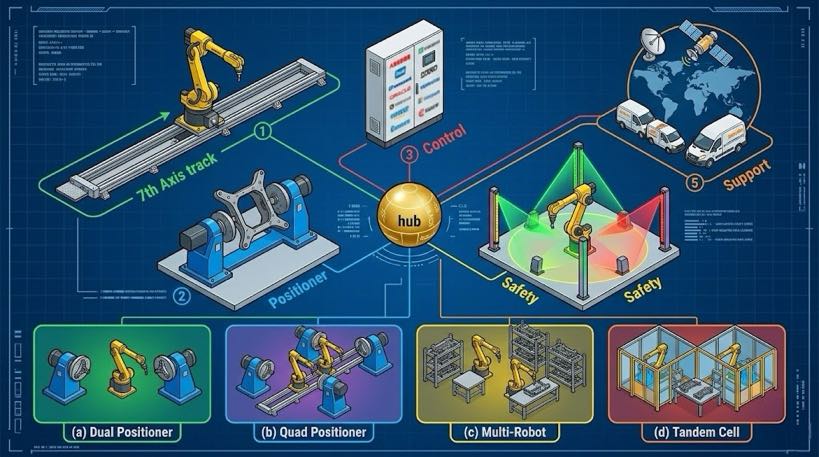
Layout 1: Single 7th Axis Robot + Dual Positioners (Most Common)
This is the most popular flexible welding cell configuration for medium to high production volumes.
Configuration:
- One 7th axis robot(10-30m travel)
- Two robotic positioners(500-3,000kg capacity each)
- One operator station between positioners
How it works:
- 7th axis robot welds on Positioner A
- Operator unloads finished part from Positioner B
- Operator loads new part onto Positioner B
- 7th axis robot finishes weld on A, slides to B
- Operator unloads/loads Positioner A
- Cycle repeats
Results:
- Arc-on time:85-90%
- Operator utilization:100%(no waiting)
- Typical ROI:8-12 months
Layout 2: Single 7th Axis Robot + Four Positioners (High Volume)
For high-volume production of smaller parts that require shorter weld times.
Configuration:
- One 7th axis robot(15-30m travel)
- Four robotic positioners arranged in line
- One operator station at each end
How it works:
- 7th axis robot rotates between 4 positioners
- Two operators load/unload continuously
- 7th axis robot welds non-stop
Results:
- Arc-on time:90-95%
- Output:3-4x standalone robot
- Typical ROI:6-10 months
Layout 3: Multiple 7th Axis Robots + Multiple Positioners (Large Parts)
For very large parts (wind towers, ship sections, heavy equipment).
Configuration:
- Two 7th axis robots on same or parallel tracks
- Two or more robotic positioners
- Collaborative welding on single large part
How it works:
- Two 7th axis robots weld simultaneously on opposite sides
- Positioners rotate part for access
- Coordinated motion between robots
Results:
- Cycle time:50-60%reduction
- Weld consistency:Perfect
- Typical ROI:12-18 months
Part 3: Key Integration Considerations for 7th Axis with Positioner
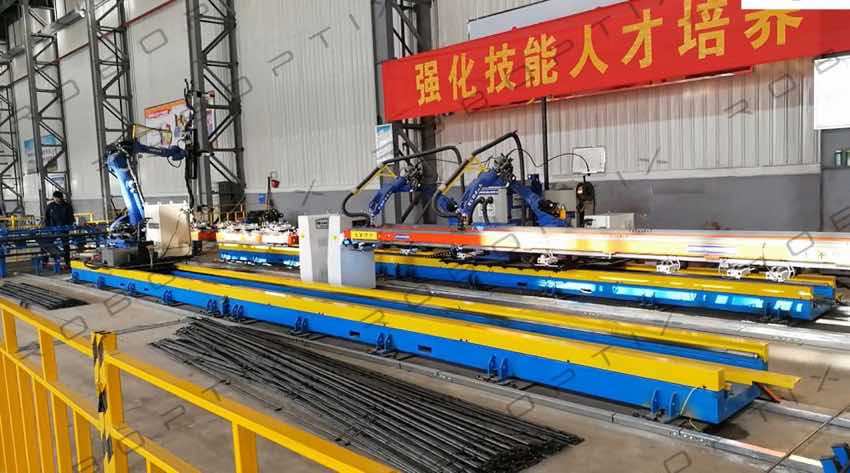
1. Synchronization and coordination
The 7th axis robot and robotic positioner must move in a coordinated manner. This requires:
- Single controller architecture (robot controls both)
- Or synchronized multi-controller with real-time communication
- Collision detection and avoidance programming
2. Work envelope planning
Map the combined motion of 7th axis with positioner:
- Calculate total reachable area
- Identify potential collisions
- Plan safe zones for operators
- Verify coverage of all weld seams
3. Part changeover strategy
Design for flexible welding cell operation:
- Quick-change tooling on positioners
- Pre-programmed recipes for each part type
- Barcode or RFID part identification
- Automatic program selection
4. Safety integration
A flexible welding cell with 7th axis and positioner requires:
- Light curtains or area scanners for operator access
- Interlocked safety gates
- E-stops accessible from multiple points
- Safe torque off (STO) on all axes
5. Cable management
Moving cables for 7th axis robot + positioner:
- Robot cables through drag chain on track
- Positioner cables through slip rings or cable guides
- Strain relief at all connection points
- Spare conductors for future expansion
Part 4: Real-World 7th Axis Robot + Positioner Integration Cases
Case 1: Heavy Equipment — Excavator Arm Welding Cell
The challenge:
Customer needed to weld 12-meter excavator arms (2,200kg) with multiple seams on all sides. Manual repositioning took 30 minutes per arm.
The solution:
- D003 heavy-duty 7th axis robot(15m travel)
- Two 10-ton robotic positioners with synchronized rotation
- Single Fanuc controller managing 7th axis + positioners
The results:
| Metric | Before | After | Improvement |
| Arc-on time | 34% | 88% | +54% |
| Daily output | 16 arms | 42 arms | +162% |
| Repositioning time | 30 min/arm | 0 min | -100% |
| Payback | — | 11 months | — |
Customer quote:
“The 7th axis with positioner combination changed everything. Our flexible welding cell runs continuously while operators load parts. We doubled output without adding people.” — Welding Manager
Case 2: Automotive Supplier — Subframe Welding Cell
The challenge:
Manufacturer needed to weld 8 different subframe variants. Changeover between variants took 2 hours with manual fixtures.
The solution:
- D002 7th axis robot(12m travel)
- Four headstock/tailstock positioners with quick-change tooling
- Recipe-based programming for all 8 variants
The results:
| Metric | Before | After | Improvement |
| Changeover time | 2 hours | 5 minutes | -96% |
| Daily output | 80 parts | 210 parts | +162% |
| Defect rate | 5% | <0.5% | -90% |
| Payback | — | 9 months | — |
Customer quote:
“The flexible welding cell with 7th axis and positioners allows us to run any of our 8 subframes with 5-minute changeover. This is the future of manufacturing.” — Plant Manager
Case 3: Wind Tower — Flange Welding Cell
The challenge:
Wind tower sections up to 30 meters long required flange welding at both ends. Manual welding was slow and inconsistent.
The solution:
- D003 heavy-duty 7th axis robot(32m travel)
- Two heavy-duty positioners(25-ton capacity each)
- Coordinated motion between 7th axis robot and positioners
The results:
| Metric | Before | After | Improvement |
| Welding time per flange | 3 hours (manual) | 1.5 hours | -50% |
| Daily throughput | 1 tower | 2.5 towers | +150% |
| Reject rate | 8% | <1% | -87% |
| Payback | — | 10 months | — |
Customer quote:
“The 7th axis robot + positioner combination let us weld both ends of a 30-meter tower section without repositioning the part. That was impossible before.” — Plant Director
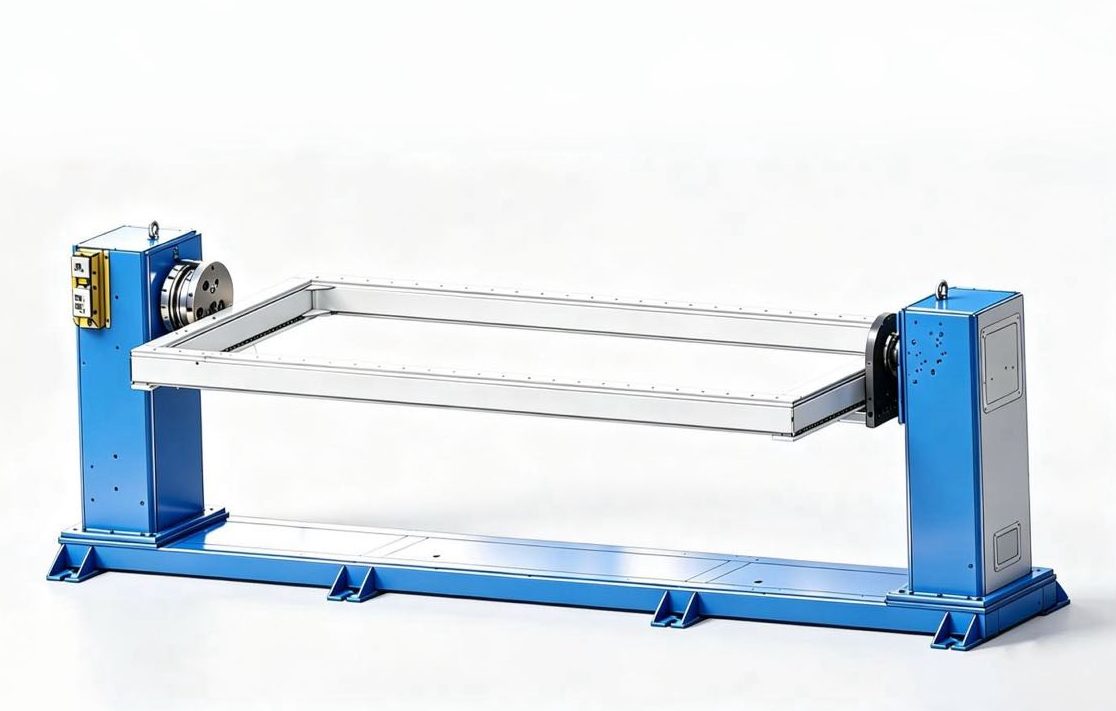
Part 5: Our 7th Axis + Positioner Integration Capabilities
With 1,500+ global projects, we have integrated every combination of 7th axis robot and positioner on the market.
Our standard integration offerings:
| Component | Our Capability |
| 7th axis robots | D001, D002, D003 (500-3,000kg payload) |
| Robotic positioners | Headstock/tailstock, L-type, H-type, turntable |
| Controller integration | Fanuc, ABB, KUKA, Yaskawa, Siemens |
| Communication protocols | EtherCAT, Profinet, DeviceNet, Ethernet/IP |
| Positioner capacity | 500kg to 30,000kg |
| Number of positioners per 7th axis | 2 to 8 stations |
| Number of 7th axis robots per cell | 1 to 4 |
What makes our flexible welding cell integration different:
1. Single-point responsibility
We supply and integrate the 7th axis robot,positioners, controller, safety system, and tooling. One contract. One project manager. One warranty.
2. Pre-engineered solutions
We have standard designs for common flexible welding cell configurations:
- Dual positioner cell(most popular)
- Quad positioner cell(high volume)
- Multi-robot cell(large parts)
- Tandem cell(long parts)
3. Offline programming and simulation
Before any steel is cut, we simulate your entire flexible welding cell:
- Cycle time verification
- Collision detection
- Reach studies
- Operator ergonomics
4. On-site commissioning and training
Our certified technicians:
- Install and align all equipment
- Configure 7th axis with positioner synchronization
- Train your operators and maintenance team
- Provide complete documentation
5. Global support network
With projects in 30+ countries, we provide:
- Remote diagnostics
- Spare parts warehouse
- Local service partners
- 24/7 technical support
Part 6: ROI Analysis for 7th Axis + Positioner Flexible Welding Cell
Typical investment range for a flexible welding cell:
| Component | Cost Range |
| 7th axis robot(D002 or D003) | $35,000 – $70,000 |
| Two robotic positioners(1-3 ton) | $40,000 – $80,000 |
| Controller and integration | $15,000 – $30,000 |
| Safety system | $8,000 – $15,000 |
| Installation and training | $10,000 – $20,000 |
| Total investment | $108,000 – $215,000 |
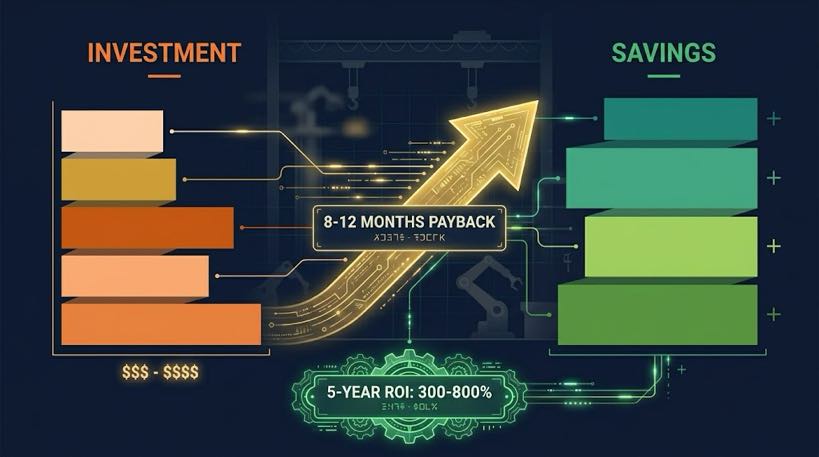
Annual savings from a flexible welding cell:
| Savings Source | Annual Savings |
| Labor reduction (1-2 operators) | $40,000 – $100,000 |
| Productivity increase (50-100%) | $50,000 – $150,000 |
| Reduced rework (50-90% defect reduction) | $10,000 – $50,000 |
| Changeover time savings | $5,000 – $20,000 |
| Total annual savings | $105,000 – $320,000 |
Quick ROI calculation:
Payback period = Total investment ÷ Annual savings
- Low end: $108,000 ÷ $105,000 =12 months
- High end: $215,000 ÷ $320,000 =8 months
- Typical payback: 8-12 months
5-Year ROI:
- Total savings over 5 years: $525,000 – $1,600,000
- Net profit after investment: $400,000 – $1,400,000
- 5-Year ROI: 300-800%
Take Action Now
You have seen how a flexible welding cell with 7th axis robot and robotic positioners can transform your welding production — higher arc-on time, lower labor costs, faster changeovers, and proven ROI.
Is your operation ready for a 7th axis + positioner flexible welding cell?
We will provide:
- Layout drawing for your specific floor space
- Cycle time simulation for your parts
- Equipment recommendation (7th axis model + positioner capacity)
- Detailed ROI analysis
- Turnkey integration proposal
Coming Next in Part 9
Title:Maintenance & Troubleshooting Guide for Robot 7th Axis Track Systems
In Part 9, we will cover:
- Daily, weekly, monthly, and annual maintenance checklists
- Troubleshooting common 7th axis robot issues
- Spare parts management
- Extending track life beyond 10 years
Technical Summary: Flexible Welding Cell with 7th Axis + Positioner
| Feature | Benefit |
| 85-90% arc-on time | Maximum welding productivity |
| 100% operator utilization | No waiting time |
| 5-minute changeover | Flexible mix-model production |
| 8-12 month payback | Fast ROI |
| Single controller | Simplified programming and operation |
| Collision detection | Safe, reliable operation |
| Offline simulation | Risk-free design verification |
| Turnkey integration | One supplier, one responsibility |
References & System Integration Standards
- Multi-Axis Kinematics & Coordinated Control:
- FANUC B-83284EN-1 Manual:Core reference for managing secondary and tertiary motion groups, defining synchronized interpolation profiles for the D-Series tracks and auxiliary positioners.
- IEEE Automation Science (2025):Empirical research validating the 85%-90% arc-on time efficiency threshold achieved via automated dual-station linear rail cross-talk.
- Functional Safety & Operator Separation:
- EN ISO 10218-2:2011:Safety requirements for industrial robot system integration. This protocol governs our multi-station safe zoning, light curtain blanking, and dual-channel safety PLC handshakes.
- ANSI/RIA R15.06-2014:American National Standard defining Safe Torque Off (STO) and Safety-Rated Reduced Speed (SLS) parameterizations inside flexible welding cells.
- Digital Twin & Simulation Metrology:
- ABB 3HAC0509-02 Documentation:Engineering standard utilized for collision matrix calculation, reach analysis, and offline kinematic recipe programming within RobotStudio/WorkVisual environments.
- ISO 17572-3:2020:Dynamic spatial positioning and baseline testing protocols for linear tracking slides working in tandem with rotatable tables.
- Electrical Safety & Electromagnetic Compatibility:
- EN 60204-1:2018:Electrical safety guidelines for interconnected automated systems, ensuring earth-ground loop prevention under high-current robotic arc welding conditions
- EN IEC 61000-6-4:2019:Industrial EMC compliance matrix safeguarding signal integrity across EtherCAT/Profinet backbones during active high-frequency TIG/MIG arcs.
- European Union CE Compliance Database: Verified and registered under official turnkey Certificate No. M.2026.206.C134866.
- Statistical Field Evidence:Global validation datasets derived from 26 years of industrial execution, 40+ independent patents, and the successful deployment of 1,500+ operational turnkey automation workcells as of May 2026.
Author Identification
I am a robotic welding system integration expert with 12+ years of industry experience specializing in 7th axis robot and robotic positioner integration. My company has 26+ years of professional expertise, holds 40+ patents, and has successfully completed 1,500+ global projects(of which approximately 70% integrate 7th axis robots with positioners into welding cells). We hold EU CE certification(Certificate No.: M.2026.206.C134866) for our 7th axis robot and positioner systems.
Updated: May 2026
RELATED POSTS
Welding Positioner Buying Checklist: 6 Inputs for an Accurate RFQ
2026 Robot Positioner Buyer’s Guide: All 5 Types Compared — Head-and-Tailstock, L-Type, U-Type, and More
7th Axis Robot vs Traditional Gantry: Which Is Better for Your Welding or Material Handling Line?
Coordinated Welding Cell: Positioner and Robot as One Kinematic Chain
Welding Positioner Types Compared: Headstock, L-Type, U-Type, 3-Axis & More