


Производител на работни станции за роботи и лазерни системи по поръчка



Роботизирано лазерно заваряване: Принципи, Предимства, и Приложения (2026 Пълно ръководство)
Introduction
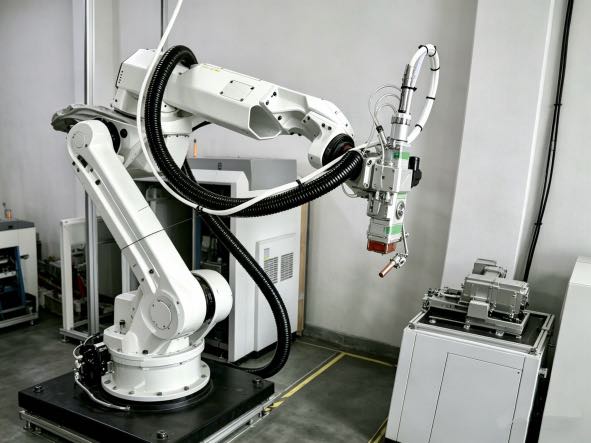
Robotic laser welding has become the most competitive automated welding process in modern manufacturing. Той съчетава лазерни лъчи с висока енергийна плътност с многоосни индустриални роботи за постигане на висока скорост, високо прецизен, non-contact welding of metal components.
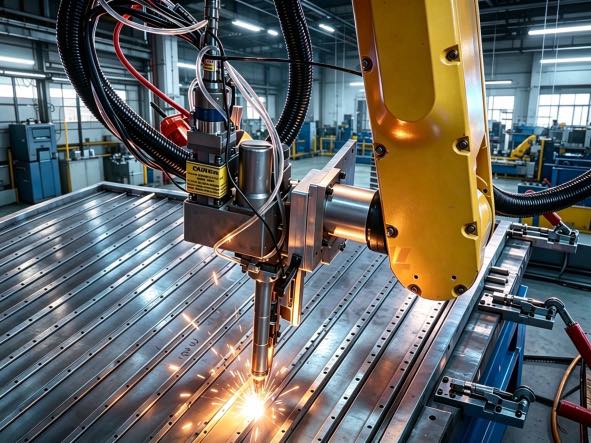
Според Global Market Insights, the global robotic laser welding market exceeded $1.7 billion in 2025, is projected to reach $1.9 billion in 2026, and is expected to approach $4 милиард от 2035, with a compound annual growth rate (CAGR) of approximately 8.9%. New energy vehicles, power batteries, and precision manufacturing primarily drive this growth.
Whether you are in the automotive, power battery, медицинско изделие, or consumer electronics industry, understanding its principles, advantages, and limitations is key to evaluating its investment value.
Източници на данни: This article is based on the latest technical documentation from suppliers such as IPG Photonics, TRUMPF, and Fanuc, as well as on-site feedback from multiple Tier 1 suppliers and battery manufacturers. All data is publicly verifiable.
Working Principle
The core of robotic laser welding lies in highly efficient energy conversion: electrical energy is converted into a laser beam, which is then focused onto the metal surface to instantly melt and solidify it, forming a weld. The process is non-contact and results in a minimal heat-affected zone.
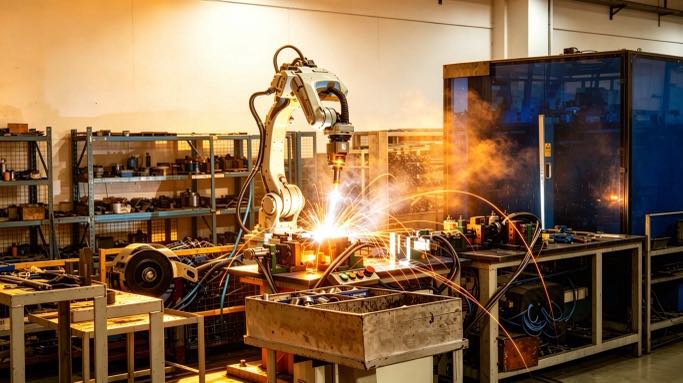
The welding process consists of four steps:
1. Laser Generation: Fiber lasers are the mainstream choice, operating at a wavelength of approximately 1070 nm and power ranging from 500 W to over 6 kW. Райкъс、MAX Photonics fiber lasers achieve an electro-optical conversion efficiency of over 40%, with the ECO series exceeding 35%, far surpassing traditional CO₂ lasers (приблизително 10%). They are energy-efficient and stable.
2. Beam Transmission: The laser is transmitted through a 50-200 μm fiber optic cable to the robotic welding head, with virtually no energy loss and no impact from joint movement.
3. Focusing and Positioning: The welding head focuses the beam into a 0.2–0.8 mm spot with an energy density as high as 10⁶–10⁷ W/cm², capable of melting metal in milliseconds. 6-axis robots achieve repeatability of ±0.05 mm (Fanuc, ПЛАЧЕ, ABB, и т.н.).
4. Melt Pool Formation and Solidification: The laser creates a “keyhole” effect, generating a vapor channel within the metal surrounded by a liquid melt pool. Heating and cooling rates are extremely fast (10³–10⁶ °C/s), with a heat-affected zone of only 0.1–1 mm.
Technical Highlights: Supports self-fusion welding without the need for filler wire, eliminating the risk of material composition inconsistencies.
Core Components and Configuration Options
Industrial-grade systems consist of five core modules:
| Компонент | функция | Typical Specifications | Selection Criteria |
| Laser | Generates laser energy | Fiber laser, 1–6 kW+ | Select power based on material thickness and speed |
| Industrial Robot | Executes motion paths | 6-ос, payload 10–50 kg | Covers the total weight of the welding head and cables |
| Laser Welding Head | Focuses the beam | Collimating lens 100/150 мм, focusing lens 150–300 mm | Long focal length suitable for deep cavities; short focal length suitable for high speeds |
| Система за контрол | Coordinates movements | PLC + Dedicated software | Supports real-time power modulation |
| Safety Protection(Optional) | Laser protection | Class 4 защитно заграждение + Interlocks | Complies with IEC 60825-1 стандартен |
Optional high-end configurations: Vision-based weld seam tracking (±0,1 мм), OCT online penetration depth monitoring, and oscillating welding head (to reduce gap sensitivity).
Key Application Scenarios and Case Studies
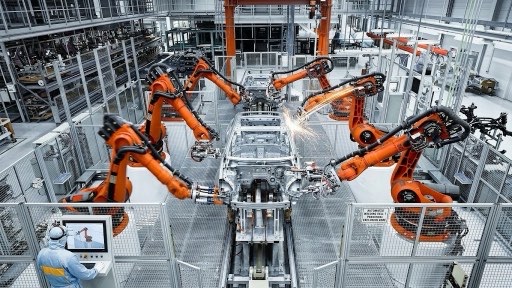
1. Automotive Manufacturing: White body side panels, doors, B-pillars, и т.н. Materials include galvanized steel, горещо формована борна стомана, and 6000-series aluminum. A European luxury automaker has deployed multiple systems on its electric vehicle platform, achieving a welding speed of 90 mm/s and an annual production capacity exceeding 100,000 единици.
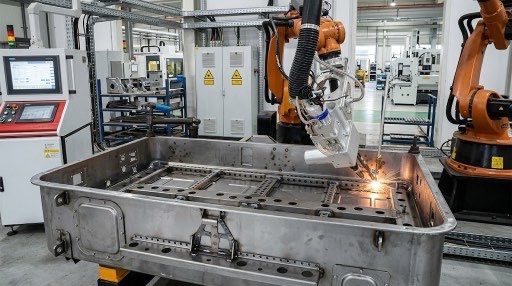
2. Power Batteries: Busbars, tabs, and pressure relief valves. Materials include red copper, алуминий, and copper-aluminum dissimilar metals. A leading battery manufacturer has deployed over 200 системи, with a single-line capacity of 200 ppm and a defect rate below 0.3%.
3. Медицински изделия: Pacemaker housings, surgical instruments. Materials include Ti6Al4V and 316L stainless steel. Welds are contamination-free, rework rates have dropped from 4.2% към 0.6%, and the process is ISO 13485 certified.
4. Consumer Electronics: Smartphone mid-frames, headphone contacts. Weld width: 0.3 мм; aesthetically pleasing with a small heat-affected zone, allowing for anodizing without grinding.
Clarification of Common Misconceptions
Q1: Is robotic laser welding limited to thin sheets?
Q2: Does robotic laser welding have to be performed in a dust-free environment (cleanroom)?
Q3: Robotic laser welding equipment is extremely expensive—can small factories afford it?
Q4: Is robotic laser welding very complex to operate, requiring professional welding engineers?
Q5: Does laser welding require any shielding gas?
ЧЗВ
Q1: How fast is the welding speed? Typical data: 1 mm stainless steel at 80–120 mm/s (1 kW); 2 mm aluminum alloy: 40–60 mm/s (2 kW); 0.3 mm copper foil: 150–200 mm/s (pulsed mode). Actual speeds require optimization based on material and power.
Q2: What is the approximate initial investment? An entry-level complete system (1 kW laser + small 6-axis robot + welding head + защитно заграждение) costs approximately $30,000–$80,000.
Q3: Is it difficult to learn? Operator training typically takes 1–2 weeks and covers offline programming, laser safety, and parameter adjustment. Basic knowledge of metals is sufficient; no background as a professional welding engineer is required.
Q4: Is the weld strength lower than that of MIG welding? The strength of self-fusion laser welds typically reaches 90%–100% of the base material. When there is a gap, strength can be enhanced through oscillating welding or wire-fed laser welding.
Q5: Which safety standards are met? These primarily include IEC 60825-1 (Safety of laser products) и ISO 11553 (Safety of laser processing machines). The equipment must be equipped with a Class 4 защитно заграждение, interlock switches, and emergency stop devices.
Референции
IPG Photonics Fiber Laser Welding Guide
TRUMPF Automotive Laser Welding
Global Market Insights Robotics Laser Welding Report
IEC 60825-1:2014
Disclaimer: The information in this article is for reference only; actual results require verification through sample testing.
Идентификация на автора
Тази статия е базирана на Международната федерация по роботика (IFR) Световен доклад за роботиката 2025, Американско дружество по заваряване (AWS) данни за работната сила, и технологични пътни карти на основните производители.
Автор:
Експерт в интегрирането на роботизирана система за заваряване с над 12 години опит в индустрията. Компанията ми приключи 26 години професионален опит, съдържа повече от 40 патентовани технологии, и приключи успешно 1,500 проекти по целия свят (приблизително 70% от които са включени роботизирани клетки за заваряване, общо повече от 1,000 единици). Фирмата притежава ЕС CE сертификат (Сертификат №: M.2026.206.C134866) и отговаря на EN 60204-1:2018 и EN ISO 12100:2010 стандарти. Помагал съм на множество производствени компании по време на целия процес на внедряване на роботизирана работна станция за заваряване, от избора до стартирането на производството.
Актуализиран: май 2026
СВЪРЗАНИ ПУБЛИКАЦИИ
Как да изберете правилната роботизирана заваръчна клетка за вашия магазин? Единична станция срещу. Две станции (2026 Пълно ръководство)
2026 Ръководство за купувача на робот-позиционер: Всички 5 Сравнени типове — предна и задна част, L-тип, U-тип, и още
Автоматизация на заваряване на трансформаторни резервоари:Решаване на предизвикателството на големия, Неповтарящи се части
Тенденции в роботизирана заваръчна клетка 2026–2030 г: AI, Машинно зрение & Бъдещето на автоматизацията на заваряването
6 Често срещани предизвикателства при роботизираното лазерно заваряване и как да ги разрешим
