


Stasiun Kerja Robot Khusus Dan Produsen Sistem Laser



Lintasan Lantai vs Robot Sumbu 7 di Atas Kepala: Instalasi, Keamanan & Panduan Seleksi
“Haruskah saya memasang robot sumbu 7 saya di lantai atau dari langit-langit?”
This is one of the most common questions we hear after customers decide to add a7robot sumbu ke-th. Both options have their place. Tapi salah pilih, and you could face safety issues, difficult maintenance, or wasted floor space.
Let me help you make the right choice based on your specific application.
Bagian 1: Quick Comparison — Floor Track vs. Overhead 7th Axis
| Dimensi | Floor Track | Overhead Track |
| Instalasi | Bolt to concrete floor | Mount to ceiling steel structure |
| Floor Space | Requires ~0.8-1.2m width | Zero floor footprint |
| Load Capacity | Up to 5,000kg (D003: 3,000kg) | Limited to 500-1,500kg |
| Waktu Instalasi | 2-5 hari | 1-3 minggu (requires structural work) |
| Maintenance Access | Easy — ground level | Difficult — requires lift or scaffolding |
| Risiko Keamanan | Low — operator isolation | High — falling parts, overhead loads |
| Aplikasi yang Cocok | Pengelasan, penanganan yang berat, multi-station | Light assembly, clean rooms, space-constrained |
| Structural Requirements | Standard concrete floor | Reinforced ceiling structure |
| Robot Compatibility | All sizes | Small to medium only |
| Biaya | $30,000 – $60,000 | $40,000 – $80,000+ (plus structural work) |
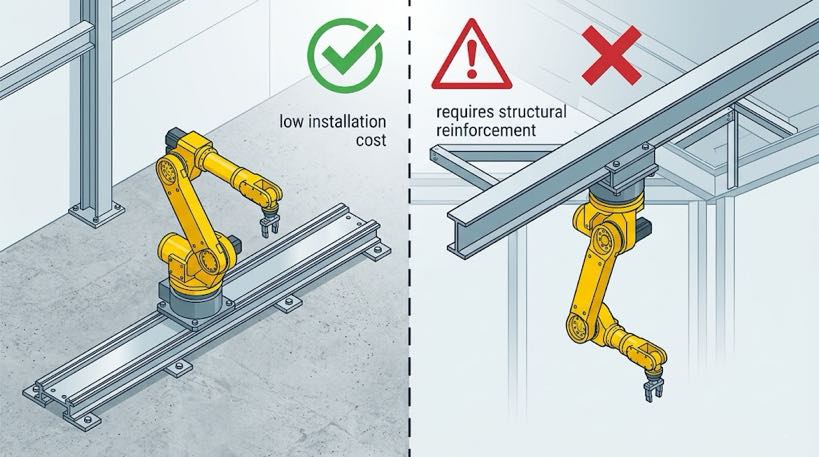
Bagian 2: Detailed Analysis — Floor Mounted 7th Axis
What is a floor mounted 7th axis robot?
A floor mounted7robot sumbu ke-th consists of a linear track bolted directly to your concrete floor. The robot rides on the track, moving horizontally between stations.
Key advantages of floor mounted 7th axis
Easy installation:Bolt to existing floor — no structural modifications
High load capacity:Supports robots up to 3,000kg (D003 model)
Simple maintenance:All components at ground level — no ladders or lifts needed
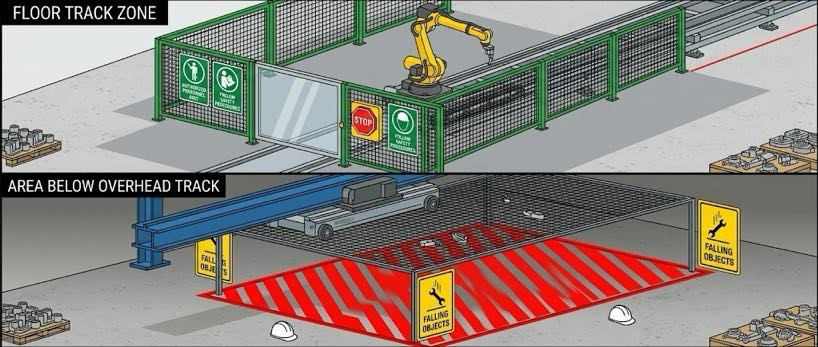
Better safety:Robot operates at floor level, easily isolated with standard fencing
Modular expansion:Add track sections later without structural changes
Compatible with all robot sizes:From small 6-axis to heavy-duty spot welding robots
Easier programming:Operator can walk alongside the robot during teach mode
Disadvantages of floor mounted 7th axis
Uses floor space:Requires 0.8-1.2m width of production floor
Floor flatness requirement:Needs ±1mm per 3 meter (standard industrial floor is fine)
Not suitable for crossing obstacles:Cannot pass over conveyors or equipment
Best applications for floor mounted 7th axis
- Welding cells (arc welding, spot welding)
- Heavy material handling (500-3,000kg payloads)
- Multi-station CNC tending (3-5 mesin)
- Automotive and heavy equipment manufacturing
- Foundries and high-dust environments (with IP67 protection)
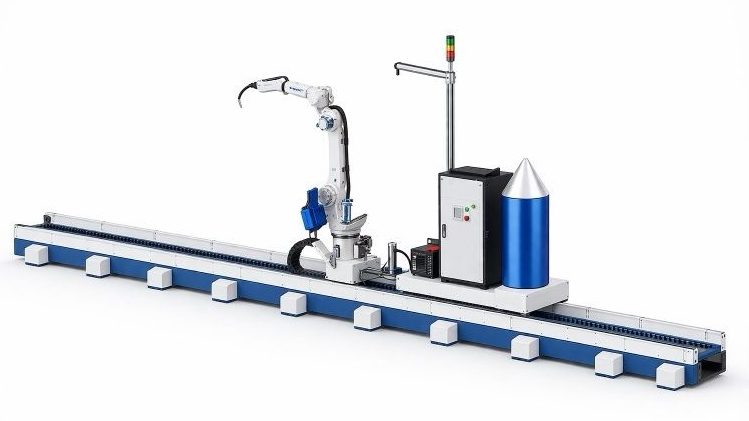
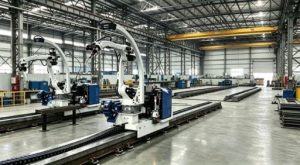
(The ground tracks shown in the figure do not include the robotic arm)
Bagian 3: Detailed Analysis — Overhead (Ceiling Mounted) 7sumbu ke-
What is an overhead / ceiling mounted 7th axis robot?
An overhead7robot sumbu ke-th is suspended from a ceiling-mounted rail system. The robot hangs upside down or rides on a track attached to the overhead structure.
Key advantages of overhead mounted 7th axis
Zero floor footprint:Frees up valuable production floor space
Can cross obstacles:Passes over existing equipment, konveyor, or workstations
Ideal for clean rooms:Keeps floor area clear for other processes
Good for very long travel:Can span entire facility length without floor interference
Disadvantages of overhead mounted 7th axis
Complex installation:Requires reinforced ceiling structure — often $20,000-50,000 in structural work
Lower load capacity:Typically limited to 500-1,500kg (ceiling structure limitation)
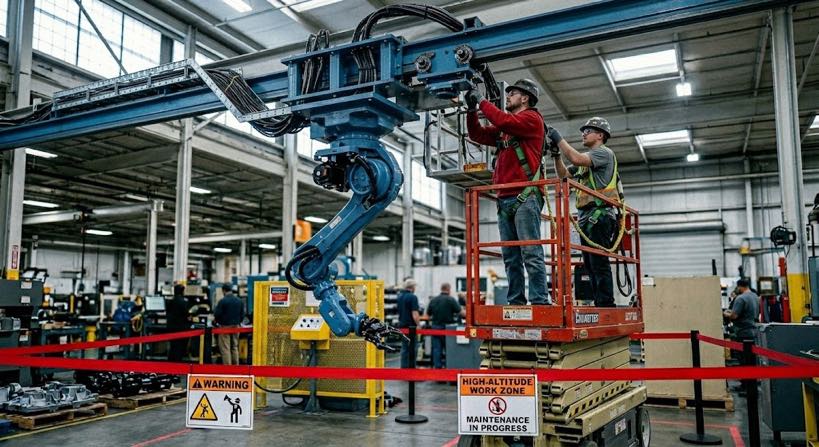
Difficult maintenance:All components require ladders, lifts, or scaffolding to access
Higher safety risk:Falling parts, dropping tools, overhead loads
Limited robot compatibility:Only small to medium robots (under 1,500kg)
Difficult to expand:Adding length requires structural modifications
More complex programming:Harder for operators to observe robot during teach mode
Higher cost:Peralatan + structural work typically $10,000-30,000 more than floor track
Best applications for overhead mounted 7th axis
- Kamar bersih (perangkat medis, electronics assembly)
- Facilities with extremely tight floor space
- Light assembly operations (under 500kg payload)
- Applications requiring crossing over existing equipment
- Demonstration or exhibition lines
Bagian 4: Our Core Strength — Floor Track 7th Axis Systems
Berdasarkan26+ bertahun-tahun of experience and1,500+ proyek global, we specialize infloor mounted 7th axis robot sistem. Here’s why most manufacturers choose our floor track solution:
1. Proven reliability in harsh environments
Seri D kamifloor mounted 7th axis systems are designed for welding shops, pengecoran logam, and heavy manufacturing. DenganIP67 protectionDanmetal covers or bellows, milikmu7robot sumbu ke-th survives spatter, debu, and coolant.
2. High load capacity (up to 3,000kg)
D003 kamifloor track 7th axis robot handles3,000muatan kg— cukup untuk robot pengelasan besar, senjata las titik, dan benda kerja berat digabungkan.
3. Fast installation — 2 ke 5 hari
Bolt to your existing concrete floor. No structural engineering. No ceiling reinforcement. No expensive consultants.
4. Easy maintenance at ground level
All lubrication points, inspection ports, and replaceable components are atwaist height. Your in-house maintenance team can service the entire7robot sumbu ke-th without special equipment.
5. Modular expansion
Mulailah dengan 10 meters today. Menambahkan 5 meters next year. Kitafloor track 7th axis system usesmodular sections that bolt together. No need to replace the entire system.
6. Compatible with your existing robots
Kitafloor mounted 7th axis works withFanuc, MENANGIS, ABB, Yaskawa, UR, dan semua merek besar. Simply replace the mounting plate.
Bagian 5: Safety Comparison — Floor Track vs. Overhead 7th Axis
Safety is critical when choosing a 7th axis robot installation type.
| Safety Factor | Floor Track | Atas |
| Risk of falling parts | Low — robot at floor level | High — suspended above personnel |
| E-stop access | Easy — within reach | Difficult — may require ladder |
| Operator isolation | Simple fencing | Complex — overhead zone protection |
| Maintenance safety | Standing on floor | Working at height |
| Spatter/fire risk | Standard protection | Higher — spatter can fall onto equipment below |
| CE compliance | Standar | Requires additional overhead safeguards |
Safety recommendation
For welding and heavy material handling applications,floor mounted 7th axis systems are significantly safer. Overhead systems introduce additional risks: falling parts, difficult emergency access, and overhead load concerns.
CE/UL Note:Atas7robot sumbu ke-th systems require additional safety certifications for overhead loads and falling object protection. This adds2-4 minggu Dan$5,000-15,000 to the project.
Bagian 6: Decision Guide — Which 7th Axis Installation Should You Choose?
Choose Floor Mounted 7th Axis Robot if you answer YES to 3 or more:
- Do you need to handle payloads over 500kg?
- Is your application welding, penanganan yang berat, or CNC tending?
- Do you have standard concrete floor space available?
- Do you want installation in under 1 week?
- Do you prioritize easy maintenance access?
- Is your budget under $70,000?
- Do you need to serve 3-5 stations with one robot?
Choose Overhead Mounted 7th Axis Robot if you answer YES to 3 or more:
- Is your floor space extremely limited (zero room for a track)?
- Do you need to cross over existing equipment or conveyors?
- Is your application light assembly (under 500kg payload)?
- Is this a clean room or electronics assembly environment?
- Do you have an existing reinforced ceiling structure?
- Is your budget over $80,000 (including structural work)?
Bagian 7: Our Floor Track 7th Axis Robot Specifications
| Parameter | D001 | D002 | D003 |
| Jenis pemasangan | Floor | Floor | Floor |
| Kapasitas beban | Hingga 500kg | Hingga 1.500kg | Hingga 3.000kg |
| Stroke range | 3M – 10M | 5M – 20M | 10M – 50m+ |
| Pengulangan | ±0,05mm | ±0,05mm | ±0,05mm |
| Kecepatan maksimal | 2.5 MS | 2.5 MS | 2.0 MS |
| Perlindungan | IP54 (IP67 opt.) | IP54 (IP67 opt.) | IP54 (IP67 opt.) |
| Meliputi | Opsional | Opsional | Opsional |
| Waktu instalasi | 2-5 hari | 2-5 hari | 2-5 hari |
| Waktu memimpin | 3-4 minggu | 3-5 minggu | 4-6 minggu |
Bagian 8: Pertanyaan yang Sering Diajukan
Q: Can I convert a floor mounted 7th axis to overhead later?
A: TIDAK. The track structure and mounting systems are completely different. Choose based on your long-term plan.
Q: Which is cheaper — floor or overhead?
A:Floor mounted 7th axis is typically$10,000-30,000 less because no structural engineering is required.
Q: Does overhead 7th axis require special safety certification?
A: Ya. Atas7robot sumbu ke-th systems require additional CE/UL certifications for overhead loads and falling object protection. Floor mounted systems use standard certifications.
Q: Can I use an overhead 7th axis for welding?
A: Not recommended. Welding spatter can fall onto equipment below, creating fire hazards. Also, maintenance is much more difficult.
Q: Which type do most manufacturers choose?
A: Berdasarkan kami1,500+ proyek, lebih90% of manufacturers choosefloor mounted 7th axis systems for welding and material handling applications.
We provide free installation type consultation
- Review your floor space and ceiling structure
- Analyze your payload and application requirements
- Provide side-by-side cost comparison (floor vs. atas)
- Recommend the optimal 7robot sumbu ke-th konfigurasi
- Deliver safety assessment and ROI analysis
Referensi & Structural Engineering Standards
- Structural Integrity & Crane Runway Dynamics:
- AISC Design Guide 7 (Industrial Building Design):Structural evaluation framework governing the dynamic torsional stress and bending moments imposed on ceiling trusses by overhead linear gantries.
- ISO 12488-1:2012:Cranes — Tolerances for rails and tracks. Used to benchmark the alignment straightness differences between ceiling-suspended frames and floor-anchored steel beds.
- Occupational EHS & High-Access Regulations:
- OSHA 29 CFR 1910.28:United States Federal mandate defining falling object protection protocols and safety harness requirements for elevated heavy machinery maintenance.
- ANSI/ASSP Z359.1:American National Standard governing industrial fall protection codes during high-elevation servomotor and gearbox servicing.
- Industrial Fire Prevention & Hot Work Protocols:
- NFPA 51B (2024 Edisi):National Fire Protection Association standard for fire prevention during automated arc welding, detailing the hazardous perimeter guidelines for suspended “hot work” zones.
- AWS F4.1:American Welding Society safety specifications regarding molten slag and spatter mitigation in automated fabrication cells.
- Keamanan Fungsional & Certification Registries:
- DALAM ISO 13849-1:2015:Safety-related parts of control systems. Validated baseline ensuring emergency-stop and Safe Torque Off (STO) latency alignment.
- European Machinery Directive 2006/42/EC Compliance Register: Logged and authorized under Certificate No. M.2026.206.C134866.
- Empirical Field Data Framework:Statistical ratios, lifecycle projections, Dan 90%+ adaptation preferences derived from 26 years of specialized manufacturing experience, 40+ paten independen, and a historical archive of 1,500+ global operational tracks as of May 2026.
Identifikasi Penulis
Saya seorang ahli integrasi sistem pengelasan robot12+ bertahun-tahun pengalaman industri yang mengkhususkan diri dalam7robot sumbu ke-th sistem. Perusahaan saya punya26+ bertahun-tahun keahlian profesional, memegang40+ paten, dan telah berhasil diselesaikan1,500+ proyek global. Kami tahanSertifikasi CE UE(Nomor Sertifikat.: M.2026.206.C134866) untuk kita7robot sumbu ke-th sistem.
Diperbarui: Mungkin 2026
POSTINGAN TERKAIT
Apa Itu Sel Pengelasan Robot? 2026 Panduan Pemula | 37 Data Toko
Teknologi Pindai untuk Mengelas:Bagaimana Pemodelan Terbalik Menggantikan Pemrograman Robot
Pemosisian Pengelasan Laser: Akurasi dan Kecepatan untuk Lasan Pengukur Tipis
Sel Pengelasan Terkoordinasi: Positioner dan Robot sebagai Satu Rantai Kinematik
ROI Sel Pengelasan Robot Tanpa Pemrograman: Panduan Praktis untuk Aplikasi Baja Struktural
