Fabricant de postes de travail robotisés et de systèmes laser personnalisés



Budget serré, Choix intelligent:Comment les petites et moyennes usines tirent le meilleur parti d'un positionneur de robot 2026
Voici une vérité que la plupart des fournisseurs d’automatisation ne vous diront pas: un positionneur de robot bien spécifié au bon prix surpassera un système coûteux choisi sans penser à la pièce à usiner elle-même.
The most expensive mistake small factories make is not buying too cheap. It is buying the wrong type — either overpaying for capacity they will never use, or underpaying for a unit that cannot handle their actual parts.
This guide was written specifically for production managers and factory owners working with a limited automation budget who need to get it right the first time.
Section 1: Redefine ‘Value’ Before You Look at a Single Price Tag
In automation purchasing, ‘high value’ does not mean ‘low price’ — it means the lowest total cost to achieve a specific production outcome.
Before opening a supplier catalog, answer these four questions. They will eliminate 80% of the options on the market and focus your budget where it actually matters.
| Question | Why It Matters | What a Bad Answer Costs You |
| What is my heaviest workpiece, y compris le luminaire? (kilos) | Drives payload rating — the single most critical spec | Under-rated positioner = equipment failure and voided warranty |
| Do I need synchronized motion with the robot? | Synchronized = 25–40% more arc-on time, but costs more | Non-sync on complex seams = poor weld quality and rework |
| How many part changeovers per shift? | Frequent changeovers need quick-change fixtures — budget separately | Slow changeovers kill ROI on any positioner, regardless of price |
| What is my target payback period? | Defines the maximum justifiable investment | No payback target = no way to evaluate whether the price is right |
Golden rule for budget-limited buyers: buy exactly the payload capacity you need (avec un 20% safety margin) — and do not pay for synchronization unless your weld seams require it.
Section 2: Le 4 Robot Positioner Types That Deliver Best Value
These four configurations consistently deliver the strongest ROI for small and mid-size factories. All pricing ranges below are verified against current product specifications (FOB, excluding fixtures, intégration, and guarding).
| ⚠️ Pricing Disclaimer Prices shown are indicative FOB ranges based on current product specifications. Le prix final est déterminé par les spécifications du projet, exigences de charge utile, compatibilité des marques de robots, et coûts actuels des matériaux — contactez-nous pour un devis de projet à jour. |
Taper 1: Poupée / Positionneur de poupée mobile — from $3,400
| Spec | Your Products — Verified Data |
| Models available | MRK-B001 (Lumière) · MRK-B002 (Heavy Load) · MRK-B004 (Heavy Duty Servo) |
| Plage de charge utile | 500–1 000 kg (B001) / 1,000–1 500 kg (B002) / 1,500–5 000 kg (B004) |
| Répétabilité | ±0.05 mm @ R350 (B001/B002) / ±0.075 mm @ R500 (B004) |
| Max flip speed | 90°/s (B001) / 60°/s (B002) / 30°/s (B004) |
| Standard span | 2 m – 3.5 m (B001/B002) / 3 m – 8 m (B004) |
| Application | Soudage, assembly repositioning, line transfer |
| Indicative FOB price range | $3,400 – $22,000 (request quote for current pricing) |
The headstock/tailstock is the workhorse of entry-level welding automation — mechanically simple, fiable, and easy to program. For factories welding long or heavy symmetrical parts — pipes, poutres, essieux, agricultural implements — it is almost always the right answer at this budget level.
| ⚠️ Value warning: The most common mistake at this tier: buying a positioner rated to 500 kg without checking that the rating includes the fixture. A steel fixture for a 300 kg weldment can weigh 80–120 kg, reducing your actual workpiece capacity significantly. Note that MRK-B001’s rated payload starts at 500 kg — confirm your total fixture + workpiece weight before specifying. |
Taper 2: Positionneur de type L — from $8,700
| Spec | Your Products — Verified Data |
| Models available | MRK-L001 (Travaux légers) · MRK-L002 (Robuste) |
| Plage de charge utile | 300–500kg (L001) / jusqu'à 1,500 kilos (L002) |
| Flip axis repeatability | ±0.075 mm @ R500 (L001) |
| Tooling axis repeatability | ±0.05 mm @ R350 (L001) |
| Max rotation speed | 60°/s (L001) / 4 rotation du régime, 3 rpm flip (L002) |
| Standard table diameter | 750 mm (L001) / max rotation radius 1,500 mm (L002) |
| Application | Welding and assembly repositioning |
| Indicative FOB price range | $8,700 – $26,400 (request quote for current pricing) |
The L-type is the most space-efficient option in this category. It tilts the workpiece to the flat or horizontal welding position, which is critical for fillet and butt welds on smaller assemblies. If your factory has limited floor space — a common constraint in job shops — the L-type is often the better choice over a headstock/tailstock unit.
One limitation to understand: the inside face of a bracket or box section can be difficult for the robot torch to reach. If your parts have internal welds in recessed corners, discuss this with your supplier before ordering.
Taper 3: Positionneur rotatif à axe unique — from $2,700
| Spec | Your Products — Verified Data |
| Models available | MRK-H002 (Lumière) · MRK-H001/H003 (Light Standard) · MRK-H004 (Standard) · MRK-H005 (Lourd) |
| Plage de charge utile | 300–500kg (H002) / 500–2 000 kg (H001) / 300 kilos (H003) / 500–1 500 kg (H004) / 1,500–2 000 kg (H005) |
| Répétabilité | ±0.05 mm @ R350 (H001/H002/H004/H005) |
| Max rotation speed | 60°/s (H001/H002/H004) / 45°/s (H005) |
| Standard table diameter | 1,000 mm (H002) / 600–2,000 mm range (H001) / 1,500 mm (H004) / 2,500 mm (H005) |
| Application | Soudage EV, assembly repositioning |
| Indicative FOB price range | $2,700 – $11,200 (request quote for current pricing) |
If your workpieces are relatively flat — base plates, cadres d'équipement, panel assemblies — and you mainly need to rotate the part to the flat position for welding rather than flip it continuously, the servo rotary table is the most cost-effective solution. It delivers precise, repeatable indexing at the lowest cost per kg of payload capacity in this tier.
Note: the H-series are full servo rotary tables with continuous 360° rotation capability, not simple tilt tables. This gives them greater flexibility than a basic tilt-only unit for applications requiring multi-position welding.
Taper 4: Positionneur de soudage de type U— from $6,300
| Spec | Your Products — Verified Data |
| Models available | MRK-U001 (Lumière) · MRK-U002 (Standard)·MRK-U004 |
| Plage de charge utile | 300 kilos (U001) / 500–1 000 kg (U002)/300 kilos(U004) |
| Flip axis repeatability | ±0.05 mm @ R250 (U001) / ±0.075 mm @ R500 (U002) |
| Flip axis range | ±90° (U001) / 45°/s max flip speed (U002) |
| Rotation axis range | ±200° (U001) / 60°/s max rotation (U002) |
| Standard table diameter | 500 mm (U002) / diamètre de rotation maximum 750 mm (U002) |
| Application | Welding and assembly repositioning |
| Indicative FOB price range | $6,300 – $17,000 (request quote for current pricing) |
The U-type dual-axis servo positioner gives you both flip and rotation in a compact footprint — making it the most versatile configuration at this price point. For factories welding components that require access on multiple faces without manual repositioning, the U-type delivers the best arc-on time improvement per dollar at the SME budget level.
For heavier or more complex multi-axis requirements, the MRK-B series (three-axis servo positioners, from $15,100–$35,400 FOB) offers extended payload and axis combinations — though these move beyond the SME entry budget range covered in this guide.
Section 3: Le 5 Hidden Costs That Make Cheap Positioners Expensive
A positioner quoted at a low price is not a low-cost investment. These five costs are almost never included in the base price — and routinely add 40–80% to the real first-year spend.
| Coût caché | Gamme typique | How to Control It |
| Fixtures and tooling | $1,200 – $8,000 | Get a fixture quote alongside the positioner quote; design for quick-change if changeovers are frequent |
| Robot interface / external axis cable | $800 – $3,500 | Confirm which robot brand you have and whether synchronization license is included |
| Gardiennage de sécurité (fence, rideau lumineux, or area scanner) | $1,800 – $7,000 | Required in most markets; get a compliance quote from your robot cell integrator |
| Installation et mise en service | $1,500 – $5,000 | Can be reduced if your team has robot programming experience; clarify what is included |
| Des pièces de rechange (Année 1 buffer) | $400 – $1,800 | Ask for a recommended spare parts list at time of order; servo drives and encoder cables are the most common Year 1 failures |
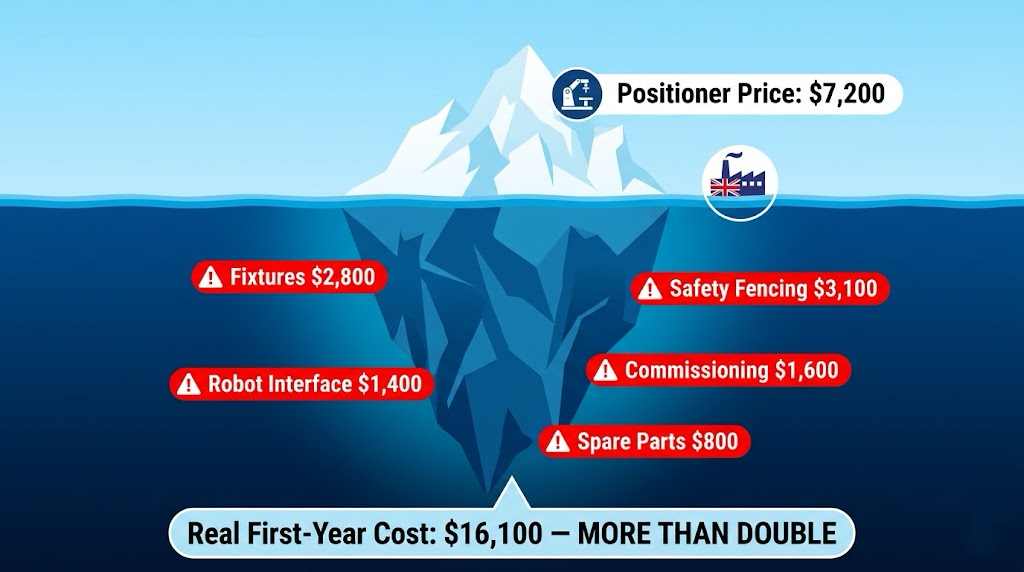
| Exemple réel: A UK job shop purchased a headstock/tailstock positioner at £7,200. By the time they added fixtures (£2,800), clôture de sécurité (£3,100), robot interface cable and programming (£1,400), et mise en service (£1,600), the real first-year cost was £16,100 — more than double the quoted price. Their ROI calculation had been based on the equipment price alone. The investment still paid off, but the payback timeline was 14 months instead of the 7 months projected. |
The fix: always ask for a ‘total first-year cost’ estimate, not just equipment price. A supplier who refuses to provide this estimate is a supplier to be cautious of.
Section 4: How to Calculate Whether a Robot Positioner Is Worth It
ROI calculation here doesn’t need a finance degree. Here’s the method we use with first-time buyers.
Étape 1: Calculate your current cost per part
- Operator hourly rate (entièrement chargé, including benefits): par ex., $28/heure
- Average weld time per part including repositioning: par ex., 24 minutes = 0.4 heures
- Current labor cost per part: $28 × 0.4 = $11.20
Étape 2: Estimate new cycle time with positioner
A positioner typically cuts manual repositioning by 60–80%. For three 3-minute repositioning steps (9 minutes totales), the positioner reduces this to near-zero.
- New weld time per part: 24 min − 9 min repositioning + 1 min positioner index = 16 minutes
- New labor cost per part: $28 × (16/60) = $7.47
- Économie par pièce: $11.20 − $7.47 = $3.73
Étape 3: Calculate annual saving
- Daily production: 80 parties/jour
- Working days per year: 240
- Annual parts: 80 × 240 = 19,200 parties
- Économie de main d'œuvre annuelle: 19,200 × $3.73 = $71,616
Étape 4: Calculate payback period
- Total first-year cost (positionneur + luminaires + guarding + installation): project-specific — request quote
- Example at $18,500 total project cost: $18,500 / $71,616 = 3.1 mois
| Aperçu clé: Even at a modest production volume of 80 parties/jour, a well-scoped project with total first-year cost around $18,500 pays back in approximately 3 months in this example. For most SME fabricators running structured weld operations, payback within 6–18 months is realistic. The constraint is never whether the investment makes sense — it is always choosing the right type and specification for the workpiece. |
Section 5: The SME Buyer Decision Framework — 6 Steps
Follow these six steps in order. Skipping any one of them is the most reliable way to end up with the wrong system.
- Étape 1. Weigh your heaviest workpiece with the fixture attached — actually weighed, not estimated. This is your payload requirement.
- Étape 2. Measure your largest workpiece envelope — length, width, height. This determines whether a headstock/tailstock, Type L, or rotary table physically fits the part.
- Étape 3. Count your repositioning steps per part and measure how long each one takes. This is your baseline saving opportunity and the foundation of your ROI calculation.
- Étape 4. Decide whether you need synchronized motion. Straight lines and simple angles: non-synchronized is sufficient. Curved seams or continuous rotation during welding: synchronization is required.
- Étape 5. Get a total cost estimate — not just the positioner price. Ask every supplier to list: positionneur, luminaires, interface cable, guarding, installation, and first-year spares.
- Étape 6. Request a sample weld test on your material before committing. Any supplier who builds robot positioners and integrates them should be willing to run a demonstration weld.
Section 6: What Good Value Looks Like — And What It Does Not
| Signs of Good Value at This Budget | Red Flags That Signal False Economy |
| Published gearbox service interval (par ex., 5,000 heures) | No maintenance documentation available |
| Robot brand compatibility confirmed in writing | ‘Compatible with most robots’ with no specifics |
| Fixture design support included or quoted separately | Fixture cost not mentioned until after you order |
| CE or relevant safety certification included | Safety certification listed as an optional extra |
| Reference customer in your industry available | No reference customers offered |
| Factory acceptance test (GRAISSE) available before shipment | No pre-shipment testing mentioned |
| Spare parts availability confirmed with lead time quoted | ‘Parts available on request’ with no lead time |
Section 7: Real Deployments — What SME Factories Actually Spent and Got
The following data comes from real positioner installations we have supported. Client names are withheld per agreement; industrie, country, workpiece type, and financial outcomes are accurate.
| Factory Profile | Type de poste | Total First-Year Cost | Annual Labor Saving | Période de récupération |
| Small structural steel fabricator, 12 employees, Germany | Poupée/contrepointe, 400 kilos | $16,800 | $58,400 | 3.5 mois |
| Agricultural equipment job shop, USA | Type L, 250 kilos, non-synchronized | $13,200 | $34,700 | 4.6 mois |
| Stainless steel enclosure manufacturer, Southeast Asia | Table rotative, 300 kilos | $9,400 | $21,000 | 5.4 mois |
| General fabrication shop, first-time automation, UK | Poupée/contrepointe, 500 kilos | $19,100 | $49,800 | 4.6 mois |
| Trailer component manufacturer, Canada | Type L, 600 kilos, synchronisé | $28,500 | $87,200 | 3.9 mois |
Pattern across all five projects: payback within 6 mois, even at conservative production volumes. The constraint was never whether the investment made sense — it was always choosing the right type and specification for the workpiece.
Get a Positioner Recommendation for Your Specific Workpiece and Budget
Dites-nous le poids de votre pièce, dimensions, robot brand, et volume de production. Our engineering team will recommend the right positioner type and configuration — with a total cost breakdown — within 24 heures d'ouverture.
| Demandez votre recommandation gratuite de positionneur → No sales pressure. A straight answer on what fits your workpiece and your budget. → ROBOPTIX | 24-hr response |
À propos de l'auteur
Expérience & Informations d'identification
Spécialiste de l'intégration de systèmes de soudage robotisés avec 12+ années d'expérience directe en matière de projets axées sur la sélection et l'intégration de positionneurs de robots. A fourni des conseils à 300+ usines à travers l’Amérique du Nord, Europe, et l'Asie. Toutes les données de spécification de cet article sont tirées du H réel / B / L / Fiches techniques des produits de la série U.
Contexte de l'entreprise: 26+ années d'ingénierie en automatisation du soudage, 40+ brevets actifs, 1,500+ projets réalisés à l'échelle mondiale, environ 70% impliquant l'intégration du positionneur de robot.
Certifications
- OIN 9001: 2015 (GB/T 19001-2016) — Système de gestion de la qualité
- GJB 9001C-2017 — Système de gestion de la qualité des équipements militaires/armes
- CE UE — Directive Machines 2006/42/CE (Certifié. Non. M.2026.206.C134866)
- Entreprise de haute technologie — Cert. Non. GR202341000595 (Publié en novembre. 2023)
Dernière mise à jour: juin 2026
ARTICLES CONNEXES
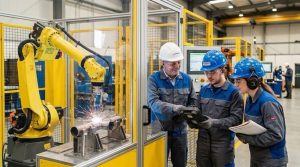
Comment sélectionner un fournisseur de soudage laser robotisé: De l’évaluation technique aux tests sur échantillons
Positionneur de soudage laser: Précision et vitesse pour les soudures fines

Une comparaison complète entre le soudage laser robotisé et. Soudage MIG et TIG: Lequel vous convient le mieux?
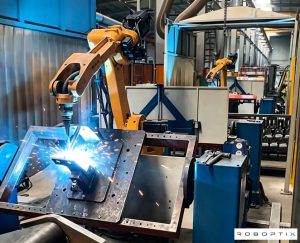
Programmation de mouvements coordonnés: Faire bouger votre robot et votre positionneur comme une seule chaîne cinématique
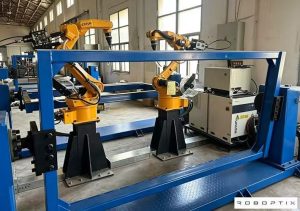
Cellule de soudage coordonnée: Positionneur et robot comme une seule chaîne cinématique