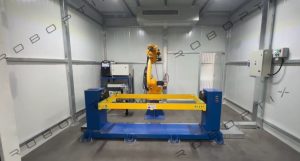
Fabricant de postes de travail robotisés et de systèmes laser personnalisés



Applications réelles des cellules de soudage robotisées dans l'industrie générale: Études de cas 2026
Beyond Automotive — Robotic Welding Cell in General Industry
While automotive manufacturing is the star application for robotic welding, cellules de soudage robotisées are also widely used in general industry.
According to the International Federation of Robotics (IFR) 2025 rapport, welding applications account for approximately 21% of global industrial robot installations — a significant portion deployed in non-automotive general industry: structure en acier, engins de chantier, agricultural equipment, meubles en métal, récipients sous pression, tuyau, matériel, et plus.
These industries share common challenges: smaller batch sizes than automotive, lower margins, yet the same pressures from welder shortages and inconsistent quality.
This article presents three real (anonymisé) general-industry application cases, showing the actual performance and value of robotic welding cells across different scenarios.
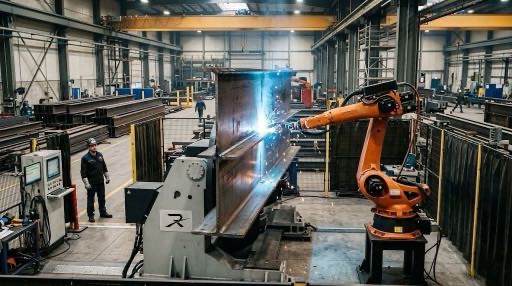
Cas 1: Steel Structure Fabrication Shop — Large Component Welding Efficiency Improvement
Company Background
A mid-sized steel structure fabrication shop in East China, producing steel beams, colonnes, and trusses for construction. Annual output value: environ $12 million USD.
Main pain points before deployment: Difficulty hiring welders. Large components required frequent flipping and repositioning. Multi-angle welding depended heavily on skilled welders. Weld quality was inconsistent with high rework rates.
Deployment
Introduced a two-station robotic welding cell in early 2025, configured with:
- 6-axis industrial robot (16kg de charge utile, 1.8m atteindre)
- Dual-axis servo positioner (Type L, 2-capacité en tonnes)
- Seam tracking system
- Clôture de sécurité + light curtain interlock
- Investissement total: environ $150,000 USD
Before/After Data Comparison
| Métrique | Avant (Manuel) | Après (Robotic) | Changement |
| Single weld seam time | 18 minutes | 6.8 minutes | ~2.65x productivity gain |
| First-pass weld acceptance rate | 91% | 98.50% | +7.5 points de pourcentage |
| Welder requirement | 6-7 soudeurs | 2 opérateurs + 1 QC | ~57% reduction |
| Annual production capacity | Référence | 62% | Significant increase |
| Période de récupération | — | 14 mois | — |
Key Success Factors
The L-type dual-axis positioner combined with the seam tracking system effectively solved the challenge of multi-angle, multi-position welding on large steel structures. The robot automatically adapts to minor weld path deviations, ensuring consistent weld quality.
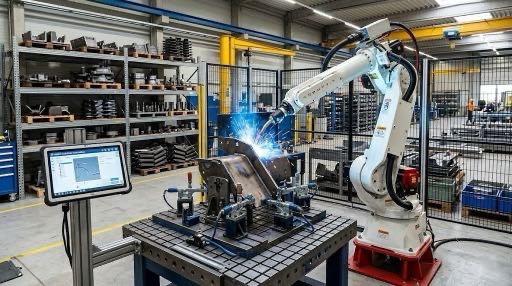
Cas 2: Agricultural Machinery Manufacturer — High-Mix Low-Volume Flexible Production
Company Background
An agricultural machinery parts manufacturer in North China, producing rotary tiller blade holders, cadres, and protective covers — over 200 different product specifications annually.
Main pain points before deployment: High product variety, small batch sizes, changements fréquents. Each changeover took 1-2 hours for tooling and program adjustment. The welder workforce was aging, with few young replacements.
Deployment
Introduced a standard single-station robotic welding cell, configured with:
- 6-axis industrial robot (10kg de charge utile)
- Quick-change tooling fixture system (conception modulaire)
- Offline programming software
- Investissement total: environ $70,000 USD
Before/After Data Comparison
| Métrique | Avant (Manuel) | Après (Robotic) | Changement |
| Temps de changement | 45 minutes | 7-9 minutes | ~80% reduction |
| Production quotidienne | Référence | ~2.4x increase | — |
| Weld defect rate | Référence | 65% réduction | — |
| Welding labor cost | Référence | ~57% reduction | — |
| Période de récupération | — | 15 mois | — |
Key Success Factors
The modular quick-change fixture system + offline programming dramatically improved flexibility for high-mix low-volume production. Operators can complete path planning on a computer and finish changeover within 15 minutes.
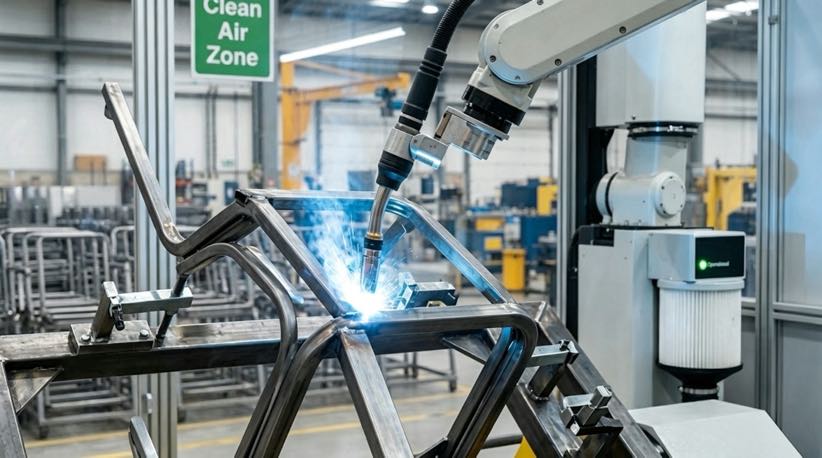
Cas 3: Metaje Furniture Manufacturer — Quality and Efficiency Improvement for Batch Frame Welding
Company Background
A metal furniture manufacturer in South China, producing office chair frames, rayonnage, and display stands — typical medium-batch production, primarily exporting to the European market. European customers had extremely high requirements for weld appearance consistency.
Main pain points before deployment: Welders’ skill levels varied significantly. The same chair model welded by different welders produced vastly different weld quality. Customer complaints about weld appearance. High return rates. High welding fume concentration, environmental pressure.
Deployment
Deployed a single-station robotic welding cell in 2025, configured with:
- 6-axis industrial robot (6kg de charge utile)
- Pulse MIG welding power source
- Single-axis rotary positioner
- Standardized fixture system
- Torch-mounted fume extraction
- Investissement total: environ $60,000 USD
Before/After Data Comparison
| Métrique | Avant (Manuel) | Après (Robotic) | Changement |
| Weld time per frame | 12 minutes | 4.5 minutes | ~2.7x productivity gain |
| Weld appearance consistency | Highly variable | Highly consistent | Dramatic improvement |
| Customer return rate | Référence | 70% réduction | — |
| Welding production lines | 4 manual lines | 1 cellule robotique + minor manual assist | — |
| Overall production capacity | Référence | ~145% increase | — |
| Période de récupération | — | 12 mois | — |
Key Success Factors
Standardized fixtures + stable pulse MIG welding parameters ensured the high weld appearance and consistency requirements for metal furniture, while significantly reducing worker physical strain. Torch-mounted fume extraction effectively improved the workshop environment.
Key Takeaways from All Three Cases
| Dimension | Cas 1 (Steel Structure) | Cas 2 (Ag Machinery) | Cas 3 (Meubles en métal) |
| Point douloureux principal | Large components, soudage multi-angle | Frequent changeovers, aging welders | Quality consistency, appearance requirements |
| Selection direction | Deux stations + suivi des coutures | Station unique + outillage à changement rapide | Station unique + standardized fixtures |
| Investissement typique | ~$150k USD | ~$70k USD | ~$60k USD |
| Période de récupération | 14 mois | 15 mois | 12 mois |
| Biggest gain | 2.65x productivity gain | 80% faster changeover | 70% return rate reduction |
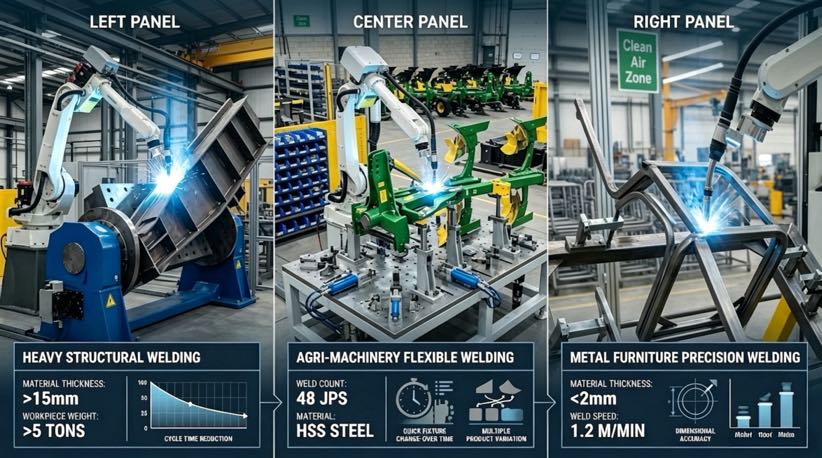
Common Success Factors for Robotic Welding Cell Deployment in General Industry
Match Selection to Production Characteristics
Grandes pièces, low batch sizes → favor single-station. Stable batch sizes → favor two-station. Don’t overspecify — Case 2’s single-station solution fully met the high-mix low-volume needs with lower investment and faster payback.
Fixture Design Is Critical
Multiple cases prove that professional fixture investment often determines project success. The modular quick-change fixtures in Case 2 and standardized fixtures in Case 3 were key success factors. Budget 5-10% of total investment for fixture iterations.
Training and After-Sales Support
Operator training and responsive after-sales support are critical for long-term stable operation. All three companies received 1-2 weeks of on-site training, enabling operators to independently handle program recall, changeover, et dépannage de base.
Safety and Environmental Compliance
All deployments complied with ISO 10218-2 safety standards and included efficient fume extraction systems. Cas 3 specifically used torch-mounted extraction, effectively improving workshop air quality.
These three real cases from steel structure fabrication, machines agricoles, and metal furniture manufacturing fully demonstrate: robotic welding cells deliver exceptional practical value in general industry as well.
They not only significantly improve production efficiency and weld quality but also effectively address welder shortages and accelerate automation transformation.
For small-to-medium manufacturers planning to introduce automated welding, the key is selecting the right robotic welding cell configuration based on your product characteristics and production rhythm — not simply pursuing the most complex solution.
Prochaines étapes
If you are considering introducing a robotic welding cell to your shop, please share the following information:
1. Your main product type (par ex., structure en acier, pièces de machines, meubles en métal)
2. Typical part dimensions and daily output volume
3. Your biggest current pain point (pénurie de main d'œuvre, instabilité de la qualité, or low efficiency)
We will provide targeted initial recommendations based on our real-world experience.
Sources de données
– Fédération internationale de robotique (IFR) – World Robotics 2025 Report
– Société américaine de soudage (AWS) – Données sur la main-d’œuvre en soudage
– Summary of experience from 1000+ robotic welding cell delivery projects
Lecture connexe
- How to Choose a Robotic Welding Cell? Station unique vs. Deux stations
- 2026 Robotic Welding Cell Cost and ROI Analysis
- 10 Principaux avantages de la mise en œuvre d'une cellule de soudage robotisée dans votre atelier
Identification de l'auteur
Cet article est basé sur la Fédération internationale de robotique (IFR) Rapport mondial sur la robotique 2025, Société américaine de soudage (AWS) données sur la main-d'œuvre, et les feuilles de route technologiques des principaux fabricants.
Auteur:
Un expert en intégration de systèmes de soudage robotisés avec plus de 12 années d'expérience dans l'industrie. Mon entreprise a plus 26 années d'expérience professionnelle, détient plus de 40 technologies brevetées, et a complété avec succès plus de 1,500 projets dans le monde entier (environ 70% dont des cellules de soudage robotisées, totalisant plus de 1,000 unités). L'entreprise est certifiée CE par l'UE (Numéro de certificat: M.2026.206.C134866) et est conforme à la norme EN 60204-1:2018 et EN ISO 12100:2010 normes. J'ai accompagné de nombreuses entreprises manufacturières tout au long du processus de mise en place de postes de soudage robotisés., de la sélection au lancement de la production.
Mis à jour: Peut 2026
ARTICLES CONNEXES
Qu'est-ce qu'une cellule de soudage robotisée? 2026 Guide du débutant | 37 Données de la boutique
Soudage laser robotisé: Principes, Avantages, et applications (2026 Guide complet)
7Robot de l'Axe + Positionneurs robotisés: Construire des cellules de soudage flexibles complètes
Cellule de soudage robotisée sans programmation: Guidé par la vision, Pas de pendentif d'apprentissage
L'audit pré-achat: Une liste de contrôle de visite d'usine et un protocole de test au banc pour les acheteurs de positionneurs de soudage