Custom Robot Workstations And Laser Systems Manufacturer


How to Choose the Right Robotic Laser Welding System for Your Factory
In previous articles, we explored the technical principles, typical applications, potential challenges, and upgrade options of laser welding. Now that you understand the benefits laser welding can bring to your factory, it’s time to move into the practical stage: how to select the right robotic laser welding system that truly matches your production needs.
The biggest mistake in selecting a robotic laser welding system isn’t buying the most expensive option, but buying one that doesn’t fit your actual requirements. The system with excessive power, insufficient precision, or mismatched reach will fail to increase output and may cause wasted investment, high maintenance costs, and quality issues. This article provides a clear, practical decision-making framework to help you transition from understanding laser welding to confidently choosing the right robotic laser welding solution.
Step 1: Determine Laser Power Based on Material Thickness
Laser power is the heart of any robotic laser welding system, directly affecting weld depth, speed, and heat input.
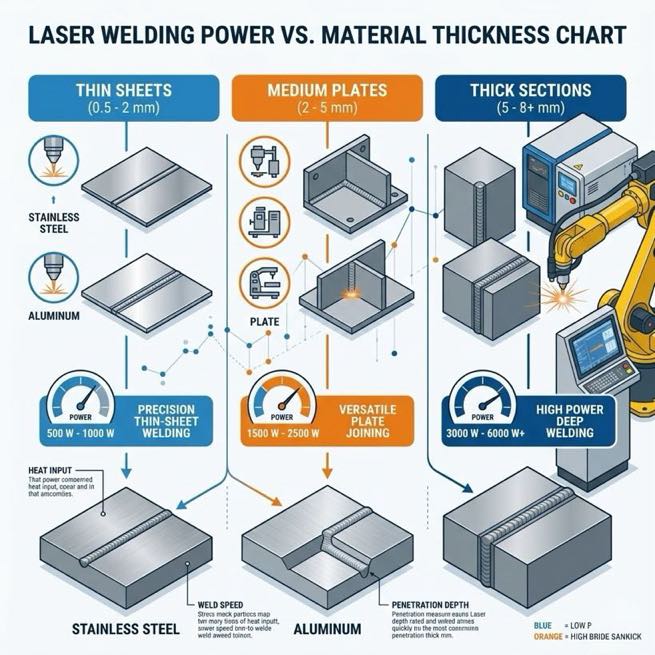
- Thin sheets (0.5–2 mm): Recommend 500–1,500 W. Ideal for stainless steel, aluminum alloy sheets, electronic enclosures, and battery casings. It delivers fast welding speeds (up to 3,000–8,000 mm/min), minimal heat-affected zone, and almost no distortion.
- Medium-thick sheets (2–5 mm): 1,500–3,000 w is appropriate. This range enables full penetration welding for automotive parts, kitchenware, and stainless steel structures.
- Thicker materials (≥5–8 mm): Requires 3,000 W or higher (multi-mode or hybrid welding). Note that laser welding has limitations on very thick plates due to the single-pass penetration depth. Evaluate combining processes or selecting a higher power when necessary.
Remember, higher power is not always better. Excess power increases costs and energy consumption and may cause wider welds or spatter. Allow a 20–30% power margin based on your main materials and verify everything through sample welding tests.
Step 2: Select Robot Reach and Payload Based on Workpiece Size
The robot acts as the arm of your robotic laser welding system. Its reach (working radius) and payload determine which workpieces it can handle effectively.
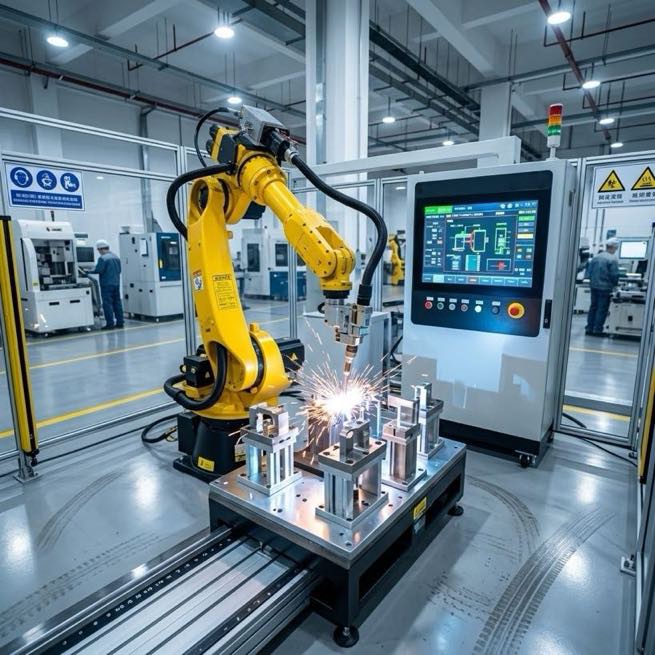
- Small workpieces (electronics, precision parts): Reach of 1,000–1,500 mm and payload of 5–10 kg. Collaborative robots (Cobots) excel here with flexible deployment and high safety.
- Medium-sized workpieces (automotive components, cabinets): Reach of 1,600–2,000 mm and payload of 10–20 kg. Standard 6-axis industrial robots handle complex trajectories well.
- Large or heavy workpieces: Reach of 2,000–2,500 mm or more, with a payload of 20–50 kg. Consider the total weight of the laser welding head and trackers; maintain at least 1.3 times the payload margin.
Also consider workpiece positioning: Do you need positioners, rotary tables, or external axes? If the workpiece requires multi-angle welding, insufficient reach will force frequent flipping and reduce cycle time.
Step 3: Precision Requirements Determine Robot Grade
Robotic laser welding requires extremely high seam positioning accuracy (gaps usually must be controlled within 0.1 mm or less). Otherwise, incomplete fusion or burn-through can easily occur.
- Standard precision (±0.05–0.08 mm): Suitable for most general applications.
- High precision (±0.03–0.05 mm): Essential for thin-walled parts, precision assemblies, and the heat-sensitive materials (aerospace, medical, electronics). Repeatability directly affects weld consistency and appearance quality.
Recommendation: Choose robots with integrated weld seam tracking (laser or vision) and force sensors. These features automatically compensate for workpiece variations and significantly improve yield rates.
Step 4: Choosing the Laser Source — Fiber, Disk, and Diode Lasers
Three main laser types are available for robotic laser welding. Selection should consider efficiency, maintenance, and your specific application:
- Fiber Laser: This is our most popular and highly recommended option. Our product features high electro-optical conversion efficiency (25–30%+), excellent beam quality, and ease of maintenance, and is ideally suited for robotic fiber-optic delivery. It is particularly suitable for thin to medium-gauge stainless steel, aluminum, and carbon steel. With its high-speed operation and stability, it is the ideal choice for high-volume production.
- Disk Laser: Delivers superior beam quality, best for ultra-high precision or deep penetration on thicker plates. However, it comes with higher equipment costs and more complex maintenance.
- Diode Laser: Lower cost and compact size, suitable for low-power precision work or as a pump source. Efficiency and beam quality are generally lower than those of fiber lasers, so it is often used for auxiliary or low-heat-input applications.
For most factories, a fiber laser is the best balance of performance, reliability, and cost-effectiveness in a robotic laser welding system. Consider disk lasers only for specialized high-end needs.
Step 5: Match Budget with Configuration Level — New Purchase vs. Retrofit
Your budget determines the overall configuration level of the robotic laser welding system:
- Entry-level: Low-power fiber laser + standard 6-axis robot + basic safety protection — suitable for small factories or pilot projects.
- Mid-to-high-end: High-power laser + high-precision robot + vision/tracking systems + production line integration — ideal for mass production.
- Top-tier: Multi-robot collaboration, AI path planning, remote monitoring, etc.
New Purchase vs. Retrofit Existing Equipment:
- New system advantages: Optimized design, latest technology (higher efficiency lasers, smarter controllers), full warranty, and high integration. Initial investment is higher (a complete unit can range from tens of thousands to hundreds of thousands of dollars, depending on specs).
- Retrofit advantages: Lower cost by using your existing robots or stations — simply add the laser head, source, and controls. Good for factories with some automation already in place. Disadvantages include compatibility risks, potentially lower stability, and longer implementation time.
If your production volume is stable and workpieces are highly repeatable, prioritize a new robotic laser welding system when budget allows. For tighter budgets or step-by-step upgrades, retrofitting existing robots is a practical starting point.
Comprehensive Decision-Making Framework
Use this checklist to quickly evaluate your needs:
- Material and thickness → Determines laser power and type
- Workpiece size and complexity → Determines robot reach, payload, and axes
- Precision and quality requirements → Determines robot repeatability and need for tracking/vision systems
- Production volume and cycle time → Determines automation level (single station vs. full line integration)
- Budget and ROI → Calculate payback period (usually fast through higher speed, lower scrap, and reduced labor)
- Safety and maintenance → Ensure laser safety protection, cooling systems, and reliable supplier support
Always run sample welding tests on your real workpieces before making a final decision. Pay close attention to welding speed, finished quality, and power consumption — these real-world results are still the best way to avoid expensive mistakes.
When you follow this straightforward approach — letting the material decide the power, the part size decide the robot reach, the precision needs decide the grade, and your budget decide the final configuration — you’ll end up with a robotic laser welding system that fits your factory perfectly and genuinely improves your competitiveness.
Author Identification
An expert in robotic welding system integration with over 12 years of industry experience. My company has over 26 years of professional experience, holds more than 40 patented technologies, and has successfully completed over 1,500 projects worldwide (approximately 70% of which involved robotic welding cells, totaling more than 1,000 units). The company holds EU CE certification (Certificate No.: M.2026.206.C134866) and complies with the EN 60204-1:2018 and EN ISO 12100:2010 standards. I have assisted numerous manufacturing companies throughout the entire process of robotic welding workstation implementation, from selection to production launch.
Updated: May 2026
RELATED POSTS
Installation & Maintenance Guide for Robotic Laser Welding Systems: A Practical Roadmap
7th Axis Robot Track System Maintenance & Troubleshooting Guide
3D Vision Laser Seam Tracking Explained:From Point Cloud to Weld Path in Seconds
Why a 2-Ton Positioner Can’t Always Hold a 2-Ton Part: Eccentric Loading, Overturning Moment, and Inertia
Fixture-Free Fabrication: When a Welding Positioner Replaces Complex Jigs, Tack Welds, and Crane Time