Custom Robot Workstations And Laser Systems Manufacturer


10 Key Benefits of Implementing a Robotic Welding Cell in Your Shop
Facing global manufacturing labor shortages and intensifying competition, the robotic welding cell has become a critical technology for manufacturers to reduce costs, increase efficiency, and improve quality.
According to the American Welding Society (AWS) , the United States will need approximately 320,500 new welding professionals by 2029, with a current welding workforce of about 771,000, many of whom are approaching retirement age. Meanwhile, International Federation of Robotics (IFR) data shows that global industrial robot installations continued their growth trajectory in 2023, with welding robots representing one of the most significant application categories.
In the area of safety standards, the International Organization for Standardization (ISO) has published the ISO 10218 series — “Robots and robotic devices — Safety requirements for industrial robots” — providing the authoritative technical framework for robotic welding cell system integration and safe deployment.
Based on these authoritative sources and real-world deployment cases, this article systematically summarizes the 10 key benefits of implementing a robotic welding cell, helping manufacturing decision-makers fully evaluate its value.
1. Consistent Weld Quality, Significantly Reducing Spatter and Porosity
Robotic welding executes precisely according to programmed paths and parameters, complying with ISO 10218-1:2025 requirements for industrial robot repeatability and risk control. Welding robots achieve repeatability of ±0.05mm, producing uniform weld appearance and excellent bead profile.
Industry research shows that robotic welding reduces defect rates from 8-12% for manual welding to 2-3% , with advanced systems achieving below 1%. This directly reduces spatter, porosity, undercut, and other defects, improving overall product quality consistency.
2. Dramatically Increased Productivity with 24/7 Continuous Operation
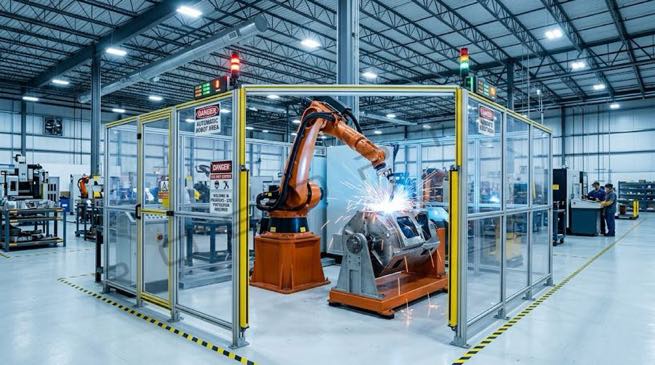
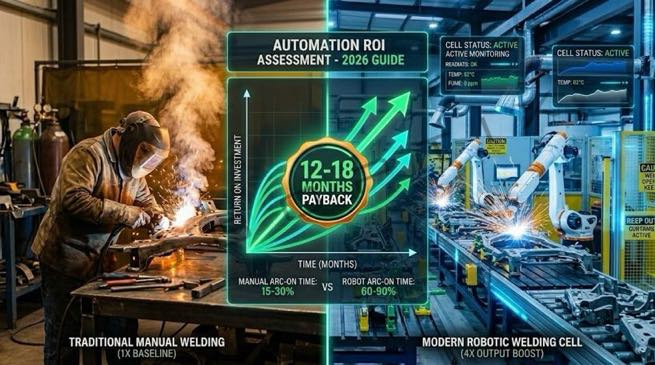
Robots operate continuously without fatigue, unaffected by shift changes. Arc-on time typically reaches 60-90% , compared to only 15-30% for manual welding.
According to the IFR’s definition of industrial robot applications, robots — as “automatically controlled, reprogrammable, multipurpose” machines — achieve stable welding speeds of 35 inches per minute, compared to 18-20 inches per minute for skilled manual welders, delivering overall productivity gains of 3 to 5 times.
Real-world case: The Qiqihar Rolling Stock Depot of China Railway Harbin Group introduced an intelligent welding system, reducing welding time per door from 15 minutes to 3 minutes and increasing daily output from 30 to 120 doors — an efficiency increase of 400% .
3. Significantly Lower Labor Skill Requirements
Traditional manual welding heavily depends on highly experienced master welders. Robotic welding cells primarily require operators to handle part loading/unloading, start programs, and perform basic quality checks. Regular workers become proficient after 1-2 weeks of training.
This not only effectively addresses the welder shortage crisis that AWS has warned about but also enables companies to maintain or even expand production despite tight labor supply.
4. Reduced Rework and Scrap Rates
Stable welding parameters and precise control dramatically reduce defective products. Multiple company case studies show that after introducing robotic welding, scrap and rework rates drop by over 50% , and in some cases even more.
Industry data shows this saves not only material costs but also time spent on secondary processes like grinding and repair. Some users report welding defect rates dropping below 3% .
5. Significantly Improved Worker Safety and Occupational Health
The ISO 10218 series clearly specifies safety requirements for industrial robot systems, including hazard identification, risk reduction measures, and system integration specifications. Robotic welding cell deployment is a typical application scenario for these safety requirements.
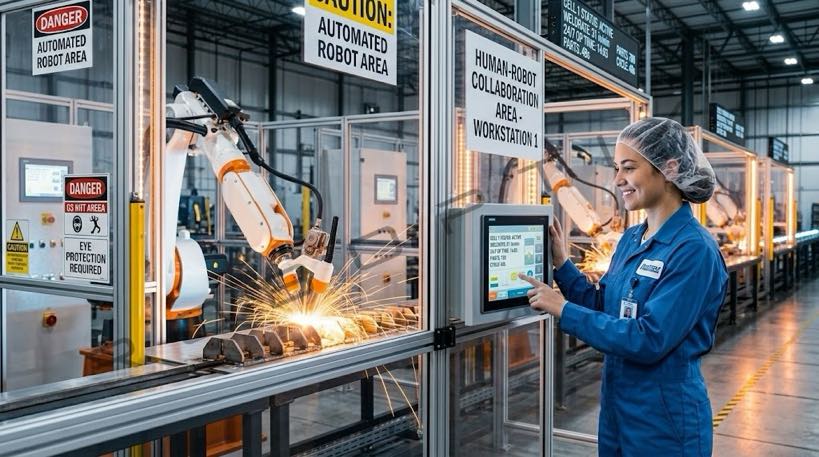
Robots replace humans in high-risk welding operations. Operators monitor from outside safety fencing, dramatically reducing exposure to intense arc radiation, hazardous welding fumes, high temperatures, and the risk of heavy physical labor.
In practice, enclosed welding chambers combined with powerful fume extraction systems allow workers to completely leave behind the harsh “smoke and heavy labor” environment that once defined welding work. In the long term, this significantly reduces occupational disease rates and workplace injuries while improving safety compliance performance.
6. Savings on Consumables: Wire and Shielding Gas
Robots precisely control wire feed speed and shielding gas flow, eliminating the “over-welding” common in manual operations.
Industry data shows that wire and gas consumption typically decreases by 15-30% , delivering substantial long-term cost savings for the enterprise.
7. Fast Changeover Capability for High-Mix Low-Volume Production
Modern robotic welding cells support offline programming and quick-change fixturing systems, complying with the ISO 10218-2 technical framework for robot system integration. Changeovers for different parts are completed in minutes.
This provides exceptional flexibility for shops with high-mix, low-volume production, breaking the traditional limitation that “automation only suits high-volume production.” Advanced technology companies have introduced smart welding cells that use 3D scanning and AI to automatically identify parts and plan weld paths without traditional teach pendant programming, further improving changeover efficiency.
8. Data Collection and Full Process Traceability
Advanced systems capture real-time data on welding current, voltage, speed, temperature, and other key parameters, enabling traceability for every weld seam.
This is critical for industries with strict quality requirements — automotive, pressure vessels, rail transportation, and aerospace — easily meeting audit demands for ISO, IATF 16949, and other quality management systems.
9. Strong Long-Term ROI: 12 to 18 Months Payback
Although initial investment is significant, combining multiple benefits — labor savings, productivity gains, defect reduction, and consumable savings — most companies achieve payback within 12-24 months. High-performance applications achieve payback in as little as 12-18 months.
Real-world case: The Qiqihar Rolling Stock Depot of China Railway Harbin Group saved approximately $815,000 USD in procurement costs within just one year of introducing an intelligent welding system.
10. Enhanced Overall Competitiveness as an Intelligent Manufacturing Benchmark
Implementing a robotic welding cell is not just equipment upgrade — it represents strategic business transformation.
According to the IFR 2025 AI Index Report , global industrial robot installations continued their growth trend in 2023. In welding applications, with the development of industries such as shipbuilding and steel structures, intelligent welding technology is transitioning from traditional “teach-type” to “programming-free” and “teaching-free” systems. Automation capability has become a key indicator of manufacturing competitiveness.
It helps companies shorten delivery times, secure higher-standard orders, and establish themselves as an intelligent manufacturing benchmark in the industry — all while navigating ongoing welder shortages.
Call to Action
If you are evaluating whether to introduce a robotic welding cell in your shop, please share your part types, daily production volume, current pain points, or shop conditions in the comments section. Our professional team can provide you with preliminary configuration recommendations and return on investment analysis.
The key data cited in this article comes from three authoritative sources:
International Federation of Robotics (IFR) : Global industrial robot installation and trend data
International Organization for Standardization (ISO) : ISO 10218 robot safety standards series
American Welding Society (AWS) : Welding workforce supply and demand data
Author Identification
This article is based on the International Federation of Robotics (IFR) World Robotics Report 2025, American Welding Society (AWS) workforce data, and major manufacturer technology roadmaps.
Author:
An expert in robotic welding system integration with over 12 years of industry experience. My company has over 26 years of professional experience, holds more than 40 patented technologies, and has successfully completed over 1,500 projects worldwide (approximately 70% of which involved robotic welding cells, totaling more than 1,000 units). The company holds EU CE certification (Certificate No.: M.2026.206.C134866) and complies with the EN 60204-1:2018 and EN ISO 12100:2010 standards. I have assisted numerous manufacturing companies throughout the entire process of robotic welding workstation implementation, from selection to production launch.
Updated: May 2026
RELATED POSTS
3D Vision Laser Seam Tracking Explained:From Point Cloud to Weld Path in Seconds
ROI of a No-Programming Robotic Welding Cell: A Practical Guide for Structural Steel Applications
Why a 2-Ton Positioner Can’t Always Hold a 2-Ton Part: Eccentric Loading, Overturning Moment, and Inertia
7th Axis Robot + Robotic Positioners: Building Complete Flexible Welding Cells
Robotic Laser Welding: Principles, Advantages, and Applications (2026 Complete Guide)