Custom Robot Workstations And Laser Systems Manufacturer


How Much Does a Robotic Welding Cell Cost in 2026? Full Pricing Breakdown
How Much Does a Robotic Welding Cell Cost in 2026?
In 2026, a complete robotic welding cell typically requires an initial investment of 35,000 to110,000 USD, depending on robot brand, positioner configuration, safety system level, and integration complexity. A standard two-station welding cell (including 6-axis robot, welding power source, positioner, safety fencing, fume extraction, and integration) has a typical budget of 50,000 to75,000 USD. Most companies recover their investment within 12 to 24 months through labor savings and efficiency gains.
Why a Clear Cost Breakdown Matters
According to the American Welding Society (AWS) , the United States will need approximately 320,500 new welding professionals by 2029, with a current workforce of about 771,000, many approaching retirement age. Meanwhile, International Federation of Robotics (IFR) data shows that global industrial robot installations reached 541,302 units in 2023, with welding robots representing one of the most significant application categories.
However, many manufacturers evaluating a robotic welding cell focus only on the robot arm price, ignoring “hidden” costs such as positioners, tooling, safety systems, integration, and training. This perception gap leads to budget shortfalls or incorrect system selection.
This article breaks down the four cost modules of a robotic welding cell based on the ISO 10218 series safety integration framework and real-world deployment cases.
Cost Module 1: Hardware (Approximately 50-65% of Total Investment)
Hardware is the foundation of any robotic welding cell.
6-Axis Industrial Robot is the core of the system. Leading brands include ABB, Fanuc, Yaskawa, and KUKA. Depending on payload capacity (6kg to 20kg is common for welding) and repeatability (±0.05mm), prices range from 17,000 to 39,000 USD. Domestic Chinese brands are lower, at 11,000 to 21,000 USD.
Welding Power Source & Wire Feeder selection depends on process requirements. MIG/MAG power sources range from 4,000 to 11,000 USD, with premium brands like Lincoln Electric, Fronius, and Miller reaching $14,000+. TIG power sources are typically more expensive.
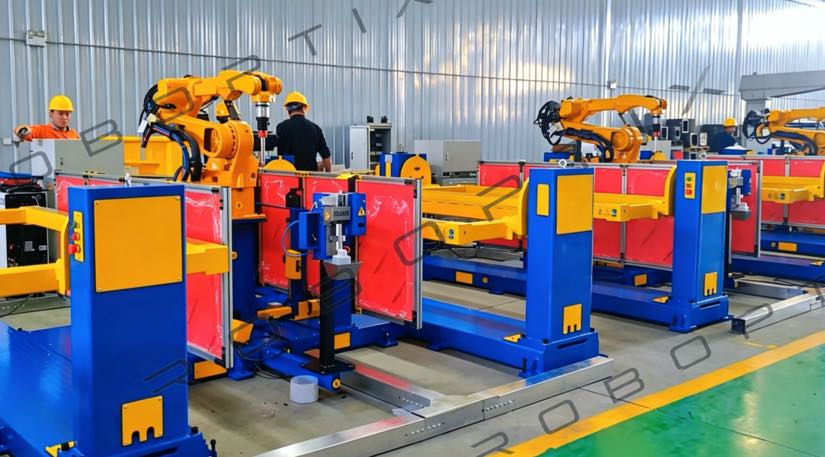
Positioners & Tooling Fixtures are often underestimated but account for 15-25% of total investment. A dual-axis servo positioner costs 7,000 to 17,000 USD, with custom tooling fixtures adding 3,000 to 8,000 USD. Designs compliant with ISO 10218-1:2025 require additional clamping force monitoring and fall prevention mechanisms.
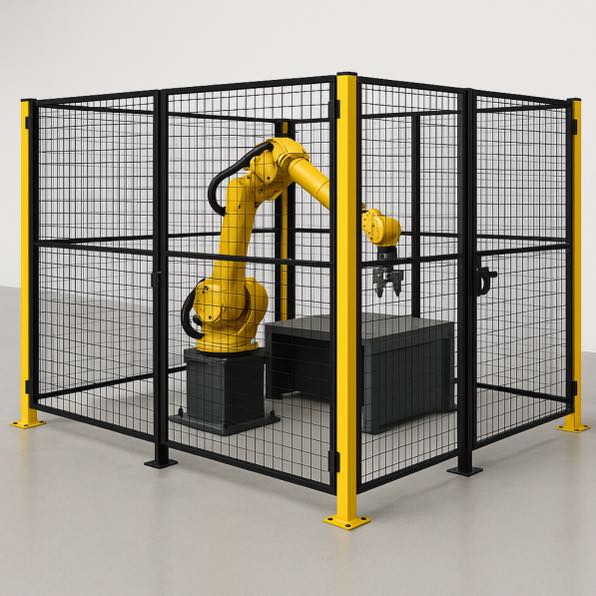
Safety System is mandatory. The ISO 10218 series clearly requires industrial robot systems to include safety fencing, interlocking devices, and risk assessment documentation. A compliant safety fencing and light curtain package costs 3,000 to 7,000 USD, with fume extraction adding 2,000 to 5,500 USD.
Cost Module 2: Software & Programming (Approximately 5-10% of Total Investment)
Software costs are often overlooked by first-time buyers.
Offline Programming Software licenses cost 3,000 to 8,000 USD. Popular options include RobotStudio (ABB), Roboguide (Fanuc), and Sim Pro (Yaskawa). These tools enable path planning and collision detection without consuming production time.
Teach Pendant & User Interface is usually included with the robot, but advanced features like seam tracking or adaptive control may require additional licenses, costing 7,000 to 50,000 USD.
Data Collection & MES Integration requires additional software modules and development hours if traceability is needed in a connected production environment. Budget 1,500 to 3,000 USD.
Cost Module 3: Integration & Commissioning (Approximately 15-25% of Total Investment)
Integration is the process of combining hardware and software into a functional system — and a critical success factor.
System Integration Service Fees range from 7,000 to 21,000 USD depending on integrator experience and project complexity. Experienced integrators shorten commissioning timelines but charge higher rates.
On-Site Installation & Commissioning typically takes 2 to 4 weeks, costing 3,000 to 7,000 USD. System integration compliant with ISO 10218-2 requires additional risk assessment and safety validation.
Training Costs range from 1,500 to 4,000 USD, including operator training (1-2 weeks) and maintenance engineer training (3-5 days). AWS data shows adequate training is a key factor in achieving over 70% robotic cell utilization.
Cost Module 4: Operating & Maintenance Costs (Annual Budget, Approximately 8-12% of Initial Investment)
Operating costs are essential to consider for long-term ownership.
Annual Maintenance Contract costs 2,000 to 4,000 USD, typically covering periodic inspections, software updates, and remote support. Some companies opt for on-demand service at 300to700 USD per visit.
Spare Parts & Consumables include welding torch nozzles, contact tips, wire feed rollers, and robot lubricants. Annual budget: 1,500 to 3,000 USD.
Compared to manual welding, robotic welding saves 15-30% on wire and gas, partially offsetting spare parts costs.
Electricity Consumption: A welding robot averages 5-8kW. With 24/7 operation, annual electricity costs are approximately 2,000 to 4,000 USD.
Cost Summary Table
| Cost Category | Low Budget | Standard | High-End |
| Robot | $11-17k | $21-31k | $31-39k |
| Welding Power Source | $3,500-5,500 | $5,500-8,500 | $8,500-14k |
| Positioner + Tooling | $5,500-11k | $11-17k | $17-25k |
| Safety + Fume | $3,000-5,500 | $5,500-8,500 | $8,500-12,500 |
| Software Licenses | $700-2,000 | $3,000-5,500 | $5,500-8,500 |
| Integration + Training | $4,000-8,500 | $8,500-14k | $14-21k |
| Total Initial Investment | $28-49k | $54-83k | $83-118k |
Note: Above prices based on 2026 market reference rates. Actual prices vary by brand, configuration, and region.
Real-World Cases: Three Budget Scenarios
Case Study 1: Small Metal Furniture Factory (Low-Budget Solution, Total Investment of Approximately $39,000)
This company has an annual welding volume of approximately 8,000 pieces, with workpieces consisting of square tube frames. The solution selected included a 6-axis robot (approximately $12,500) + a MIG welder (approximately $4,200) + a single-axis positioner (approximately $5,500) + a simplified safety enclosure (approximately $3,000). The integrator provided two weeks of commissioning support and three days of training. After 12 months of actual operation, the system eliminated the need for 1.5 welders, generating annual savings of approximately $25,000, with a payback period of about 19 months.
Case Study 2: Medium-Sized Automotive Parts Supplier (Standard Solution, Total Investment Approx. $72,000)
This company is a Tier 2 automotive supplier that welds subframes and bracket-type parts. They selected a Fanuc ARC Mate robot (approx. $29,000) + Lincoln Electric welder (approx. $8,500) + dual-axis servo positioner (approx. $14,000) + compliant safety enclosure and fume extraction system (approx. $8,500) + offline programming software (approx. $4,200). The integrator was fully responsible for commissioning and training. After implementation, the defect rate dropped from 9% to 2.5%, with an annual net benefit of approximately $58,000 and a payback period of about 15 months.
Case Study 3: Large Construction Equipment Manufacturer (High-Specification Solution, Total Investment: Approximately $108,000)
This company welds buckets and structural components, which are heavy and have high weld quality requirements. The solution included a Yaskawa Motoman robot (approx. $36,000) + Fronius TPS/i welder (approx. $12,500) + heavy-duty dual-axis positioner (approx. $21,000) + fully enclosed safety enclosure and laser scanner (approx. $12,500) + complete data acquisition and MES integration (approx. $7,000). The integration fully complies with all requirements of ISO 10218-2. After implementation, production capacity increased by 3.8 times, with annual revenue of approximately $118,000 and a payback period of approximately 11 months.
Hidden Costs
Based on actual deployment cases, here are four costs most companies overlook:
Tooling Iteration: First-run tooling often requires 1-2 modifications. Budget an additional 1,500 to 4,000.
Trial Welding & Process Development: For new materials or joint types, additional parameter development costs 700 to 3,000.
Initial Spare Parts Inventory: Purchase consumables upfront — contact tips, nozzles, wire feed rollers. Budget 400 to 1,100.
Electrical & Air Line Upgrades: Some shops need panel upgrades or compressed air line modifications. Budget 700 to 3,000.
ROI Reference Framework
According to International Federation of Robotics (IFR) data and enterprise tracking, a typical ROI model looks like this:
Using a standard system (~$70,000 total investment) as an example:
- Replaces 1.5-2 welders → annual labor savings: $21,000-28,000
- Productivity gains from increased throughput → $14,000-21,000
- Rework reduction (8% → 2-3%) → $4,000-7,000
- Wire & gas savings (15-30%) → $3,000-4,000
Total annual benefit: $42,000-60,000, payback period of 14-20 months. The next 5-8 years are net positive.
Frequently Asked Questions
Are used robotic welding cells worth considering?
Used equipment costs 40-60% of new prices. However, verify controller version supports offline programming, spare parts are still in production, and safety systems meet current ISO 10218 requirements. An independent integrator should conduct a condition assessment.
Is leasing or Robotics-as-a-Service (RaaS) available?
Some integrators offer leasing at 1,100 to 2,100 per month, including equipment, maintenance, and some technical support. Suitable for first-time adopters, shops with limited budget, or those with fluctuating order volumes.
How do response times vary by brand?
Tier 1 brands typically offer 24-48 hour response in major industrial cities. Some brands may take 3-5 days. Spare parts lead times range from 2 days to 2 weeks. Clarify these commitments during vendor selection.
Key data cited in this article comes from:
- International Federation of Robotics (IFR) : Global industrial robot installation and trend data
- International Organization for Standardization (ISO) : ISO 10218 robot safety standards series
- American Welding Society (AWS) : Welding workforce supply/demand data
- 2024-2025 actual deployment case procurement and audit information
Next Step
If you are evaluating the budget and ROI of a robotic welding cell for your shop, continue to the next article in this series:
Robotic Welding Cell vs Manual Welding: Which Is Better for Modern Manufacturing?
We will compare selection logic, configuration recommendations, and real-world case studies for different business scales.
Data Sources & References
- International Federation of Robotics (IFR) – World Robotics Report, industrial robot installation data
- International Organization for Standardization (ISO) – ISO 10218-1:2025 “Robotics — Safety requirements for industrial robots”
- International Organization for Standardization (ISO) – ISO 10218-2:2011 “Robot systems and integration safety requirements”
- American Welding Society (AWS) – Welding Workforce Data, 2029 welder shortage projection
- 2024-2025 actual deployment case procurement and audit data (anonymized)
Author Identification
This article is based on the International Federation of Robotics (IFR) World Robotics Report 2025, American Welding Society (AWS) workforce data, and major manufacturer technology roadmaps.
Author:
An expert in robotic welding system integration with over 12 years of industry experience. My company has over 26 years of professional experience, holds more than 40 patented technologies, and has successfully completed over 1,500 projects worldwide (approximately 70% of which involved robotic welding cells, totaling more than 1,000 units). The company holds EU CE certification (Certificate No.: M.2026.206.C134866) and complies with the EN 60204-1:2018 and EN ISO 12100:2010 standards. I have assisted numerous manufacturing companies throughout the entire process of robotic welding workstation implementation, from selection to production launch.
Updated: May 2026
RELATED POSTS
Fixture-Free Fabrication: When a Welding Positioner Replaces Complex Jigs, Tack Welds, and Crane Time
Robotic Welding Cell vs Traditional Welding Line: What Actually Changes on Your Shop Floor
Manual vs Robotic Welding for Structural Steel:When Does Automation Pay Off?
Tight Budget, Smart Choice:How Small and Mid-Size Factories Get the Most Value from a Robot Positioner in 2026
How to Choose the Right Robotic Welding Cell for Your Shop? Single-Station vs. Two-Station (2026 Complete Guide)