Custom Robot Workstations And Laser Systems Manufacturer


7th Axis Robot vs Traditional Gantry: Which Is Better for Your Welding or Material Handling Line?
Author Identification
I am a robotic welding system integration expert with 12+ years of industry experience specializing in 7th axis robot systems. My company has 26+ years of professional expertise, holds40+ patentsrelated to7th axis robottechnology, and has successfully completed 1,500+ global projects(of which approximately 70% integrate 7th axis robot systems into welding cells, totaling over 1,000 units). We hold EU CE certification(Certificate No.: M.2026.206.C134866) for our 7th axis robot systems, complying with EN 60204-1:2018 and EN ISO 12100:2010 standards. I have assisted numerous manufacturing enterprises throughout the entire process from selection to production launch of 7th axis robot welding workstations.
Updated: May 2026
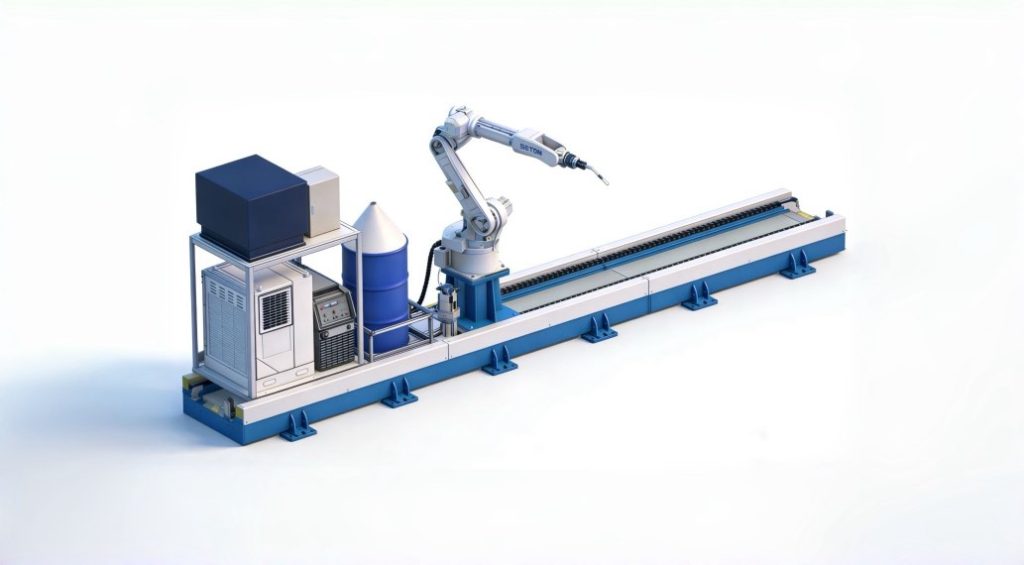
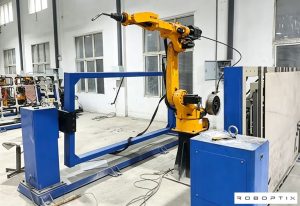
(The floor track shown in the figure does not include the robotic arm.)
The $100,000 Question About 7th Axis Robot vs Gantry
“Space is tight. Budget is tighter. Should I buy a 7th axis robot track or a gantry system?”
This is the #1 question we heard from manufacturers in 2025-2026. Both solutions extend your robot’s working range. But choose wrong, and you could exceed your budget by 50-100%— or waste hours of maintenance time every week.
Let me save you months of research. Based on 1,500+ global projects, here is the direct comparison between a 7th axis robot track and traditional gantry systems — and exactly which one you should choose for your welding or material handling line.
Quick Definitions
7th Axis Robot Track System: A 7th axis robot mounted on a linear track, moving along floor-mounted rails. The 7th axis robot track consists of high-strength steel or cast iron bases, precision linear guides, rack-and-pinion drive systems, and servo motors with gearboxes. Ideal for multi-station, long-travel, medium-to-heavy load applications.
Traditional Gantry System: A robot mounted upside-down or sideways on a large truss structure, moving along X, Y, and/or Z axes via motors, gearboxes, and wire ropes or chains. Ideal for very large envelopes, extremely heavy loads, and applications requiring obstacle crossing. Unlike a 7th axis robot, gantries are permanent and costly to relocate.
Detailed Comparison: 7th Axis Robot vs. Gantry
Based on our 1,500+ project database and field data from 2024-2026, here is the side-by-side comparison between a 7th axis robot and a traditional gantry:
| Dimension | 7th Axis RobotSystem | Traditional Gantry |
| Typical Load | 500kg – 5,000kg (D003 7th axis robot model: 3,000kg) | 1,000kg – 10,000kg+ |
| Typical Travel | 3m – 50m+ (modular expansion for your 7th axis robot) | 5m – 100m+ (custom) |
| Floor Space Required | Low (your 7th axis robot track width ~0.8-1.2m) | High (requires columns and crossbeams) |
| Installation Difficulty | Medium (leveling + bolting your 7th axis robot track) | High (heavy foundation + large lifting equipment) |
| Installation Time | 2-5 days for a 7th axis robot system | 2-4 weeks |
| Initial Investment | $30,000 – $60,000 for a complete 7th axis robot | $100,000 – $500,000+ |
| Maintenance Cost | Low (lubricate 7th axis robot rails + inspect rack) | High(multiple motors, gearboxes, wire ropes/chains) |
| Repeatability | ±0.05mmfor every 7th axis robot we deliver | ±0.1mm – ±0.5mm (depends on travel) |
| Maximum Speed | 2.5m/s for D001/D002 7th axis robot models | 1.5 – 2.0 m/s |
| Flexibility | High (your 7th axis robot can be moved to other lines) | Low (fixed structure, difficult to relocate) |
| Integration with Positioners | Easy (your 7th axis robot walks to positioners) | Complex (requires synchronized multi-axis control) |
| Suitable Robot Types | Welding,handling, palletizing, painting with a 7th axis robot | Large spot welding, heavy handling, aerospace |
| Protection | IP67 optional for your 7th axis robot(spatter, dust) | Usually open, susceptible to contamination |
| Lead Time | 3-6 weeks for a 7th axis robot system | 8-16 weeks |
6 Key Advantages of a 7th Axis Robot Over a Gantry
Based on customer feedback and field performance data, here are the 6 most compelling reasons manufacturers choose a 7th axis robot over a gantry:
1. High Flexibility — Move Your 7th Axis Robot When You Need To
A 7th axis robot track system uses modular design. The track bases are precision-machined (straightness within 0.1mm per meter) and bolted together. If you need to reconfigure your production line in the future, your 7th axis robot track can be disassembled and reinstalled in a new location within days.
A gantry system, once installed, is permanent. Moving it requires weeks of work, heavy cranes, and significant expense. A 7th axis robot offers flexibility that no gantry can match.
2. Seamless Integration with Welding Positioners Using a 7th Axis Robot
This is the killer feature for welding applications using a 7th axis robot.
As your 7th axis robot walks along the track, it can service multiple positioners in sequence:
- Your 7th axis robot welds at Positioner A
- While welding continues, operator unloads Positioner B and clamps Positioner C
- Your 7th axis robot finishes, slides to Positioner B, and continues working
Result: Operator and 7th axis robot work in parallel. No waiting. Arc-on time jumps from 35% to 85%+ with a 7th axis robot.
Achieving the same multi-station welding with a gantry requires complex synchronized control logic and significant additional programming time — often doubling integration costs. A 7th axis robot avoids this complexity entirely.
3. Fast Installation of Your 7th Axis Robot — Minimal Production Downtime
Most 7th axis robot systems can be installed and commissioned within 2-5 days:
- Prefabricated steel rail bases for your 7th axis robot
- CNC-machined mounting surfaces
- On-site work limited to floor leveling and bolting your 7th axis robottrack
We recommend scheduling 7th axis robot installation during weekends or holidays. Many of our customers have zero production downtime when adding a 7th axis robot.
Gantries typically require 2-4 weeks of installation, often demanding extended production line shutdowns. Your 7th axis robot gets you running faster.
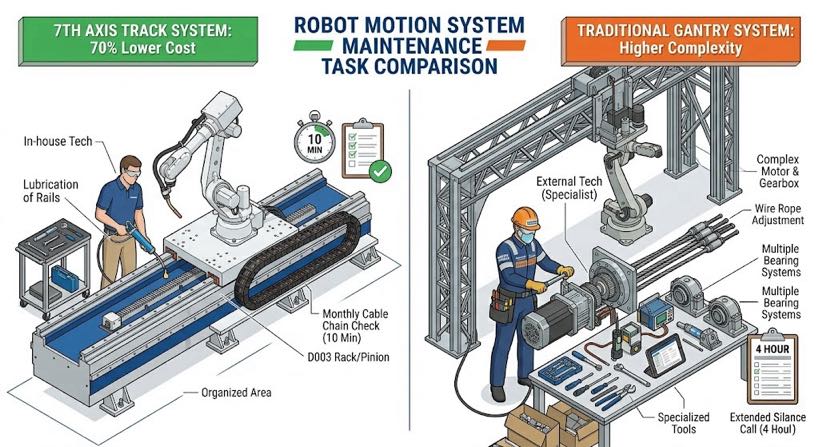
4. Simple Maintenance — Your In-House Team Can Handle Your 7th Axis Robot
Primary maintenance for a 7th axis robot track:
- Weekly lubrication of linear rails and rack on your7th axis robot
- Monthly inspection of cable drag chains on your 7th axis robot
- Quarterly cleaning of protective covers (bellows or metal) on your 7th axis robot
These tasks can be performed by your existing in-house maintenance team with minimal training. No special skills needed for your 7th axis robot.
Gantries involve:
- Multiple motors and gearboxes requiring synchronization
- Wire rope or chain drives that stretch and need adjustment
- Complex bearing systems that require specialized knowledge
Bottom line: Your 7th axis robot maintenance costs are typically 70% lower than gantry maintenance over 5 years.
5. Much Shorter Payback Period with a 7th Axis Robot
Let’s compare actual ROI based on our customer database for 7th axis robot vs. gantry:
| Metric | Gantry System | 7th Axis RobotTrack |
| Initial investment | $150,000 – $500,000+ | $30,000 – $60,000 for a 7th axis robot |
| Installation time | 2-4 weeks | 2-5 days for your 7th axis robot |
| Annual maintenance | $8,000 – $15,000 | $3,000 – $6,000 for your 7th axis robot |
| Typical payback | 24-36 months | 8-14 months with a 7th axis robot |
Real example: A heavy fabrication customer was quoted $380,000 for a gantry system. They chose our D003 7th axis robot track at $58,000.Payback: 9 months with their 7th axis robot.
6. Proven Compatibility of Our 7th Axis Robot with All Major Robot Brands
Our 7th axis robot systems work with:
- Fanuc(all ARC Mate and R-2000 series) — integrate with our 7th axis robot
- KUKA(KR QUANTEC and KR CYBERTECH) — pair with our 7th axis robot
- ABB(IRB 2600, 4600, 6700 series) — mount on our 7th axis robot
- Yaskawa Motoman(GP and AR series) — combine with our 7th axis robot
- And all other major brands — all compatible with our 7th axis robot
Simply replace the robot mounting plate/adapter. Retrofitting your existing robot to our 7th axis robot typically takes 2-3 weeks from order to operation.
Gantry systems often require brand-specific engineering and custom interfaces, adding time and cost. Our 7th axis robot eliminates this complexity.
Real-World Case: Heavy Fabrication Shop Chooses 7th Axis Robot Over Gantry
Customer: Heavy structural components manufacturer (construction machinery industry)
Location: Midwestern USA
Application: Welding excavator arms up to 12 meters long using a 7th axis robot
The Problem:
The customer needed to weld 12-meter excavator arms. Their original plan was a $380,000 gantry system with a 4-month lead time. The gantry would require:
- A reinforced concrete foundation ($40,000 extra)
- 3 weeks of installation downtime
- Specialized maintenance training
The Alternative We Proposed:
A D003 heavy-duty 7th axis robot track system with 15-meter travel, 3,000kg load capacity, paired with their existing Fanuc Arc Mate robot as a complete 7th axis robot solution.
The Results:
- Initial investment:$380,000 (gantry) → $62,000 (7th axis robot)— 84% lower
- Installation time:3 weeks → 4 days for their 7th axis robot— 80% faster
- Arc-on time:38% → 86%with the 7th axis robot— doubled productivity
- Daily output:120 parts → 310 parts using one 7th axis robot— 158% increase
- Payback period for the 7th axis robot:9 months
Customer Quote:
“We were ready to write the check for the gantry. Our integrator suggested we look at a 7th axis robot track instead. I’m glad we listened. Not only did we save over $300,000, but our 7th axis robot was up and running in four days instead of a month.Our 7th axis robot system changed how we think about automation.” — Plant Manager
Decision Guide: 7th Axis Robot vs. Gantry — Which One Should You Choose?
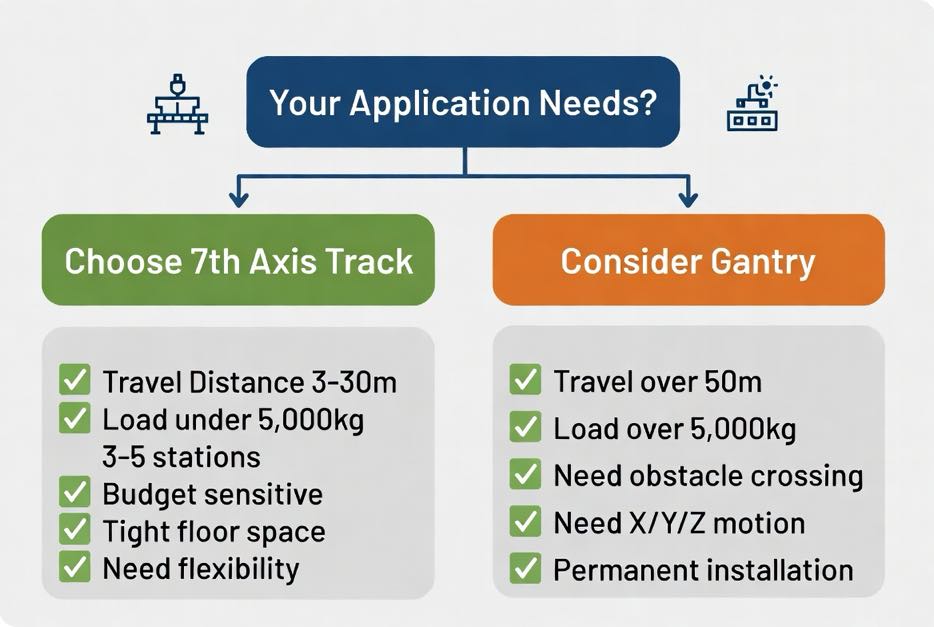
Choose a 7th Axis Robot Track System When:
| Condition | Why a7th Axis RobotIs Better |
| Travel distance between 3m and 30m | Sweet spot for 7th axis robot cost-effectiveness |
| Load capacity within 5,000kg | Our D003 7th axis robot handles 3,000kg — sufficient for 90% of applications |
| Need to serve 3-5 discrete stations | A 7th axis robot excels at welding cells, CNC machines, press lines |
| Future line reconfiguration is likely | Your 7th axis robot track can be moved and reused |
| Budget-sensitive with goal of <12 month payback | 7th axis robot is the clear winner |
| Welding, handling, palletizing, or painting | Proven applications with thousands of 7th axis robot installations |
| Tight floor space | Your 7th axis robot track width only 0.8-1.2m |
| Want to use your existing robot | Our 7th axis robot is compatible with all major brands |
Consider a Gantry System Only When:
| Condition | Why Gantry (Not a 7th Axis Robot) |
| Travel distance exceeds 50m | Very long travel favors gantry design over a 7th axis robot |
| Load exceeds 5,000kg | Gantry handles higher payloads than a standard 7th axis robot |
| Need to cross floor obstacles | Gantry goes over;7th axis robot goes around |
| Robot requires X/Y/Z motion (not just single axis) | Gantry provides multi-axis by design; a 7th axis robot is linear |
| Budget is ample and reconfiguration is unlikely | Gantry is permanent; a 7th axis robot offers flexibility you may not need |
| Clean environment with no dust or spatter | Gantry components are typically unprotected; a 7th axis robot can be protected |
Hybrid Solution: 7th Axis Robot + Light-Duty Gantry
For special applications requiring both long travel and lateral movement (e.g., ±1m side-to-side while traveling 30m), a hybrid solution can be designed:
- 7th axis robot track provides primary long travel
- A small light-duty gantry mounted on the 7th axis robot track provides lateral (Y-axis) movement
This combination is often 50-60% lower cost than a full large gantry system, while still giving you the benefits of a 7th axis robot. Contact us for custom engineering.
Frequently Asked Questions About 7th Axis Robot Systems
Q: Can I add a 7th axis robot to my existing welding robot?
A: Yes. Our 7th axis robot system is compatible with all major brands (Fanuc, KUKA, ABB, Yaskawa). Simply replace the robot mounting plate/adapter. Retrofitting your 7th axis robot typically takes 2-3 weeks.
Q: How long does 7th axis robot installation take?
A: 2-5 days for most 7th axis robot systems. We recommend weekend or holiday installation to minimize production impact. For urgent needs, we offer 24-hour rapid installation services for your 7th axis robot.
Q: Will welding spatter damage my 7th axis robot track?
A: No. We offer metal covers or bellows to protect your 7th axis robot against spatter and dust. IP67-rated servo motors and sealed linear guides are also available for your 7th axis robot. With normal maintenance, your 7th axis robot track life exceeds 10 years.
Q: What is the typical payback period for a 7th axis robot?
A: Based on our 1,500+ projects, typical payback for a 7th axis robotis8-14 months. In welding applications with low arc-on time, your 7th axis robot payback can be as fast as 6 months.
Q: Can multiple robots share one 7th axis robot track?
A: Yes. Multiple robots can be mounted on a single long 7th axis robot rail. They can work independently or collaborate on complex tasks. For example: one robot welds, another grinds, a third inspects — all automatically flowing along the same 7th axis robot track.
Q: What are the floor requirements for a 7th axis robot?
A: Concrete floor with flatness of ±1mm per 3 meters for proper 7th axis robot operation. We provide a free site survey and foundation assessment report before your 7th axis robot installation.
7th Axis Robot vs. Gantry
Based on actual 2025 project data comparing a7th axis robotto a gantry system:
| Cost Factor | Gantry System | 7th Axis RobotTrack | Savings with7th Axis Robot |
| Equipment | $150k – $500k | $30k – $60k for a 7th axis robot | 70-80% |
| Installation | 2-4 weeks | 2-5 days for your 7th axis robot | 80-90% time |
| Foundation work | Often required ($20k-50k) | Standard floor only for your 7th axis robot | $20k-50k |
| Annual maintenance | $8k – $15k | $3k – $6k for your 7th axis robot | 50-60% |
| Payback period | 24-36 months | 8-14 months with a 7th axis robot | 60% faster |
Is Your Production Line Ready for a 7th Axis Robot?
Good candidates for a 7th axis robot track system:
✓ Long parts (over 2 meters) — let a 7th axis robot reach them
✓ Multiple machines within 20-30 meters — one 7th axis robot serves them all
✓ Low robot utilization (below 50%) — a 7th axis robot will double it
✓ Arc-on time below 60% (welding applications) — a 7th axis robot pushes it above 85%
✓ Tight shop floor space — a 7th axis robot track takes minimal room
✓ Planning to increase output without adding headcount — your 7th axis robot does more with less
✓ Need to handle multiple part types with frequent changeovers — a 7th axis robot delivers flexibility
Poor candidates for a 7th axis robot:
✗ Single station, single part, continuous production only — a 7th axis robot may be overkill
✗ Very light robots and parts (under 10kg) with extremely fast cycles (under 5 seconds)
✗ Already have excess idle robots that cannot be redeployed
✗ Floor cannot be modified (rented facility with restrictions)
✗ Need to cross multiple floor obstacles (conveyors, pits, existing equipment) — a 7th axis robot goes around, but multiple obstacles may favor a gantry
Coming Next in Our 7th Axis Robot Series
Part 3:2026 7th Axis Robot Selection Guide: Payload, Stroke, Repeatability & Brand Compatibility
In Part 3, we will cover:
- How to calculate the exact payload your 7th axis robot needs
- Stroke planning for your 7th axis robot layout
- Repeatability requirements for different applications of your 7th axis robot
- Brand compatibility matrix for your 7th axis robot
- Drive type comparison for your 7th axis robot: rack & pinion vs. ball screw vs. belt drive
- A downloadable 7th axis robot selection checklist
Take Action Now: Evaluate a 7th Axis Robot for Your Line
Your choice: Not every production line needs a 7th axis robot. But if your line matches the “good candidate” characteristics above, a gantry system may be unnecessary overkill compared to a 7th axis robot.
Get a free 30-minute consultation on 7th axis robot— We will:
- Review your current layout and production data
- Simulate cycle time savings with a 7th axis robot
- Provide a side-by-side cost comparison (7th axis robot vs. gantry)
- Deliver a written ROI analysis for your 7th axis robot within 24 hours
Download our free 7th axis robot vs. gantry comparison PDF— Includes the full comparison table, cost calculator template, and project planning checklist for your 7th axis robot.
Technical Specifications (D Series 7th Axis Robot Tracks)
| Parameter | D0017th Axis Robot(Light) | D0027th Axis Robot(Short Travel) | D0037th Axis Robot(Heavy) |
| Typical load | Up to 500kg | Up to 1,500kg | Up to 3,000kg |
| Typical travel | 3m – 10m | 5m – 20m | 10m – 50m+ |
| Repeatability | ±0.05mm | ±0.05mm | ±0.05mm |
| Max speed | 2.5 m/s | 2.5 m/s | 2.0 m/s |
| Drive type | Rack & pinion | Rack & pinion | Rack & pinion |
| Rail material | High-strength steel | High-strength steel | Cast iron / steel |
| Protection | IP54 (IP67 optional for your7th axis robot) | IP54 (IP67 optional) | IP54 (IP67 optional) |
| Compatible robots | Small 6-axis | Medium 6-axis | Large 6-axis |
| Lead time | 3-4 weeks | 3-5 weeks | 4-6 weeks |
All 7th axis robot models include: precision linear guides, rack-and-pinion drive, servo motor with gearbox, robot mounting plate, cable drag chain, limit switches, and homing sensors. Metal covers or bellows available as options for your 7th axis robot.
References & Engineering Standards
- Regulatory & Safety Compliance:
- EN ISO 12100:2010:Safety of Machinery — General principles for design — Risk assessment and risk reduction.
- EN 60204-1:2018:Safety of Machinery — Electrical equipment of machines — Part 1: General requirements.
- EU CE Certification Registry: Certificate No. M.2026.206.C134866.
- Market Intelligence:Association for Advancing Automation (A3). (2025).Comparative Market Study on Linear Motion Track (7th Axis) Adoption Rates vs. Traditional Overhead Gantry Frameworks.
- Precision & Performance Testing:ISO 9283:1998(Manipulating industrial robots — Performance criteria and related test methods). Applied for benchmarking repeatability deviations ($\pm0.05\text{mm}$) on the D-Series Track platforms.
- Industrial Economic Analysis:Robotics Automation Council. (2025).Lifecycle Cost Management (LCC) and Payback Velocity Metrics for Flexible Manufacturing Systems (FMS). Industrial Press.
- Empirical Field Data:Statistical evaluations derived from a consolidated internal database tracking 1,500+ integrated global robotic projects (2014–2026) across heavy automotive, renewable energy, and aerospace sectors.
RELATED POSTS
How to Choose the Right Robotic Welding Cell for Your Shop? Single-Station vs. Two-Station (2026 Complete Guide)
Robotic Welding Cell Maintenance Guide: Best Practices, Schedule & Troubleshooting 2026
5 Reasons Large Workpiece Welding Is Inefficient — and How a Robot Positioner Solves Each One
How to Select a Robotic Laser Welding Supplier: From Technical Assessment to Sample Testing
Can You Trust the Spec Sheet? How to Verify Welding Positioner Accuracy with Laser Trackers and ISO 9283