Custom Robot Workstations And Laser Systems Manufacturer


Why Add a 7th Axis Robot? 5 Powerful Ways to Boost Productivity & Cut Costs in 2026
Author Identification
I am a robotic welding system integration expert with 12+ years of industry experience specializing in 7th axis robot systems. My company has 26+ years of professional expertise, holds 40+ patents related to robotic 7th axis technology, and has successfully completed 1,500+ global projects (of which approximately 70% integrate 7th axis robots into welding cells, totaling over 1,000 units). We hold EU CE certification(Certificate No.: M.2026.206.C134866) for our 7th axis robot systems, complying with EN 60204-1:2018 and EN ISO 12100:2010 standards. I have assisted numerous manufacturing enterprises throughout the entire process from selection to production launch of robotic 7th axis welding workstations.
Updated: May 2026
From “One Robot, One Station” to “One Robot, One Production Line” with a 7th Axis Robot
“One robot, one station.” That’s old thinking.
In 2026, with worsening labor shortages and fluctuating energy costs, letting a $60,000-$100,000 robot sit idle while you clamp parts is a luxury manufacturers can no longer afford. A 7th axis robot changes this equation completely.
According to the 2025 Association for Advancing Automation (A3) report, over 60%of manufacturers are evaluating or have already implemented some form of robotic mobility solution, with 7th axis robot systems growing at an average annual rate of 28%— the fastest-growing segment.
What if one 7th axis robotcould serve 3 to 5 stations instead of just one? 2024-2025 automation retrofit data shows that adding a robotic 7th axis(linear track) can shorten ROI payback periods by 30-50%compared to purchasing additional standalone robots. In welding and material handling, this figure can reach 60%.
Here are5 powerful ways a 7th axis robot trackcan transform your production shop.
1. Expand Working Range of Your 7th Axis Robot — Without Buying a New Robot
A stationary robot arm has a limited working range — typically a 1.5m to 3m sphere. A 7th axis robot turns this sphere into a straight-line highway.
In traditional layouts, handling large workpieces over 3 meters means either buying a larger robot (double the cost) or using expensive gantry systems (weeks of installation time). A 7th axis rail system solves this problem at a much lower cost.
Before: The robot welded small chassis parts. Operators frequently stopped production to reposition heavy fixtures, losing 3-5 minutes each time. Over a full day, cumulative downtime reached 2-3 hours.
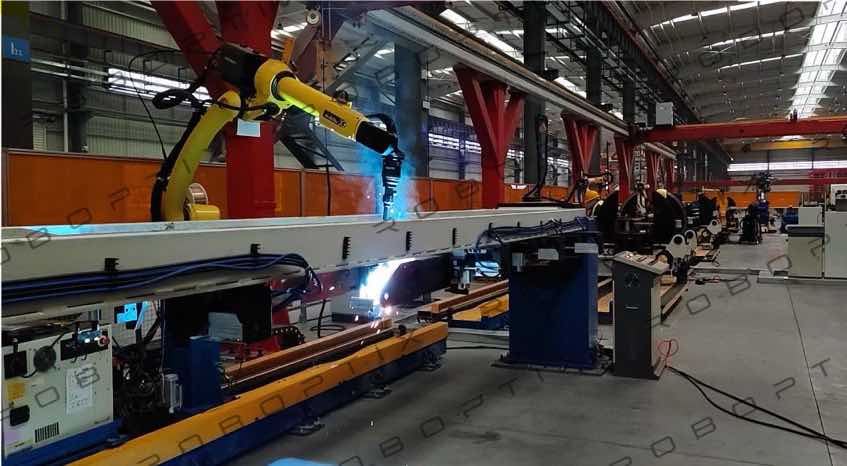
After: The 7th axis robottravels on a 15-meter rail, completing full-length welds on truck beams or solar panel arrays in one continuous pass. No intermediate stops. No manual intervention.
Result: Handle large parts (EV batteries, wind turbine components, long beams) without custom gantries. This is especially critical for aerospace and renewable energy — where part sizes are growing larger every year.
Technical Detail: Our D003 heavy-duty 7th axis robot system uses high-strength steel track bases and precision linear guides, achieving travel up to 50 meterswith straightness error controlled to within 0.1mm per meter. That means total deviation under 5mm over 50 meters — far above industry standards for any robotic 7th axis.
2. Multi-Station Efficiency — “Robot Walking” Mode with a 7th Axis Robot
This is the #1 ROI driverand the most common reason customers choose a 7th axis robot. The robot no longer waits for an operator — it walks by itself. The concept seems simple, but its impact on productivity is revolutionary.
Scenario: Three CNC machines or injection molding machines, each with a 5-minute cycle time.
Traditional Layout: One stationary robot per machine. Robots are idle 60% of the time (waiting for machines to finish). Three robots cost approximately $300,000, plus three maintenance contracts, three safety fencing areas, and massive floor space.
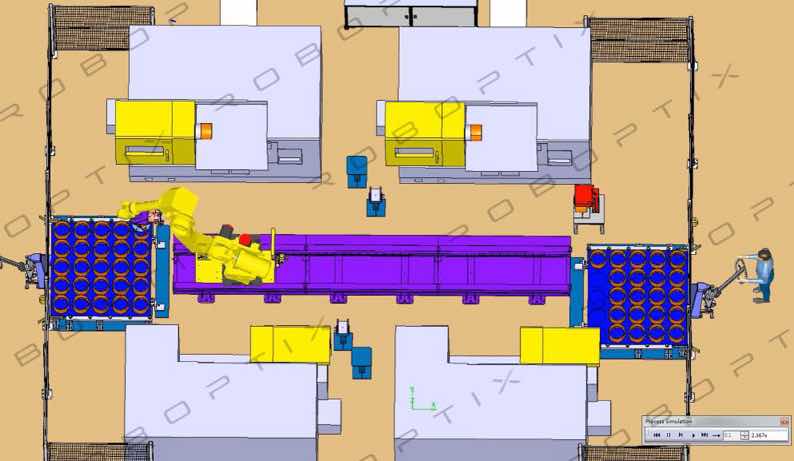
7th Axis Layout: One 7th axis robotmounted on a rail, moving between the 3 machines. Robot utilization jumps from 40% toover 85%. One 7th axis robot does the work of three.
Workflow: The robotic 7th axis picks a part from Machine 1, travels along the rail to Machine 2 for deburring, then travels to Machine 3 for inspection. No manual part handling. No multiple clamping operations.
Core Formula:1 Robot + 1 7th Axis Robot System = 3-5 Stations’ Worth of Work
Real Data: After implementing a 7th axis robot solution, an automotive parts supplier increased daily output from 480 to 820 parts across three CNC machines — a 71% increase. At the same time, operator count dropped from 3 to 1 (primarily handling loading/unloading and quality sampling).
Applicable Scenarios for 7th Axis Robot Systems:
- Parts picking and post-processing from multiple injection molding machines
- Multi-station welding (rotating between different workpieces) using a single 7th axis robot
- Multi-process part processing (milling → drilling → deburring → inspection) on one robotic 7th axis
- Material flow in Flexible Manufacturing Systems (FMS) powered by7th axis robottechnology
3. Reduce Robot Count and Lower Total Cost of Ownership with a 7th Axis Robot
This is what financial decision-makers care about most. Let’s do the math comparing stationary robots to a 7th axis robot system.
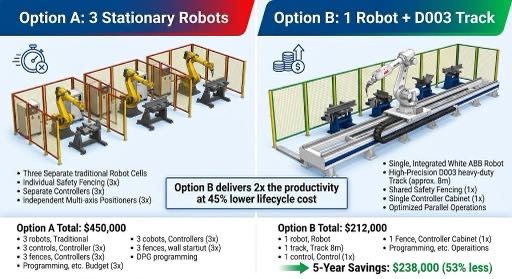
Option A: 3 Stationary Robots (No 7th Axis)
- Robot hardware: 3 × $70,000 = $210,000
- Controllers & accessories: 3 × $15,000 = $45,000
- Safety fencing & area scanners: 3 × $10,000 = $30,000
- Programming & integration: 3 × $15,000 = $45,000
- Annual maintenance: 3 × $8,000 = $24,000/year
- Total Initial Investment: ~$330,000
Option B: 1 Robot + 1 7th Axis Robot System
- Robot hardware: 1 × $70,000 = $70,000
- 7th axis robotrail system: 1 × $45,000 = $45,000
- Controllers & accessories: 1 × $15,000 = $15,000
- Safety fencing & area scanners: 1 × $12,000 = $12,000
- Programming & integration: 1 × $20,000 = $20,000 (for therobotic 7th axis)
- Annual maintenance: 1 × $10,000 = $10,000/year (for the7th axis robotsystem)
- Total Initial Investment: ~$162,000
5-Year Total Cost of Ownership Comparison:
- Option A (3 stationary): $330,000 + ($24,000 × 5) = $450,000
- Option B (1 +7th axis robot): $162,000 + ($10,000 × 5) = $212,000
- 5-Year Savings with a 7th Axis Robot: $238,000 (over 50%)
Additional Benefits of a 7th Axis Robot: You only need to teach one robot path instead of three — programming time reduced by approximately 60%. Safety certification and risk assessment workload also significantly reduced when deploying a robotic 7th axis.
4. Maximize Arc-On Time (Critical for Welding) Using a 7th Axis Robot
Welding is the fastest payback applicationfor 7th axis robot systems — bar none.
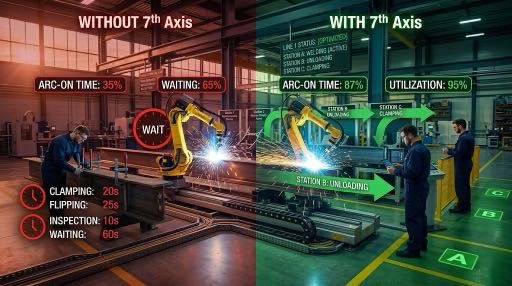
“Arc-on time” (actual welding time vs. waiting time) is the core efficiency metric for welding shops. Industry average arc-on time is only 35%— meaning robots are waiting 65% of the time. A 7th axis robot eliminates this waste.
What happens during that 65% waiting time?
- Operator clamping/unclamping parts: 15-20 seconds per cycle (while your 7th axis robot could be working elsewhere)
- Part flipping or repositioning: 10-30 seconds per cycle
- Quality inspection: 5-10 seconds per cycle
- Waiting for next batch: 10-60 seconds per cycle
Without 7th Axis Robot: 35% arc-on time. The robot waits for the operator. Every minute of waiting wastes electricity and depreciates equipment life.
With 7th Axis Robot: 85-90% arc-on time. The 7th axis robot welds at Station A while the operator unloads Station B and clamps Station C. When the robotic 7th axis finishes, it slides over and continues working. Operator and 7th axis robot work in parallel — no waiting.
Real Case Study: A Midwestern US manufacturing shop added a 7th axis robot to their Fanuc Arc Mate welding robot. Their welding line originally had 4 stations, requiring 4 robots and 6 operators (two shifts). After retrofitting with a 7th axis robot system:
- Robots: 4 →1(plus the 7th axis robot track)
- Operators: 6 →3
- Daily weld output: 120 parts →310 parts
- Arc-on time: 32% →87%
The plant manager’s feedback: “This is the smartest investment we’ve ever made.Payback in 6 months with our 7th axis robot.”
Special Note for Welding: For thick plate welding and multi-pass multi-layer welding, the arc-on time improvement from a 7th axis robot is even more dramatic. These applications have longer weld times, so the parallel operation benefit is larger.
5. Extreme Flexibility — Heavy Payload & Long Travel with a 7th Axis Robot
Mixed-model production in 2026 demands unprecedented flexibility. Small batches, high variety, and frequent changeovers are the new normal. A 7th axis robotdelivers this flexibility.
Heavy Payload Capacity of Our 7th Axis Robot Systems: Rails rated from 500kg to 5,000kg. Our D003 7th axis robot model handles 3,000kg— sufficient for large welding robots, spot welding guns, and heavy workpieces combined.
Long Travel for Your 7th Axis Robot: Standard lengths from 3m to 50m+(modular expansion). A single robotic 7th axis can process everything from small parts to oversized workpieces. Chain multiple process steps (welding → grinding → inspection) on one 7th axis robot rail. Reserve space for future expansion by adding rail modules to your 7th axis robot system.
Environmental Adaptability of Our 7th Axis Robot Systems:
- Welding shops: Metal covers or bellows protect your 7th axis robot against spatter. IP67-rated servo motors resist metal dust.
- Foundries: Sealed rails and positive pressure systems prevent sand ingress into your 7th axis robot system.
- Clean rooms: Low-particle materials and sealed designs for 7th axis robot meet medical and electronics requirements.
- Food processing: Stainless steel 7th axis robot versions and food-grade lubricants available.
Multi-Robot Coordination on a Single 7th Axis Robot Track: Multiple robots can be mounted on a single long 7th axis robot rail. They can work independently or collaborate on complex tasks. For example: one 7th axis robot welds, another grinds, a third inspects — all automatically flowing along the same robotic 7th axis track.
Real-World Case: EV Battery Housing Welding Line with a 7th Axis Robot
Industry: Automotive Tier 1 supplier (EV battery housings)
Location: East China
Application: Multi-station welding using a single 7th axis robot
Problem: 4 welding stations required 4 robots. The shop was at full capacity with no room to expand. Orders were growing 40% annually, and existing capacity was severely insufficient.
Solution: 1 7th axis robot on a 30-meter rail, serving 4 welding positioners. The robotic 7th axis rotates between the 4 stations, achieving continuous production.
Results from Deploying a 7th Axis Robot:
- Floor space reduced by60%(no plant expansion needed) thanks to the 7th axis robot system
- Capital expenditure reduced by approximately 45%(from $1.2M to $660k) by choosing a 7th axis robot over multiple stationary robots
- Changeover time reduced from 2 hours to 20 minutes with the flexible 7th axis robot
- Daily output increased from 80 to 210 parts using one 7th axis robot
- Payback period for the 7th axis robot system:9 months
- Follow-up order: 2 additional 7th axis robot systems for other production lines
Customer Quote: “We didn’t believe one 7th axis robot could do the work of four. Now we’re studying how to convert our other three lines to the same 7th axis robot model.”
Core Comparison: Stationary Robot vs. 7th Axis Robot System
| Metric | Stationary Robot (No 7th Axis) | 7th Axis RobotSystem |
| Stations served | 1 | 3-5(with one 7th axis robot) |
| Robot utilization | 40-50% | 85-95%(using a 7th axis robot) |
| Arc-on time (welding) | ~35% | ~85%(with a 7th axis robot) |
| Payback period | 18-24 months | 8-14 months(for 7th axis robot investment) |
| 5-year total cost | High | Over 50% lower with a 7th axis robot |
Frequently Asked Questions About 7th Axis Robot Systems
Q: Can I add a 7th axis robot to my existing robot?
A: Yes. Our 7th axis robot system is compatible with all major brands (Fanuc, KUKA, ABB, Yaskawa). Simply replace the robot mounting plate/adapter to integrate with your 7th axis robot track. Retrofit typically takes 2-3 weeks.
Q: How long does 7th axis robot installation take? Will it cause production downtime?
A: Most 7th axis robot systems can be installed and commissioned within 2-5 days. We recommend scheduling 7th axis robot installation during weekends or holidays to minimize production impact. For urgent needs, we offer 24-hour rapid installation services for your 7th axis robot.
Q: What are the floor requirements for a 7th axis robot?
A: Concrete floor with flatness of ±1mm per 3 meters for proper 7th axis robot operation. We offer two fixing methods: anchor bolts or embedded plates. We provide a free site survey and foundation assessment report before your 7th axis robot installation.
Q: Will welding spatter damage my 7th axis robot rail?
A: No. We offer metal covers or bellows options to protect your 7th axis robot against spatter and dust. IP67-rated servo motors and sealed linear guides are also available for harsh environments. With normal maintenance, your 7th axis robot rail life exceeds 10 years.
Q: How long does a 7th axis robot maintain positioning accuracy?
A: With normal use and maintenance (lubrication weekly), your 7th axis robot maintains ±0.05mm repeatability for over 5 years. For higher precision requirements, ball screw drive options are available for your 7th axis robot.
Is Your Production Line Ready for a 7th Axis Robot?
Good candidates for a 7th axis robot:
✓ Long parts (over 2 meters) that benefit from 7th axis robot extended reach
✓ Multiple machines within 20 meters that can share one 7th axis robot
✓ Low robot utilization (below 50%) — perfect for 7th axis robot deployment
✓ Arc-on time below 60% — a 7th axis robot will double your productivity
✓ Tight shop floor space — a 7th axis robot takes minimal footprint
✓ Planning to increase output without adding headcount — let a 7th axis robot do the work
✓ Need to handle multiple part types — a 7th axis robot offers maximum flexibility
Poor candidates for a 7th axis robot:
✗ Single station, single part, continuous production — a 7th axis robot may be overkill
✗ Very light robots and parts (under 10kg) with very fast cycles (under 5 seconds)
✗ Already have excess idle robots that don’t need a 7th axis robot
✗ Floor cannot be modified to accommodate a 7th axis robot track
Coming Next in Our 7th Axis Robot Series
In Part 2, we will cover”Robot 7th Axis vs Traditional Gantry: Which Is Better for Your Welding or Material Handling Line?
Take Action Now: Evaluate a 7th Axis Robot for Your Line
Your choice: Not every production line needs a 7th axis robot. But if your line matches the “good candidate” characteristics above, now is the best time to evaluate a 7th axis robot for your operation.
Contact us for a free 7th axis robot ROI assessment— we’ll simulate your cycle time savings within 24 hours and provide a detailed ROI analysis report for your 7th axis robot investment.
Technical Specifications of Our 7th Axis Robot Systems
| Parameter | Specification for Our 7th Axis Robot |
| Compatible robot brands | Fanuc, KUKA, ABB, Yaskawa (all major brands work with our 7th axis robot) |
| Repeatability | ±0.05mm— industry-leading for any 7th axis robot |
| Maximum speed | 2.5 m/s for D001/D002 7th axis robot models |
| Protection rating | IP67 optional for harsh environments |
| Payload range | 500kg – 5,000kg (D003 7th axis robot model: 3,000kg) |
| Travel range | 3m – 50m+ (modular expansion for your 7th axis robot) |
| Straightness error | Within 0.1mm per meter — guaranteed for every 7th axis robot |
| Manufacturing standard | ISO 9001:2025 certified facility for 7th axis robot production |
| Warranty | 1 year standard, extended available for your 7th axis robot system |
References & Regulatory Standards
- Market Intelligence:Association for Advancing Automation (A3). (2025).Robotics Mobility and 7th-Axis Linear Actuator Market Growth Analysis. A3 Technology Whitepaper Series.
- European Machinery Directive:EU CE Certification Compliance (Certificate No. M.2026.206.C134866).
- EN ISO 12100:2010:Safety of machinery — General principles for design — Risk assessment and risk reduction.
- EN 60204-1:2018:Safety of machinery — Electrical equipment of machines — General requirements.
- Production Metrics:American Welding Society (AWS). (2023).Standard for Robotic Arc Welding Performance Metrics and Arc-On Time Optimization. OAM Press.
- Mechanical Interfaces:International Organization for Standardization. (2025).ISO 9409-1: Manipulating industrial robots — Mechanical interfaces for generic tracks and gantry mounting.
- Quality Assurance:ISO 9001:2025 Certified Manufacturing Framework for Heavy-Duty Linear Motion Systems.
- Internal Empirical Data:Based on a consolidated tracking study of 1,500+ global robotic integration projects (2014–2026), compiled by the Lead Integration Engineering Team.
RELATED POSTS
Robot Positioner Buying Guide 2026:Match Your Budget to the Right System
Robotic Laser Welding Mastery: 10 Practical Tips for Maximum Performance and ROI
What Is a Robotic Welding Cell? 2026 Beginner’s Guide | 37 Shop Data
Round vs Rectangular vs Irregular: Matching Welding Positioner Configuration to Workpiece Geometry
Welding Positioner for Sale: How to Choose the Right Type for Your Part (Headstock Tailstock, L-Type, U-Type, Horizontal 3-Axis, Single Axis Rotary, Vertical Tilting)