Custom Robot Workstations And Laser Systems Manufacturer


2026 7th Axis Robot Selection Guide: Payload, Stroke, Repeatability & Brand Compatibility
The Cost of Choosing the Wrong 7th Axis Robot
“The track is installed, but the robot shakes and the torch won’t position accurately.”
This is the most common complaint I hear from customers. The problem?Wrong selection.
A poorly selected 7th axis robot causes:
- Accuracy loss
- Poor weld quality
- Shortened life (2-3 years vs. 10+ years)
- Skyrocketing maintenance costs
This is the 2026 7th axis robot quick selection guide. 5 minutes. Master the essentials.
Part 1: Five Key Parameters of a 7th Axis Robot
1. Payload — The Most Important Starting Point
How to calculate?
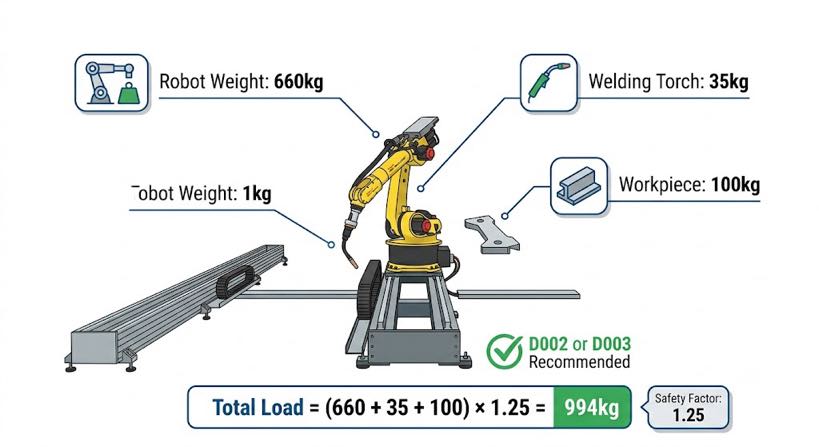
Required Load = (Robot Weight + Tool Weight + Workpiece Weight) × 1.25 (safety factor)
Real example:A Fanuc ARC Mate 120iC robot weighs 660kg. Add a 35kg welding torch and a 100kg workpiece. Total load is approximately 994kg. This scenario calls for a D002 or D003 7th axis robot.
Selection guidelines:
- Small welding or handling (150-400kg total load) →D001
- Medium welding or CNC tending (400-800kg) →D001 or D002
- Large welding or heavy handling (800-1500kg) →D002 or D003
- Extra heavy or spot welding (1500-3000kg+) →D003
Rule of thumb:The 7th axis robot rated load should be1.5xactual load for significantly longer track life.
2. Stroke — Defines Working Range
How to calculate?
Required Stroke = Left station to right station distance + Robot base length + Safety margins (200-300mm each end)
Selection guidelines:
- 3-6 meters:Single station large part or dual station compact →D001 or D002
- 6-12 meters:2-4 stations for welding or CNC lines →D002 or D003
- 12-25 meters:4-8 stations or long part welding →D003
- 25-50+ meters:Large assembly lines →D003 modular expansion
Our 7th axis robot uses modular design. You can extend later without replacing the entire system.
3. Repeatability — Affects Weld Quality
Different applications have different accuracy requirements:
- Thick plate welding (5mm+) → needs ±0.2-0.5mm
- Thin sheet welding (1-5mm) → needs ±0.1-0.2mm
- Precision sheet metal (<1mm) → needs ±0.05-0.1mm
- CNC tending → needs ±0.1-0.2mm
- Palletizing/handling → needs ±0.5-1.0mm
All D series 7th axis robot models deliver ±0.05mm repeatability. This meets all the above applications and maintains for 5+ years under normal use and maintenance.
4. Speed — Affects Cycle Time
Speed selection requires balancing efficiency and cost:
- Low speed (0.5-1.0 m/s):Heavy handling or precision welding
- Medium speed (1.0-1.8 m/s):General welding and CNC tending
- High speed (1.8-2.5 m/s):Light handling and palletizing
Our D001 and D002 7th axis robot models max speed:2.5 m/s| D003 max speed:2.0 m/s(safety for heavy loads)
Warning:Doubling your 7th axis robot speed means 4x motor power and 3x rail wear. Don’t pay for speed you don’t need.
5. Protection Rating — Defines Environmental Suitability
Dust, spatter, and coolant are the“#1 killers”of any 7th axis robot in welding shops, foundries, and grinding shops.
- IP54:General shops, light dust — our standard configuration
- IP65-67:Welding shops, foundries, high dust — optional upgrade
- IP69K:Food processing, washdown environments — custom
Critical:A 7th axis robot in a welding shop MUST use metal covers or bellows. Motor protection at least IP54.
Part 2: How to Choose Between Three 7th Axis Robot Models
Our D Series consists of three models, and the selection process is very straightforward:
D001 (Light Duty): Recommended payload 150–500 kg, stroke 3–10 meters, maximum speed 2.5 m/s. Suitable for small 6-axis robots used for material handling or small-scale welding. Delivery time is 3–4 weeks.
D002 (Short Stroke): Recommended payload 400–1,500 kg, stroke 5–20 meters, maximum speed 2.5 m/s. Suitable for medium-sized 6-axis robots used for welding or multi-station CNC loading/unloading. Delivery time: 3–5 weeks.
D003 (Heavy Duty): Recommended payload 1,000–3,000 kg, stroke 10–50 meters or more, maximum speed 2.0 m/s. Suitable for large 6-axis robots used for heavy-duty welding or spot welding. Delivery lead time: 4–6 weeks.
Quick Selection Guide: For small robots, light workpieces, and short strokes, choose D001; for medium-sized robots, multi-station applications, and welding, choose D002; for heavy robots, long strokes, and applications involving impact, choose D003.
Part 3: Why Do 7th Axis Robot Prices Vary So Much Between Suppliers?
Many customers ask:“Why are some 7th axis robot quotes only a few thousand dollars, while others reach over $100,000?”
The answer: You’re not looking at the same product.
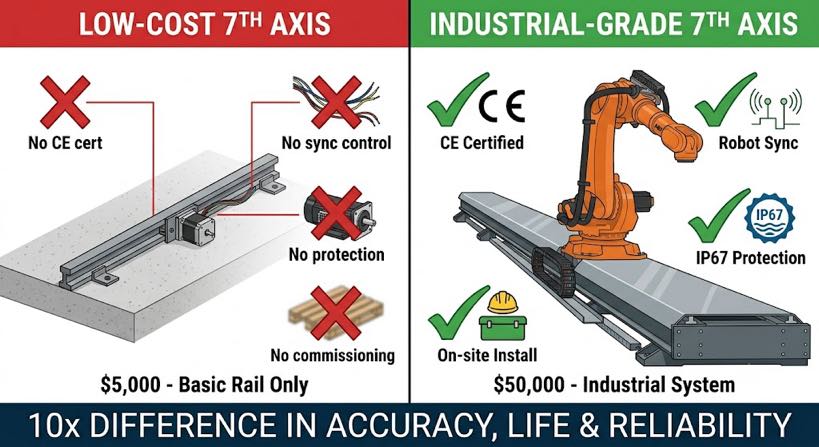
A low-cost 7th axis robot (a few thousand dollars) typically includes only:
- Basic steel structure
- Standard linear rails
- Simple motor
- No synchronized control
- No high-level protection
- No on-site commissioning
- No CE certification
Where is this 7th axis robot suitable?
- Light-duty handling
- Educational/training purposes
- Low-frequency operation
Where is this 7th axis robot NOT suitable?
- Welding (especially continuous welding)
- Spot welding
- Multi-shift factories
- Automotive industry
- Any industrial environment requiring reliability and accuracy
An industrial-grade 7th axis robot ($10,000-$100,000+) includes:
- High-rigidity steel structure
- Precision rack and pinion system
- Industrial servo system
- Synchronized communication with robot controller
- Automatic lubrication system
- Cover/protection system
- Safety system
- CE/UL certification
- Installation and commissioning services
What’s truly expensive is NOT the steel rail of the 7th axis robot itself.
Cost breakdown of an industrial-grade 7th axis robot:
| Cost Component | Percentage | Why |
| Precision machining | 15-20% | Straightness and flatness require large CNC equipment |
| Rail/rack system | 10-15% | Precision-ground racks are the core of accuracy |
| Servo system | 15-25% | Industrial servo with real-time robot communication |
| Software integration | 10-15% | Coordinating 7th axis as robot’s external axis |
| Installation & commissioning | 15-20% | On-site leveling, splicing, calibration, test cutting |
| CE/UL certification | 5-10% | Mandatory safety certifications for EU/US markets |
| Engineering design | 10-20% | Custom layout design, drawings, simulation |
In simple terms:A $5,000 7th axis robot is“a rail that can move.”A $50,000 7th axis robot is an“industrial robot seventh axis system.”The difference in accuracy, lifespan, and reliability is more than 10x.
Our advice:If your application is education, demonstration, or occasional light handling, a low-cost 7th axis robot might work. But for welding production, multi-shift operation, or any industrial application with quality requirements,choose a certified industrial-grade 7th axis robot. Otherwise, the money you save will eventually be spent on downtime, rework, and replacement.
Part 4: Compatibility with Major Robot Brands
The answer: All compatible.
Our7th axis robotsystem works with all major brands. Just replace the robot mounting plate/adapter.
| Brand | Compatible Series | Adapter Type |
| ABB | IRB 1200, 2600, 4600, 6700 series | Standard / Heavy |
| Fanuc | ARC Mate 50iC through 190iC; R-2000iC | Standard / Heavy |
| KUKA | KR 5 through KR 210 series | Standard / Heavy |
| Yaskawa Motoman | GP7 through GP88; AR series | Standard |
| Universal Robots | UR3, UR5, UR10, UR16, UR20 | Custom |
| Other brands | Kawasaki, Nachi, Hyundai, Stäubli | Standard or Custom |
Quality note:Adapters areprecision-machinedandtest-fittedwith robots before your7th axis robotis delivered.
Part 5: Customization — Our Core Strength
Standard 7th axis robot products don’t fit all needs. This is where our 26 years of experience and 40+ patents come in.
What we can customize on your 7th axis robot:
- Stroke length:Any length from 1m to 100m+
- Load capacity:Up to 10,000kg (custom)
- Protection rating:IP54, IP65, IP67, or IP69K
- Cover type:Metal covers or bellows
- Motor brand:Siemens, Yaskawa, Panasonic, or customer-specified
- Lubrication:Manual or automatic centralized
- Mounting method:Anchor bolts, embedded plates, or chemical anchors
- Color:Any RAL code
- Special features:Multi-robot coordination, explosion-proof, clean room
Customization process:
Step 1:Requirements gathering (1-2 days)
Step 2:Design proposal (3-5 days)
Step 3:Drawing approval
Step 4:Manufacturing (4-8 weeks)
Step 5:On-site installation & commissioning (2-5 days)
Part 6: Selection Checklist
Copy this checklist and confirm each item:[Download link]
Part 7: Five Common 7th Axis Robot Selection Mistakes
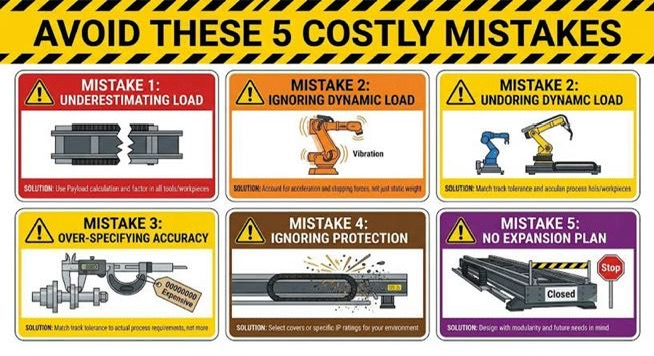
Mistake 1: Underestimating load
Calculated workpiece weight only, forgot robot weight.
Consequence:7th axis robot overload, accuracy loss, shorter life.
Solution:Use total load × 1.25 safety factor.
Mistake 2: Ignoring dynamic load
Calculated static weight only, ignored acceleration/deceleration impact.
Consequence:7th axis robot vibration, weld path deviation.
Solution:Use 1.5x safety factor for high-speed applications.
Mistake 3: Over-specifying accuracy
Requesting ±0.01mm when ±0.1mm is sufficient.
Consequence:30-50% extra cost for no benefit.
Solution:±0.05mm is enough for welding.
Mistake 4: Ignoring protection
Using unprotected rails in a welding shop.
Consequence:Sliders jam with spatter within 3 months.
Solution:Welding shops MUST use metal covers or bellows on their 7th axis robot.
Mistake 5: No expansion plan for your 7th axis robot
Stroke is just enough with no room for growth.
Consequence:Can’t extend when line changes.
Solution:Reserve 0.5-1m margin at each end.
Part 8: Investment and ROI
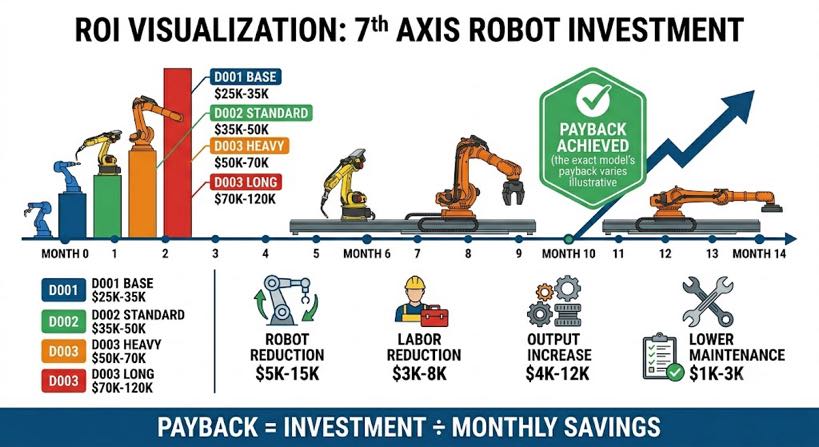
Typical 7th axis robot investment range:
| Model | Configuration | Investment Range |
| D001 | Base (3m stroke) | $25,000 – $35,000 |
| D002 | Standard (6m stroke) | $35,000 – $50,000 |
| D003 | Heavy (12m stroke) | $50,000 – $70,000 |
| D003 | Long (20-30m stroke) | $70,000 – $120,000 |
Monthly savings from a 7th axis robot:
| Savings Source | Monthly Savings |
| Robot reduction (1 vs. 2-3 robots) | $5,000 – $15,000 |
| Labor reduction (1-2 fewer operators) | $3,000 – $8,000 |
| Output increase (40% → 85% utilization) | $4,000 – $12,000 |
| Lower maintenance (single vs. multiple) | $1,000 – $3,000 |
Quick estimate:7th axis robot payback =Investment ÷ Monthly Savings
Typical payback period: 6 – 14 months
Next Steps
You’ve completed the basics of 7th axis robot selection. Now apply this knowledge to your project.
We provide FREE 7th axis robot selection support:
- Load calculation
- Layout drawing
- Cycle simulation
- ROI analysis
- Brand compatibility check
References & Engineering Standards
- Regulatory & Safety Framework:
- EN ISO 12100:2010:Safety of Machinery — Risk assessment and risk reduction guidelines for multi-axis linear platforms.
- EN 60204-1:2018:Safety of Machinery — Electrical equipment of industrial machines (Part 1: General requirements for external axes).
- EU CE Compliance Registry: Validated under Certificate No. M.2026.206.C134866.
- Kinematic & Load Calculations:
- ANSI/RIA R15.06-2014:American National Standard for Industrial Robots and Robot Systems — Safety Requirements (Dynamic Load Factor & Safety Margin Formulations).
- Mechanical Engineering Reference:Schilling, R. J. (2024).Structural Rigidity and Torque Analytics for 7th-Axis Linear Actuators under High-Acceleration Duty Cycles.
- Metrology & Accuracy Benchmarking:
- ISO 9283:1998:Manipulating industrial robots — Performance criteria and related test methods. Used as the empirical framework to guarantee the ±0.05mm long-term repeatability of the D-Series tracks.
- Environmental Mitigation:
- IEC 60529:International standard for Ingress Protection (IP54/IP67/IP69K sealing protocols for servo modules).
- AWS D16.1M:2021:American Welding Society standard for defending linear guide mechanisms against thermal slag and particulate contamination.
- Empirical System Data:Statistical validation derived from 26 years of active engineering design, 40+ proprietary patents, and the deployment of over 1,500 turnkey robotic integration cells operating globally as of May 2026.
Author Identification
I am a robotic welding system integration expert with 12+ years of industry experience specializing in 7th axis robot systems. My company has 26+ years of professional expertise, holds 40+ patents related to 7th axis robot technology, and has successfully completed 1,500+ global projects. We hold EU CE certification(Certificate No.: M.2026.206.C134866) for our 7th axis robot systems.
Updated: May 2026
RELATED POSTS
How to Install and Integrate a 7th Axis Robot: Step-by-Step Guide & Best Practices
Manual vs Robotic Welding for Structural Steel:When Does Automation Pay Off?
Turnkey Welding Workstation: From Drawing to Production-Ready Cell
6 Common Challenges in Robotic Laser Welding and How to Solve Them
Head-and-Tailstock vs. L-Type vs. U-Type Robot Positioner: How to Choose by Workpiece Shape