맞춤형 로봇 워크스테이션 및 레이저 시스템 제조업체



2026 7축 로봇 선택 가이드: 유효 탑재량, 뇌졸중, 반복성 & 브랜드 호환성
잘못된 7축 로봇을 선택하는 데 드는 비용
“트랙이 설치되어 있습니다., 하지만 로봇이 흔들리고 토치가 정확하게 위치하지 않습니다.”
This is the most common complaint I hear from customers. 문제?Wrong selection.
A poorly selected7축 로봇 causes:
- Accuracy loss
- Poor weld quality
- Shortened life (2-3 년 대. 10+ 연령)
- Skyrocketing maintenance costs
이것은 2026 7th axis robot quick selection guide. 5 분. Master the essentials.
부분 1: Five Key Parameters of a 7th Axis Robot
1. Payload — The Most Important Starting Point
How to calculate?
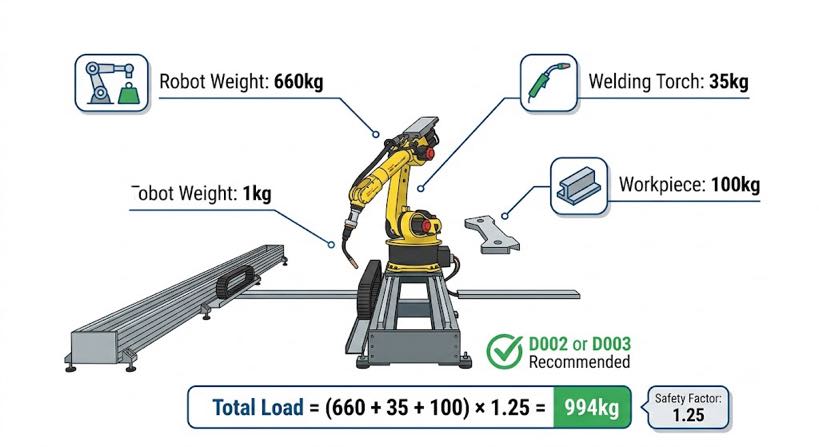
Required Load = (Robot Weight + Tool Weight + Workpiece Weight) × 1.25 (safety factor)
실제 사례:A Fanuc ARC Mate 120iC robot weighs 660kg. Add a 35kg welding torch and a 100kg workpiece. Total load is approximately994kg. This scenario calls for aD002 or D003 7th axis robot.
Selection guidelines:
- Small welding or handling (150-400kg total load) →D001
- Medium welding or CNC tending (400-800kg) →D001 or D002
- Large welding or heavy handling (800-1500kg) →D002 또는 D003
- Extra heavy or spot welding (1500-3000kg+) →D003
경험 법칙:그만큼7축 로봇 rated load should be1.5엑스actual load for significantly longer track life.
2. Stroke — Defines Working Range
How to calculate?
Required Stroke = Left station to right station distance + Robot base length + Safety margins (200-300mm each end)
Selection guidelines:
- 3-6 미터:Single station large part or dual station compact →D001 or D002
- 6-12 미터:2-4 stations for welding or CNC lines →D002 또는 D003
- 12-25 미터:4-8 stations or long part welding →D003
- 25-50+ 미터:Large assembly lines →D003 modular expansion
우리의7축 로봇 uses모듈식 디자인. You can extend later without replacing the entire system.
3. Repeatability — Affects Weld Quality
Different applications have different accuracy requirements:
- 두꺼운 판 용접 (5mm+) → needs±0.2-0.5mm
- Thin sheet welding (1-5mm) → needs±0.1-0.2mm
- Precision sheet metal (<1mm) → needs±0.05-0.1mm
- CNC tending → needs±0.1-0.2mm
- Palletizing/handling → needs±0.5-1.0mm
모두D series 7th axis robot models deliver±0.05mm repeatability. This meets all the above applications and maintains for5+ 연령 under normal use and maintenance.
4. Speed — Affects Cycle Time
Speed selection requires balancing efficiency and cost:
- Low speed (0.5-1.0 밀리미터/초):Heavy handling or precision welding
- Medium speed (1.0-1.8 밀리미터/초):General welding and CNC tending
- High speed (1.8-2.5 밀리미터/초):Light handling and palletizing
우리의D001 and D002 7th axis robot models max speed:2.5 밀리미터/초| D003 max speed:2.0 밀리미터/초(safety for heavy loads)
경고:Doubling your7축 로봇 speed means4x motor power 그리고3x rail wear. Don’t pay for speed you don’t need.
5. Protection Rating — Defines Environmental Suitability
Dust, 튐, and coolant are the“#1 killers”of any7축 로봇 in welding shops, 주조소, and grinding shops.
- IP54:General shops, light dust — our standard configuration
- IP65-67:용접 상점, 주조소, high dust — optional upgrade
- IP69K:식품 가공, washdown environments — custom
비판적인:에이7축 로봇 in a welding shopMUST use metal covers or bellows. Motor protection at leastIP54.
부분 2: How to Choose Between Three 7th Axis Robot Models
Our D Series consists of three models, and the selection process is very straightforward:
D001 (가벼운 의무): Recommended payload 150–500 kg, stroke 3–10 meters, maximum speed 2.5 밀리미터/초. Suitable for small 6-axis robots used for material handling or small-scale welding. Delivery time is 3–4 weeks.
D002 (Short Stroke): Recommended payload 400–1,500 kg, stroke 5–20 meters, maximum speed 2.5 밀리미터/초. Suitable for medium-sized 6-axis robots used for welding or multi-station CNC loading/unloading. Delivery time: 3–5 weeks.
D003 (헤비 듀티): Recommended payload 1,000–3,000 kg, stroke 10–50 meters or more, maximum speed 2.0 밀리미터/초. Suitable for large 6-axis robots used for heavy-duty welding or spot welding. Delivery lead time: 4–6 weeks.
Quick Selection Guide: For small robots, light workpieces, and short strokes, choose D001; for medium-sized robots, multi-station applications, 그리고 용접, choose D002; for heavy robots, long strokes, and applications involving impact, choose D003.
부분 3: Why Do 7th Axis Robot Prices Vary So Much Between Suppliers?
Many customers ask:“Why are some 7th axis robot quotes only a few thousand dollars, while others reach over $100,000?”
The answer: You’re not looking at the same product.
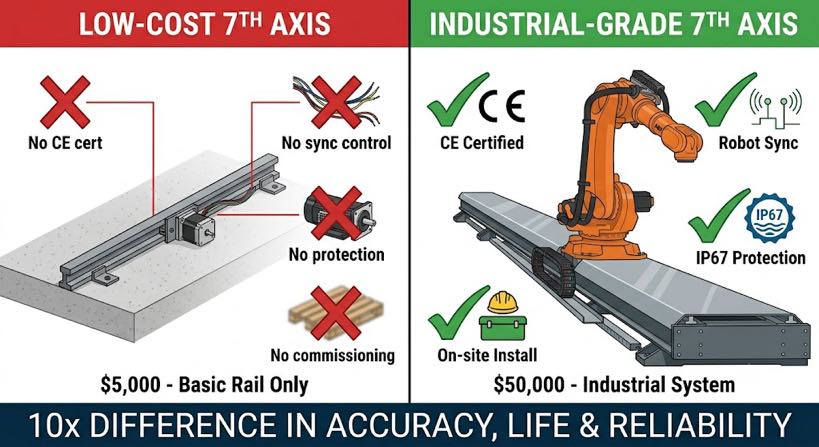
A low-cost 7th axis robot (a few thousand dollars) typically includes only:
- Basic steel structure
- Standard linear rails
- Simple motor
- No synchronized control
- No high-level protection
- No on-site commissioning
- No CE certification
Where is this 7th axis robot suitable?
- Light-duty handling
- Educational/training purposes
- Low-frequency operation
Where is this 7th axis robot NOT suitable?
- 용접 (especially continuous welding)
- Spot welding
- Multi-shift factories
- Automotive industry
- Any industrial environment requiring reliability and accuracy
An industrial-grade 7th axis robot ($10,000-$100,000+) includes:
- High-rigidity steel structure
- Precision rack and pinion system
- Industrial servo system
- Synchronized communication with robot controller
- Automatic lubrication system
- Cover/protection system
- 안전 시스템
- CE/UL certification
- Installation and commissioning services
What’s truly expensive is NOT the steel rail of the 7th axis robot itself.
Cost breakdown of an industrial-grade 7th axis robot:
| 비용 구성요소 | Percentage | 왜 |
| Precision machining | 15-20% | Straightness and flatness require large CNC equipment |
| Rail/rack system | 10-15% | Precision-ground racks are the core of accuracy |
| Servo system | 15-25% | Industrial servo with real-time robot communication |
| Software integration | 10-15% | Coordinating 7th axis as robot’s external axis |
| 설치 & 시운전 | 15-20% | On-site leveling, splicing, calibration, test cutting |
| CE/UL certification | 5-10% | Mandatory safety certifications for EU/US markets |
| Engineering design | 10-20% | Custom layout design, 그림, 시뮬레이션 |
In simple terms:A $5,0007축 로봇 is“a rail that can move.”A $50,0007축 로봇 is an“industrial robot seventh axis system.”The difference in accuracy, lifespan, and reliability ismore than 10x.
Our advice:If your application is education, demonstration, or occasional light handling, a low-cost7축 로봇 might work. But for welding production, multi-shift operation, or any industrial application with quality requirements,choose a certified industrial-grade 7th axis robot. 그렇지 않으면, the money you save will eventually be spent on downtime, 재작업, and replacement.
부분 4: Compatibility with Major Robot Brands
The answer: All compatible.
우리의7축 로봇system works with all major brands. Just replace the robot mounting plate/adapter.
| 상표 | Compatible Series | Adapter Type |
| 씨줄 | IRB 1200, 2600, 4600, 6700 시리즈 | 기준 / 무거운 |
| 화낙 | ARC Mate 50iC through 190iC; R-2000iC | 기준 / 무거운 |
| 울다 | KR 5 through KR 210 시리즈 | 기준 / 무거운 |
| Yaskawa Motoman | GP7 through GP88; AR series | 기준 |
| Universal Robots | UR3, UR5, UR10, UR16, UR20 | 관습 |
| Other brands | Kawasaki, Nachi, Hyundai, Stäubli | Standard or Custom |
Quality note:Adapters areprecision-machined그리고test-fittedwith robots before your7축 로봇is delivered.
부분 5: Customization — Our Core Strength
기준7축 로봇 products don’t fit all needs. This is where our26 years of experience 그리고40+ 특허 come in.
What we can customize on your 7th axis robot:
- Stroke length:Any length from 1m to 100m+
- 부하 용량:Up to 10,000kg (custom)
- 보호 등급:IP54, IP65, IP67, or IP69K
- Cover type:금속 커버 또는 벨로우즈
- Motor brand:지멘스, Yaskawa, 파나소닉, 또는 고객이 지정한
- 매끄럽게 하기:Manual or automatic centralized
- Mounting method:Anchor bolts, embedded plates, or chemical anchors
- Color:Any RAL code
- Special features:Multi-robot coordination, explosion-proof, clean room
Customization process:
단계 1:Requirements gathering (1-2 날)
단계 2:Design proposal (3-5 날)
단계 3:Drawing approval
단계 4:조작 (4-8 주)
단계 5:현장 설치 & 시운전 (2-5 날)
부분 6: Selection Checklist
Copy this checklist and confirm each item:[Download link]
부분 7: Five Common 7th Axis Robot Selection Mistakes
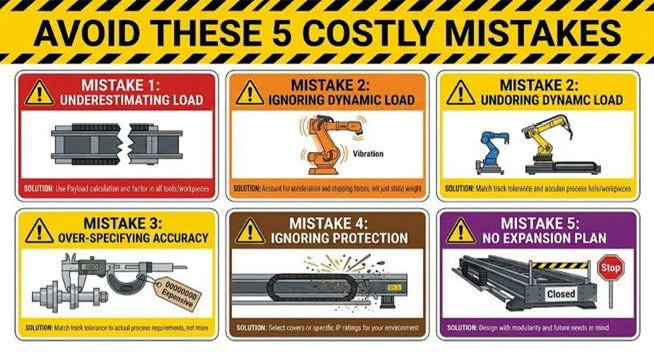
실수 1: Underestimating load
Calculated workpiece weight only, forgot robot weight.
결과:7th axis robot overload, accuracy loss, shorter life.
해결책:Usetotal load × 1.25 safety factor.
실수 2: Ignoring dynamic load
Calculated static weight only, ignored acceleration/deceleration impact.
결과:7th axis robot vibration, weld path deviation.
해결책:Use1.5x 안전계수 for high-speed applications.
실수 3: Over-specifying accuracy
Requesting ±0.01mm when ±0.1mm is sufficient.
결과:30-50% extra cost for no benefit.
해결책:±0.05mm is enough for welding.
실수 4: Ignoring protection
Using unprotected rails in a welding shop.
결과:Sliders jam with spatter within3 개월.
해결책:용접 상점MUST use metal covers or bellows on their7축 로봇.
실수 5: No expansion plan for your 7th axis robot
Stroke is just enough with no room for growth.
결과:Can’t extend when line changes.
해결책:예약하다0.5-1m margin at each end.
부분 8: Investment and ROI
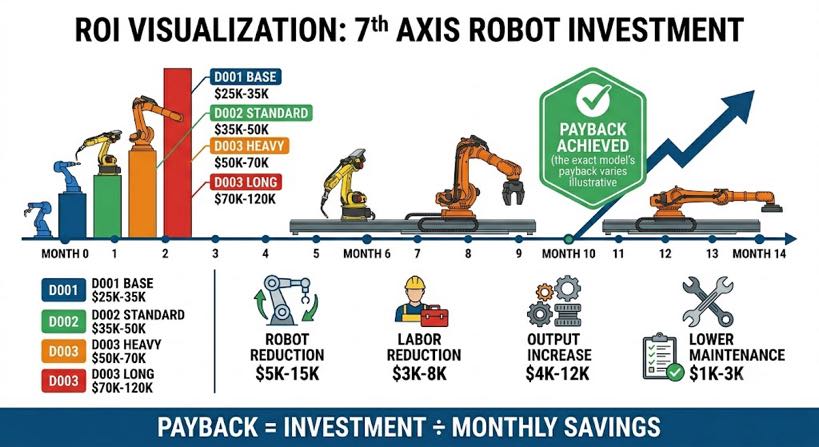
Typical 7th axis robot investment range:
| 모델 | 구성 | Investment Range |
| D001 | Base (3m stroke) | $25,000 – $35,000 |
| D002 | 기준 (6m stroke) | $35,000 – $50,000 |
| D003 | 무거운 (12m stroke) | $50,000 – $70,000 |
| D003 | 긴 (20-30m stroke) | $70,000 – $120,000 |
Monthly savings from a 7th axis robot:
| 저축 출처 | Monthly Savings |
| Robot reduction (1 대. 2-3 로봇) | $5,000 – $15,000 |
| 노동력 절감 (1-2 더 적은 수의 운영자) | $3,000 – $8,000 |
| Output increase (40% → 85% utilization) | $4,000 – $12,000 |
| Lower maintenance (싱글 대. multiple) | $1,000 – $3,000 |
Quick estimate:7th axis robot payback =Investment ÷ Monthly Savings
일반적인 투자 회수 기간: 6 – 14 개월
다음 단계
You’ve completed the basics of7축 로봇 선택. 이제 이 지식을 프로젝트에 적용해보세요.
We provide FREE 7th axis robot selection support:
- Load calculation
- Layout drawing
- Cycle simulation
- ROI analysis
- Brand compatibility check
참고자료 & 엔지니어링 표준
- 규제 & Safety Framework:
- ISO에서 12100:2010:Safety of Machinery — Risk assessment and risk reduction guidelines for multi-axis linear platforms.
- 안에 60204-1:2018:Safety of Machinery — Electrical equipment of industrial machines (부분 1: General requirements for external axes).
- EU CE Compliance Registry: Validated under Certificate No. M.2026.206.C134866.
- Kinematic & Load Calculations:
- ANSI/RIA R15.06-2014:American National Standard for Industrial Robots and Robot Systems — Safety Requirements (Dynamic Load Factor & Safety Margin Formulations).
- Mechanical Engineering Reference:Schilling, R. J. (2024).Structural Rigidity and Torque Analytics for 7th-Axis Linear Actuators under High-Acceleration Duty Cycles.
- Metrology & Accuracy Benchmarking:
- ISO 9283:1998:Manipulating industrial robots — Performance criteria and related test methods. Used as the empirical framework to guarantee the ±0.05mm long-term repeatability of the D-Series tracks.
- Environmental Mitigation:
- IEC 60529:International standard for Ingress Protection (IP54/IP67/IP69K sealing protocols for servo modules).
- AWS D16.1M:2021:American Welding Society standard for defending linear guide mechanisms against thermal slag and particulate contamination.
- Empirical System Data:Statistical validation derived from 26 years of active engineering design, 40+ proprietary patents, and the deployment of over 1,500 turnkey robotic integration cells operating globally as of May 2026.
저자 식별
저는 로봇용접 시스템 통합 전문가입니다.12+ 연령 전문 업계 경험7축 로봇 시스템. 우리 회사는26+ 연령 전문적인 지식의, 보유40+ 특허 관련된7축 로봇 기술, 성공적으로 완료되었습니다.1,500+ 글로벌 프로젝트. 우리는 보유EU CE 인증(인증서 번호: M.2026.206.C134866) 우리를 위해7축 로봇 시스템.
업데이트됨: 5월 2026