Fabricant de postes de travail robotisés et de systèmes laser personnalisés



Analyse du retour sur investissement du soudage laser robotisé: Vaut-il l'investissement?
De nombreux propriétaires d’usines envisageant le soudage robotisé au laser ont une question majeure en tête :: « Combien coûte réellement le système? Combien de temps faudra-t-il pour rembourser? Is it worth the investment?»
Dans cet article, we’re not going to sugarcoat it. We’ll lay out the real costs clearly — the breakdown of the initial investment, annual operating expenses, and how to calculate the Return on Investment (Retour sur investissement). At the end, I’ll use a typical small-to-medium manufacturing company case study to show you exactly how long it takes to break even.
1. Initial Investment Breakdown for a Robotic Laser Welding System
A complete robotic laser welding system usually consists of the following components (2026 market prices in USD):
- Laser Source (Laser à fibre): 1,500W–3,000W mainstream power: $22,000 – $62,000 (Price increases significantly above 3,000W)
- Industrial Robot Arm (6-axe): 1,600–2,000mm reach mainstream models: $15,000 – $35,000 (High-precision or collaborative robots cost more)
- Tête de soudage laser + Dévidoir (facultatif): $4,500 – $11,000
- Seam Tracking System (Laser or Vision): $4,000 – $10,000 (Strongly recommended — it can dramatically reduce defect rates)
- Safety Protection System (Laser enclosure, safety fences, rideaux lumineux, interlocks, etc.): $7,000 – $17,000
- Intégration du système + Calendrier + Positionneurs: $8,000 – $21,000
- Installation, Mise en service, Entraînement & First-Year Service: $4,000 – $8,000
Total Initial Investment Range (excluding factory renovation):
- Niveau d'entrée (around 1,500W): $50,000 – $90,000
- Mid-to-high-end configuration (2,000–3,000W + tracking system): $100,000 – $165,000
- High-end production line level: $180,000+
2. Annual Operating Costs
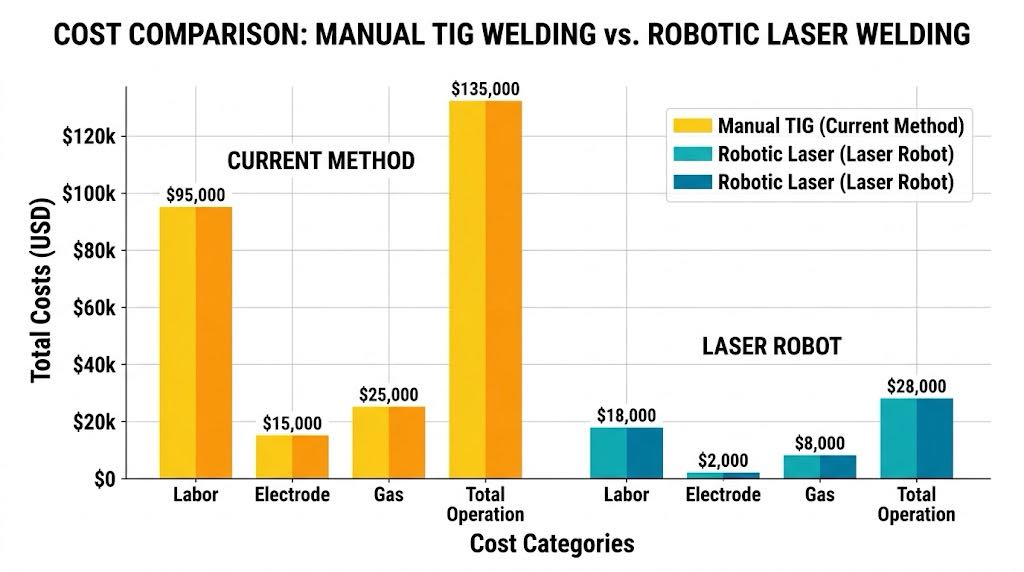
The daily running cost of robotic laser welding is actually much lower than traditional TIG/MIG welding. Main expenses include:
- Électricité: A 3,000W laser running at full power costs about $12–18 per hour (based on industrial electricity rates). Assuming 8 hours per day, annual electricity cost is approximately $5,000 – $8,000.
- Shielding Gas (Argon or Argon-Helium mix): Annual cost: $1,700 – $3,500
- Consommables (Protective lenses, buses, etc.): Annual cost: $1,100 – $2,000 (Laser welding consumables are far lower than traditional welding rods and wire)
- Entretien: Laser systems are relatively easy to maintain. The first year is usually free, then approximately $2,000 – $4,000 per year thereafter (including calibration and lens replacement).
Estimated Total Annual Operating Cost: $10,000 – $18,000 (This is significantly lower than the labor and consumable costs of equivalent traditional welding capacity.)
3. Étude de cas réel: ROI Calculation for a Small-to-Medium Enterprise
Company Background: A small-to-medium factory producing stainless steel cabinets and equipment enclosures. Previously using manual TIG welding, with an annual welding length of about 150,000 mètres, mainly on thin sheets (1–4mm).
After Implementation:
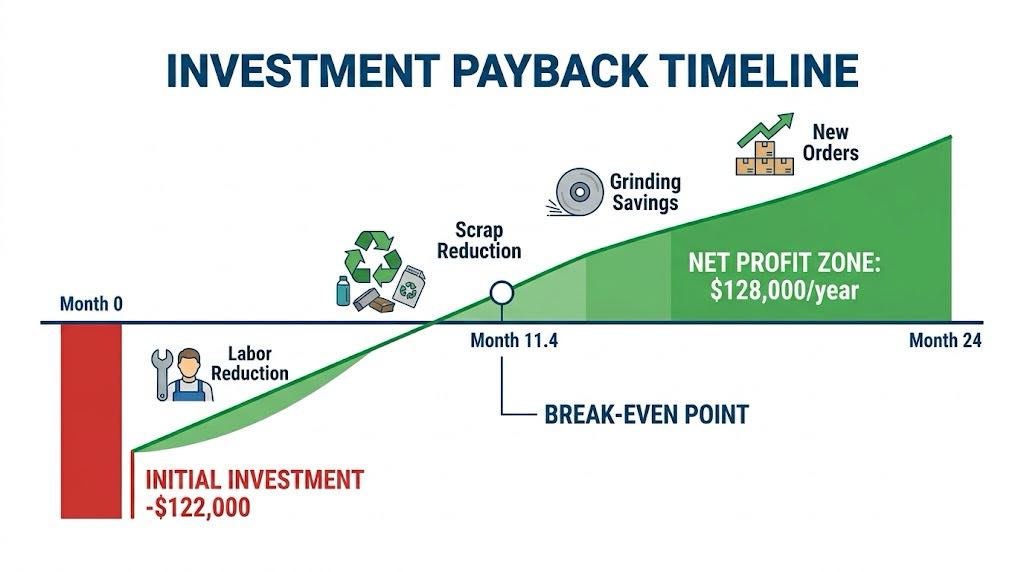
- Purchased a 2,000W robotic laser welding system with a total investment of $122,000 (including installation and basic seam tracking).
- Welding speed increased from 0.4 m/min (manuel) to 2.5–3.5 m/min, representing a 6–8 times efficiency improvement.
- Labor reduced from 8 welders to 2 (1 opérateur + 1 for loading/unloading).
- Defect rate dropped from 8% to under 1.5%.
- Post-weld grinding process greatly reduced, saving approximately $0.11 – $0.17 per meter in grinding costs.
Annual Benefits Calculation:
- Labor cost savings: ~$62,000 per year (6 soudeurs)
- Reduced scrap rate savings: ~$17,000 per year
- Grinding process savings: ~$25,000 per year
- Additional profit from increased capacity: ~$35,000 per year
- Increased electricity & gas costs: ~$11,000 per year
Net Annual Benefit ≈ $62,000 + $17,000 + $25,000 + $35,000 – $11,000 = $128,000
Payback Period Calculation: $122,000 ÷ $128,000 per year ≈ 11.4 mois
Even using a more conservative estimate (only counting labor, ferraille, and grinding savings), the net annual benefit is still around $70,000, resulting in a payback period of approximately 17–18 mois.
In most factories adopting robotic laser welding, the actual payback period falls between 12 à 24 mois.
4. Hidden Benefits: Real Profits Begin After Year Two
Once the system pays for itself, the advantages become even more apparent:
- Cohérent, high-quality welds improve product appearance and make it easier to win high-end orders
- Stable production takt time allows for multi-shift continuous operation
- Reduced heavy dependence on skilled welders (who are increasingly difficult to recruit)
- Enhanced factory automation image, which builds brand reputation and customer trust
- Easy future expansion into multi-robot lines or flexible manufacturing cells
5. Investment Decision Recommendations
- If your annual welding volume is low (<50,000 meters/year): Robotic laser welding may not be cost-effective yet. Consider outsourcing or starting with a smaller manual laser welder.
- If your annual welding volume is medium (80,000–300,000 meters): Robotic laser welding is usually a very worthwhile investment, with most factories breaking even within 18 mois.
- If your annual welding volume is high (>300,000 mètres): Payback will be even faster. Strongly recommended — multi-station solutions can also be considered.
Although the initial investment for robotic laser welding is higher than traditional welding methods, its real value lies in this: “You recover the difference within the first two years, and from the third year onward, every part you weld generates pure profit.” As long as your welding volume is stable and parts have good repeatability, robotic laser welding is very likely to be a smart and profitable medium-to-long-term investment.
Before making a purchase decision, I strongly recommend having the supplier perform detailed sample welding tests on your actual workpieces and provide a customized ROI calculation based on real data for speed, yield, and consumables.
In the next article, we will move into the practical side: the installation and commissioning process, daily maintenance tips, and how to troubleshoot common issues — helping you use the system effectively and reliably after purchase.
( The above data is based on average 2026 international market levels. Prices may vary depending on brand, configuration, et région. Please base your final investment decision on official supplier quotes and on-site testing.)
Identification de l'auteur
Un expert en intégration de systèmes de soudage robotisés avec plus de 12 années d'expérience dans l'industrie. Mon entreprise a plus 26 années d'expérience professionnelle, détient plus de 40 technologies brevetées, et a complété avec succès plus de 1,500 projets dans le monde entier (environ 70% dont des cellules de soudage robotisées, totalisant plus de 1,000 unités). L'entreprise est certifiée CE par l'UE (Numéro de certificat: M.2026.206.C134866) et est conforme à la norme EN 60204-1:2018 et EN ISO 12100:2010 normes. J'ai accompagné de nombreuses entreprises manufacturières tout au long du processus de mise en place de postes de soudage robotisés., de la sélection au lancement de la production.
Mis à jour: Peut 2026
ARTICLES CONNEXES
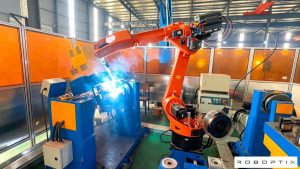
L'audit pré-achat: Une liste de contrôle de visite d'usine et un protocole de test au banc pour les acheteurs de positionneurs de soudage
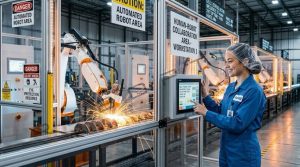
10 Principaux avantages de la mise en œuvre d'une cellule de soudage robotisée dans votre atelier
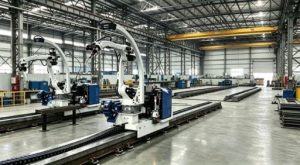
Technologie Scan-to-Weld:Comment la modélisation inversée remplace la programmation des robots
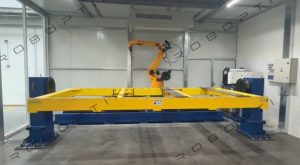
5 Questions à poser avant d'acheter une cellule de soudage robotisée pour l'acier de construction
Comment sélectionner un fournisseur de soudage laser robotisé: De l’évaluation technique aux tests sur échantillons