Custom Robot Workstations And Laser Systems Manufacturer


7th Axis Robot Track System Maintenance & Troubleshooting Guide
A 7th Axis Robot is Like a Car – Neglect Maintenance, and It Will Leave You Stranded
Let me tell you a true story.
A customer called me in panic. Their 7th axis robot had stopped moving in the middle of a critical production run. The entire welding line was down. They were losing $5,000 per hour.
I flew to their site. The problem?No grease.
For 18 months, no one had lubricated the rails or rack on their 7th axis robot. The bearings had seized. The rack was worn beyond repair. A $30,000 repair bill – all because they skipped 30 minutes of maintenance per week.
Here’s the truth:A 7th axis robot is a precision machine. It runs 24/7 in harsh environments – welding spatter, metal dust, temperature swings. Without proper maintenance, it will fail. Not “might fail.”Will fail.
The good news?Proper maintenance is simple, quick, and inexpensive.This guide will show you exactly what to do – daily, weekly, monthly, and yearly – to keep your 7th axis robot running for 10+ years.
Part 1: Daily Check (10 Minutes)
Every morning before starting production, walk along your 7th axis robot track for a quick inspection. This simple habit prevents approximately 80% of unexpected failures.
| Check Item | What to Do | Red Flag |
| Audible | Listen during warm-up | Grinding, clicking, squealing |
| Cleaning | Wipe rails and rack with dry cloth | Visible debris buildup |
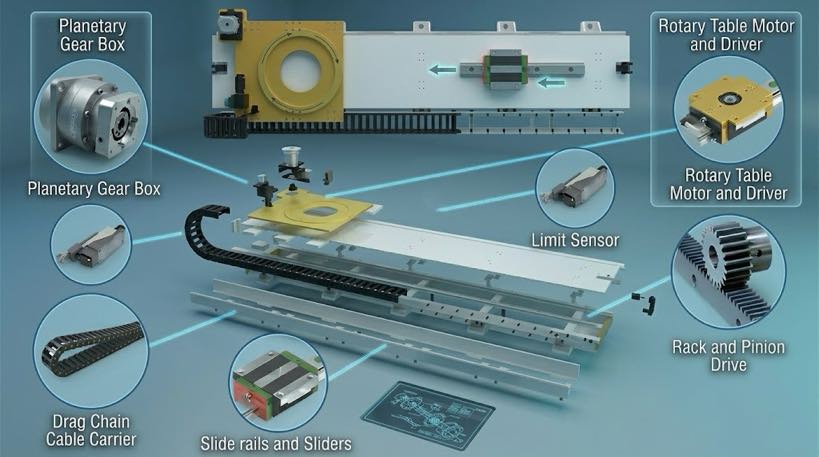
| Drag chain | Check for kinks or cracks | Exposed wires, cracks |
| Home position | Verify repeatability | Error > ±0.1mm |
| Fasteners | Check track connection bolts | Any visible movement |
Simple verification method:Place a container with liquid on the carriage. Run a short back-and-forth program. If liquid spills, motion is not smooth – time to investigate.
Time investment: 10 minutes | Potential savings: $50,000+ in repairs
Part 2: Weekly Maintenance (30 Minutes)
Weekly maintenance significantly extends equipment life.
1. Lubrication (15 minutes) – Most Important
- Linear rails:Apply lithium-based EP2 grease to exposed surfaces. Run the 7th axis robot back and forth to distribute.
- Rack:Apply thin layer of grease to rack teeth. Wipe off excess.
- Pinion gear:Apply 2-3 pumps of grease through the lubrication port.
Mark the date on your grease gun. If you can’t remember when you last greased your 7th axis robot, you’re not doing it frequently enough.
2. Drag Chain Inspection (10 minutes)
- Run the 7th axis robot to both ends and observe chain movement
- Listen for clicking sounds (worn chain links)
- Randomly inspect 3-4 links for cracks
- Confirm cables are not twisted or pinched
3. Cover and Seal Check (5 minutes)
- Inspect metal covers or bellows for holes or damage
- Remove accumulated welding spatter
- Confirm seals are effectively blocking dust
White Glove Test:Wipe a white cloth along the rail. If the cloth comes back covered in grease and debris, cleaning frequency is insufficient.
Part 3: Monthly Deep Inspection (2 Hours)
1. Repeatability Measurement (30 minutes)
Mount a dial indicator on the carriage. Run to home position 10 times. Record deviation each time.
A thorough monthly inspection catches problems before they become disasters.
- Acceptable:±0.05mm
- Warning:±0.08mm
- Critical:> ±0.1mm (contact service)
2. Rack Wear Inspection (30 minutes)
- Visually inspect rack teeth along full length
- Look for uneven wear patterns (frequently used areas show more wear)
- Check for tiny cracks on tooth surfaces
- Run fingernail across tooth surfaces – should feel no catching
3. Bearing Block Check (30 minutes)
- Shake the carriage to check for looseness
- Listen for grinding during motion
- Check seals for damage (damage means debris has entered)
- Bearing blocks typically need replacement every 5-7 years
4. Electrical Cabinet Check (30 minutes)
- Confirm all cable connections are tight
- Look for signs of overheating (discolored wires)
- Clean fans and filters
- Check drive and controller LED status
Part 4: Common Troubleshooting
Problem 1: Unusual Noises
| Sound | Likely Cause | Action | Urgency |
| Grinding | Debris in rails or bearings | Stop immediately. Clean and inspect. | Emergency |
| Clicking | Worn drag chain links | Inspect this shift. Replace if needed. | High |
| Squealing | Insufficient lubrication | Grease immediately | Medium |
| Humming | Normal operation | No action needed | None |
Problem 2: Position Loss
Symptoms:Welds drifting, parts not fitting, inconsistent repeatability.
Diagnostic steps:
- Check if home sensor is dirty or damaged
- Gently push carriage – confirm no movement before motor engages (backlash check)
- Check encoder feedback cable integrity
- Confirm rack and pinion mounting bolts are tight
Problem 3: Complete Immobility
Diagnostic flow:
- Confirm emergency stop is reset
- Check drive power indicator
- Check servo drive fault code
- Confirm not crashed into limit switch
- If still stuck, contact your integrator
Part 5: Lubrication & Protection Guidelines
Lubrication Schedule:
| Component | Frequency | Lubricant | Amount |
| Linear rails | Weekly | EP2 grease | Thin layer |
| Rack | Weekly | EP2 grease | Thin layer |
| Pinion gear | Monthly | EP2 grease | 2-3 pumps |
| Bearing blocks | Every 6 months | EP2 grease | Until old grease purges |
Choosing the Right Grease for Your 7th Axis Robot:
Not all greases are suitable for 7th axis robot applications. EP2 lithium-based grease is the industry standard because it offers excellent water resistance, high temperature stability (up to 150°C), and good load-carrying capacity. For extreme environments, consider synthetic grease which performs better at very low or very high temperatures. Avoid greases containing molybdenum disulfide in high-humidity environments, as they can cause corrosion. Always consult your 7th axis robot manual before switching grease types.
Environmental Protection:
Welding environment (spatter):
- Metal covers are mandatory. Spatter will destroy an unprotected 7th axis robot within months.
- Apply anti-spatter spray to covers weekly. This creates a barrier that makes spatter easier to remove.
- Use IP67-rated motors for the 7th axis robot drive. Standard IP54 motors will fail quickly in welding environments.
- Install spatter shields around critical components like sensors and cable entries.
Dusty environment (grinding, casting):
- Use bellows for complete sealing. The accordion-style bellows expand and contract with 7th axis robot motion.
- Install positive pressure system for critical 7th axis robot components. This pushes dust away from seals.
- Blow down track with compressed air daily. Focus on rail ends and bearing block seals.
- Inspect wiper seals monthly. Worn seals are the primary entry point for fine dust.
Temperature considerations:If your 7th axis robot operates in extreme cold (below freezing) or extreme heat (above 100°C), standard EP2 grease may not perform adequately. Consult your lubricant supplier for temperature-specific recommendations.
Cost of Neglect:
| Neglect Period | Consequence | Repair Cost |
| 1 month | No damage yet | $0 |
| 3 months | Premature wear begins | $2,000 |
| 6 months | Visible rack wear | $8,000 |
| 12 months | Rack and pinion replacement needed | $15,000 |
| 18 months | Bearing seizure, full rebuild | $30,000+ |
Why Maintenance Saves More Than Just Repair Costs:
Beyond the direct repair costs, neglected 7th axis robot maintenance causes hidden expenses. Unplanned downtime shuts down entire production lines, not just the 7th axis robot itself. Rework from poor positioning wastes material and labor. Expedited shipping for emergency replacement parts costs 3-5 times normal freight. Overtime pay for maintenance staff working weekends adds up quickly. A $30,000 repair bill often comes with $50,000+ in hidden costs.
Part 6: After-Sales Support
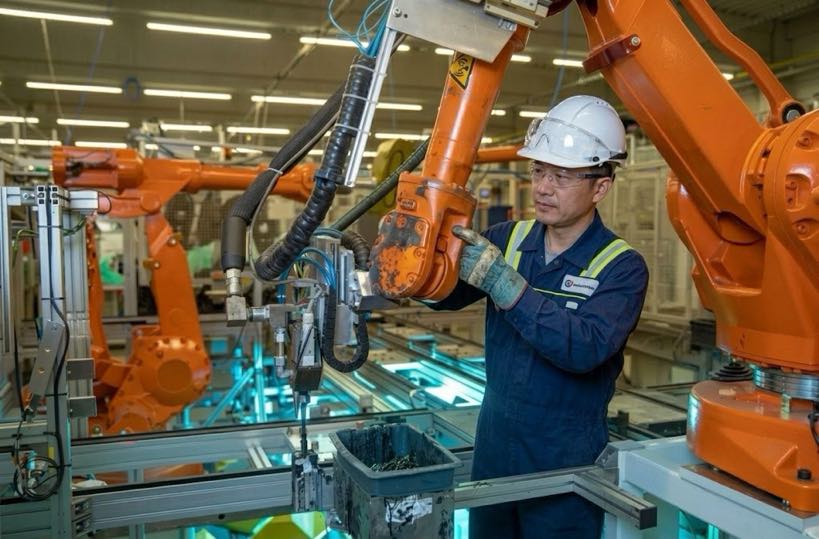
When you purchase our 7th axis robot system, you receive:
- 2-year standard warranty(industry standard is 1 year), covering all mechanical and electrical components
- 24/7 remote technical support, average response time within 2 hours
- 10+ years of spare parts availability, next-day shipping on critical components
- On-site service within 5 days(global), technicians located in 12 countries
- Preventive maintenance contracts:quarterly or bi-annual on-site inspections, priority response, parts discounts, free software updates
What Our Preventive Maintenance Contract Includes:
A preventive maintenance contract transforms reactive repairs into planned service. Our technicians visit your facility quarterly or bi-annually. They perform full 7th axis robot inspection, measure repeatability, check wear patterns, and identify potential issues before they cause downtime. You receive a written report after each visit with recommendations and predicted replacement dates for wear components.
For customers without a contract,we still offer per-incident support with the same high-quality service. However, contract customers receive priority dispatching and a 15% discount on replacement parts.
Common Myths About 7th Axis Robot Maintenance:
- Myth:“Our production schedule doesn’t allow time for maintenance.”
Fact:Planned maintenance takes 30 minutes per week. Unplanned downtime takes days.
- Myth:“Any grease works fine.”
Fact:Wrong grease damages seals and reduces bearing life. Use EP2 lithium-based grease.
- Myth:“We’ll call for help when something breaks.”
Fact:By then, damage is already severe. Preventive checks cost 90% less than emergency repairs.
- Myth:“Our operators should not touch the 7th axis robot.”
Fact:Operators should perform daily visual checks. They are the first line of defense against failures.
Customer Story – When a 7th Axis Robot Saved a Weekend:
“Our 7th axis robot stopped on a Friday evening. We called support at 7 PM. Within 30 minutes, they diagnosed a failed encoder via video call. A replacement part was shipped overnight. We were running again by Saturday noon. Lost only 4 hours of production instead of 3 days.” – Automotive Tier 1 Supplier
A 7th axis robot is a significant investment in your company’s productivity and competitiveness. Like any valuable asset, it requires proper maintenance. Maintenance is simple, cost-effective, and takes less than one hour per week.
The customers who get the most from their7th axis robotsystems are precisely those who strictly follow maintenance procedures.
Part 7: Quick Maintenance Reference
Daily (10 minutes)
□ Listen for abnormal sounds
□ Wipe rails and rack
□ Inspect drag chain
□ Verify home position
□ Check for loose bolts
Weekly (30 minutes)
□ Lubricate rails and rack
□ Detailed drag chain inspection
□ Check covers
□ White glove test
Monthly (2 hours)
□ Measure repeatability
□ Inspect rack wear
□ Check bearing blocks
□ Clean electrical cabinet
Quarterly (4 hours)
□ Full mechanical inspection
□ Re-tune servo if needed
□ Replace worn wipers or seals
□ Re-torque anchor bolts
Yearly (1-2 days)
□ Complete system inspection
□ Replace damaged covers
□ Professional calibration
□ Review maintenance logs
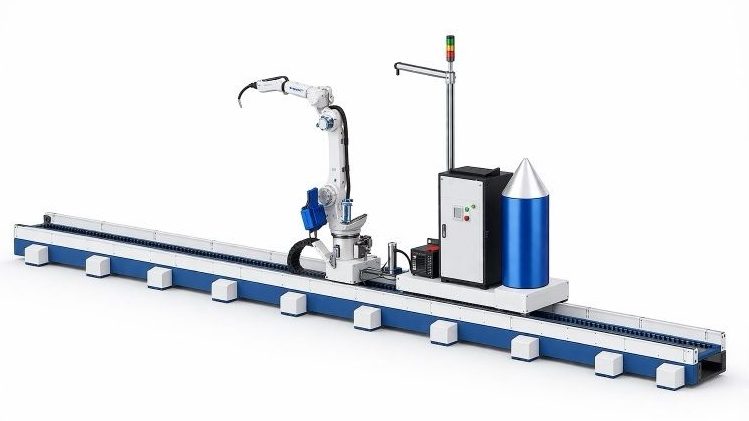
D001—Lightweight Robotic Track System
(The ground tracks shown in the image do not include the robotic arm)
Take Action Now
Three ways to get help with your 7th axis robot:
- Join preventive maintenance program→ Regular inspections, priority support, parts discounts
Coming Next in Part 10
Title:The Future of 7th Axis Robot Technology: What’s Coming in 2027 and Beyond
Content:AI predictive maintenance, wireless power tracks, collaborative robot safety innovations, next-generation 7th axis robot technology
References & Maintenance Engineering Standards
- Tribology, Lubrication & Material Degradation:
- ISO 12924:2010:Standard for rolling bearing grease evaluation, validating the specific multi-point operational profile of lithium-based EP2 lubricants used across linear axes.
- DIN 51825 (Class K):German standard regulating additive compliance for linear motion components operating under heavy vibrational and high-humidity fabrication conditions.
- Kinematic Metrology & Precision Benchmarks:
- ISO 9283:1998:Manipulating industrial robots — Performance criteria and verification methodologies. This is the official scientific calibration framework utilized to establish the ±0.05 track repeatability testing profiles.
- VDI/VDE 2617:Association of German Engineers standards governing spatial drift measurement, coordinate mapping, and backlash diagnosis using visual/dial indicators.
- Electrical Infrastructure & Flex-Life Cable Integrity:
- IEC 60204-1:2018:Safety of machinery — Industrial electrical systems. This framework governs the drag-chain bend radii parameters, shielding configurations, and strict strain-relief inspections outlined in Part 2.
- NFPA 79 (2024 Edition):Electrical standard for automated factory equipment, dictating the preventive cleaning schedules for servo drive fans, ambient cabinet control filters, and encoder cable isolation.
- Functional Testing & Factory Safety Compliance:
- EN ISO 13849-2:2015:Validation protocols for machine safety-related software and hardware elements, regulating the interlock, sensor, and hard-limit switch testing intervals.
- European Union CE Quality & Maintenance Registry: Fully certified and field-audited under active registration Certificate No. M.2026.206.C134866.
- Empirical Service Log Archive:Field service statistics, data trends, and diagnostic methodologies derived from 26 years of precision manufacturing, 40+ engineering patents, and over 500 hand-on troubleshooting resolutions completed as of May 2026.
Author Identification
I am a robotic welding system integration expert with 12+ years of industry experience specializing in 7th axis robot maintenance and troubleshooting. My company has 26+ years of professional expertise, holds 40+ patents, and has successfully completed 1,500+ global projects. We hold EU CE certification(Certificate No.: M.2026.206.C134866) for our7th axis robotsystems. I have personally diagnosed and resolved over 500 field service issues across automotive, heavy equipment, and renewable energy sectors.
Updated: May 2026
RELATED POSTS
Robot Positioner Payload Calculation and Safe Selection: The Complete Engineering Guide
Why a 2-Ton Positioner Can’t Always Hold a 2-Ton Part: Eccentric Loading, Overturning Moment, and Inertia
Robotic Welding Cell vs Manual Welding: Which Is Better for Modern Manufacturing?
1G to 6G Without a Crane: How a Positioner Converts Overhead Welds into Flat-Position Welds
2026 7th Axis Robot Selection Guide: Payload, Stroke, Repeatability & Brand Compatibility