Fabricante de sistemas láser y estaciones de trabajo robóticas personalizadas



Tendencias de las células de soldadura robótica 2026-2030: AI, Visión artificial & El futuro de la automatización de la soldadura
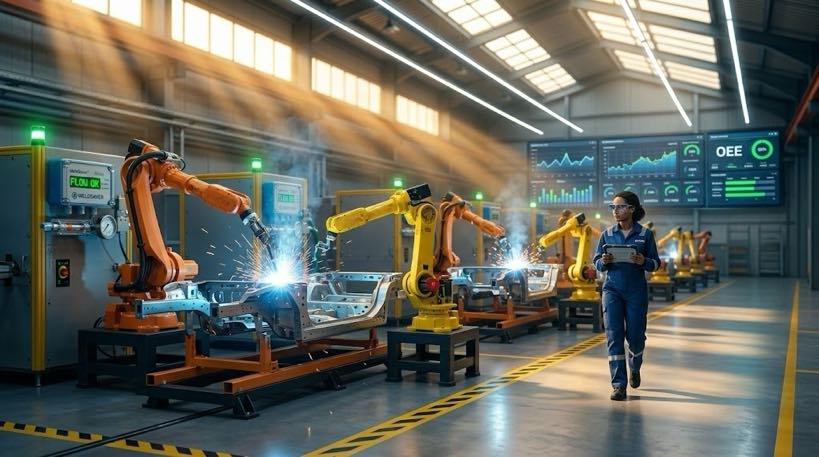
Según la IFR 2025 informe, Se alcanzaron las instalaciones globales de robots industriales. 542,000 unidades en 2024, con robots de soldadura que representan aproximadamente 21% de todas las instalaciones. Más notablemente, the compound annual growth rate (CAGR) for welding robots has increased from 8.3% (2020-2024) a 11.7% (2025-2030).
Three key drivers are fueling this growth. Primero, the global welder shortage continues to worsen — AWS projects the United States will need 320,500 nuevos profesionales de la soldadura por 2029. Segundo, robot costs have declined approximately 25% over the past five years, making automation accessible to smaller shops. Tercero, AI and vision technologies are making robots smarter, enabling them to enter manufacturing areas traditionally considered “unsuitable for automation.”
This article forecasts six major trends in robotic welding cells from 2026 a 2030 and analyzes their practical impact on small-to-medium manufacturers.
Tendencia 1: AI Adaptive Welding with Intelligent Parameter Adjustment
The traditional pain point: Conventional robotic welding is essentially “blind welding” — the robot follows taught paths and parameters without sensing actual workpiece conditions. When fit-up gaps, bevel angles, or material batches change, weld quality fluctuates. Operators must manually adjust parameters or accept inconsistent results.
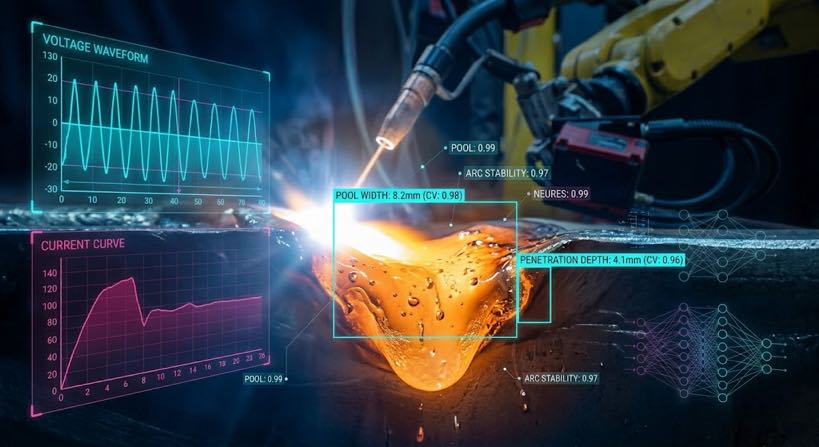
How AI adaptive welding works: AI systems monitor molten pool morphology, arc sound, and current/voltage waveforms in real-time using high-speed sensors. The system compares this data against trained “ideal weld” models and adjusts welding parameters in milliseconds. Is the weld too wide? Increase travel speed. Is the keyhole dropping? Reduce current. Detecting porosity risk? Adjust shielding gas flow.
Commercialization status: Initial features became available from manufacturers like Fronius and Lincoln Electric in 2024-2025. These early systems demonstrate the technology’s potential but carry premium pricing. Por 2027-2028, AI adaptive welding is expected to become standard on high-end welding power sources, with mid-range options following shortly after.
Impact on small-to-medium manufacturers: This technology reduces dependence on operator experience. AI automatically compensates for part inconsistencies, allowing robots to adapt to “less than perfect” incoming materials. For shops struggling with weld quality consistency, AI adaptive welding offers a path to predictable, repeatable results without requiring master welders.
Tendencia 2: Visión artificial + Laser Seam Tracking
Current technology limitations: Traditional seam tracking requires operators to pre-teach weld start and end points. The system can only compensate for ±3-5mm of deviation and has limited capability with complex welds such as intersecting pipes or curved seams.
Next-generation breakthrough: The combination of 3D structured light cameras and AI algorithms enables what integrators call “blind welding” — no teaching required. The robot automatically identifies weld position, tipo, and length using real-time vision, then plans the optimal welding path autonomously.
Real-world performance: En 2025, leading integrators demonstrated systems recognizing intersecting pipe welds with vision recognition times under 0.5 seconds and complete path planning under 2 artículos de segunda clase. Para alta mezcla, low-volume shops — where products change frequently — this technology eliminates hours of programming time per week.
Adoption timeline: It is expected to enter the mid-range price segment ($8,000-15,000 as an add-on module) por 2026-2027 and become standard by 2030. Some manufacturers have already launched “sin enseñanza” welding robots that require no programming and no teach pendant — the robot automatically identifies weld seams and plans paths through AI vision, representing an early pioneer of this trend.
Tendencia 3: Collaborative Robot Welding Cells
What is a collaborative welding robot: Robots colaborativos (cobots) are designed to share workspace with human operators without safety fencing, subject to formal risk assessment. En aplicaciones de soldadura, cobots offer a key advantage: lead-through teaching. Operators simply grab the welding torch, manually trace the desired weld seam, and the robot automatically records the path. No programming experience required.
Comparison with traditional industrial robots:
| Aspect | Traditional Industrial Robot | Collaborative Welding Robot |
| vallado de seguridad | Requerido | Opcional (after risk assessment) |
| Programming method | Teach pendant or offline programming | Lead-through teaching primary |
| Learning curve | 1-2 semanas de entrenamiento | 2-3 dias de entrenamiento |
| Maximum welding speed | Arriba a 35 inches/minute | 15-25 inches/minute |
| Best suited for | Alto volumen, high-cycle production | Low-volume, frequent changeover |
| Typical price (welding package) | $60,000-150,000 | $50,000-90,000 |
| rango de carga útil | 6-20kg common | 5-10kg typical |
Market trajectory:Collaborative welding robots are not replacing traditional industrial robots but rather expanding the boundaries of automation. For shops seeking maximum convenience, “sin enseñanza” collaborative welding robots further eliminate the lead-through teaching step, truly achieving “weld right after power-on.”En cambio, they are expanding automation into shops that were previously priced out or technically unable to adopt robotics — small batch sizes, frequent product changeovers, limited floor space, and operators without programming skills.
IFR data shows cobot installations growing at 25-30% anualmente, with welding consistently ranking among the fastest-growing application areas. For first-time automation adopters among small-to-medium manufacturers, collaborative welding robots represent the lowest-risk entry point.
Tendencia 4: Digital Twin and Simulation Technology
What is a digital twin: A digital twin is a complete virtual model of a welding cell, including the robot, posicionador, pieza de trabajo, tooling fixtures, and safety fencing. Users can perform programming, simulación, collision detection, and cycle time optimization entirely in the virtual environment before deploying anything to the physical shop floor.
Real business value:
Programación sin conexión: New product programming consumes zero production time. Changeover downtime compresses from 2-4 horas a menos 30 minutos. For shops with frequent model changes, this alone can recover weeks of production time annually.
Collision prevention: Digital twins identify robot-workpiece interferences before they happen in the real world. A single unexpected collision can cause $5,000-20,000 in damage to the robot arm, antorcha, or workpiece. Simulation eliminates this risk.
Cycle time optimization: Engineers can test multiple path strategies in simulation to find the fastest, most efficient welding sequence. Typical capacity improvements range from 5-15% without any hardware changes.
Technology accessibility: Por 2026, offline programming software from major manufacturers (ABB’s RobotStudio, Fanuc’s Roboguide, Yaskawa’s Sim Pro, KUKA’s KUKA.Sim) is mature and widely available. Cloud-based simulation platforms — such as NVIDIA Omniverse with robot manufacturer plugins — now allow small shops to access digital twin capabilities without purchasing high-end workstations.
Adoption forecast: Industry analysts project that by 2030, encima 80% of new welding cell deployments will incorporate digital twin simulation as a standard practice, not a premium option.
Tendencia 5: Green Welding — Low Energy, Low Fume
Background drivers: Global carbon emission regulations are tightening across all major manufacturing economies. Welding operations typically consume 15-30% of total shop energy. Mientras tanto, occupational exposure limits for welding fume components (manganese, chromium, níquel) are becoming stricter.
Low-energy welding technology: Next-generation pulse MIG power sources save 25-35% energy compared to traditional thyristor-based power sources. Using realistic operating conditions (300 amps, 30 volts, 16 hours/day, 250 days/year), annual energy savings reach 8,000-12,000 kilowatt-hours. This translates to $1,200-1,800 in electricity cost savings and approximately 5-8 tons of CO2 emissions reduction per welding cell annually.
Low-fume welding processes: The Cold Metal Transfer (CMT) process has 40-60% lower heat input than traditional short-circuit MIG. Lower heat input directly reduces fume generation by 50-70%. For materials that produce hazardous fumes — high-strength steel, galvanized sheet, stainless steel — this represents a significant improvement in workplace air quality.
High-efficiency fume extraction: Torch-mounted fume extraction is evolving from >95% capture efficiency to >99%. HEPA H14 filtration — which captures 99.995% of particles down to 0.1 microns — is becoming standard on high-end systems. IoT-connected sensors now enable real-time monitoring of shop air quality, with automatic alerts when thresholds approach exposure limits.
Market trend: Green welding features are transitioning from “nice to have” differentiators to “must have” compliance requirements. Por 2030, major markets are expected to implement minimum energy efficiency standards for welding equipment, making non-compliant devices unsellable.
Tendencia 6: 5GRAMO + Industrial Internet Remote Monitoring
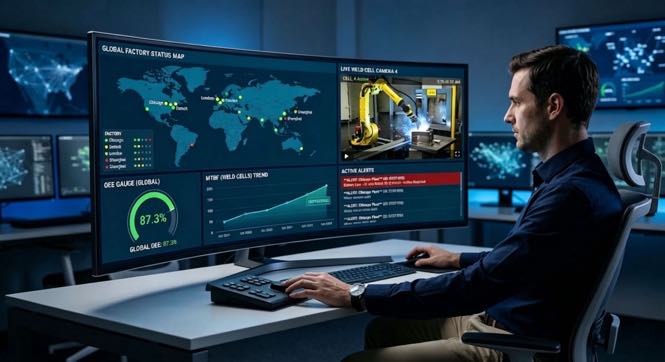
What it enables: Welding cells connect via 5G networks to industrial internet platforms, enabling three key capabilities: real-time equipment status monitoring, remote fault diagnosis, and automated production data collection.
Practical applications:
Remote monitoring: Shop managers view each cell’s operating status (welding/idle/fault), current cycle time, and daily output from their office computer or mobile phone. Anomaly alerts push instantly when parameters deviate from normal ranges.
Diagnóstico remoto: When equipment alarms, integrator technicians diagnose remotely without traveling to the site. They access alarm codes and operation logs, then guide on-site operators through troubleshooting steps. Mean time to repair (MTTR) improves dramatically — from 8-24 horas (waiting for a technician to arrive) a 2-4 horas (immediate remote assistance).
Data analytics: The system automatically calculates key performance indicators: Overall Equipment Effectiveness (OEE), Mean Time Between Failures (MTBF), and Mean Time To Repair (MTTR). These metrics support data-driven maintenance planning and equipment purchase decisions.
Is 5G necessary?: For most welding cells, 4G or industrial Wi-Fi provides sufficient bandwidth and latency. 5G’s ultra-low latency (<10ms) and high reliability (99.999%) are advantages for large factories with many connected devices, but small-to-medium manufacturers can achieve similar functionality through public cloud platforms using 4G or existing Wi-Fi.
Adoption status: Major integrators began standardizing IoT interfaces (OPC-UA, MQTT) en 2025-2026. 5G private networks are being deployed first in large automotive and heavy equipment factories. Cloud-based monitoring platforms make remote capabilities accessible to shops of any size without 5G investment.
Impact on Small-to-Medium Manufacturers
Which technologies deserve priority attention?
| Tecnología | Value for Money | Recomendación |
| AI adaptive welding | Medio-alto | Consider after 2027; current premium pricing too high for most SMBs |
| 3D vision seam tracking | Medio | Suitable for high-mix low-volume; pilot trial recommended |
| Collaborative welding robot | Alto | Best choice for first-time automation adopters |
| Simulación de gemelos digitales | Alto | Must-have — require integrator to include |
| Green welding (efficient power) | Medio | Choose efficient power sources for new purchases |
| 5G remote monitoring | Bajo | Not needed for small shops; 4G/industrial Wi-Fi sufficient |
Key recommendations for SMBs:
- Don’t adopt technology for technology’s sake. AI and vision are impressive, but if your part consistency is already good, traditional teach programming and basic seam tracking may be entirely sufficient. Match technology to your actual pain points.
- Start with collaborative or standard industrial robots. These technologies are mature, with prices reaching affordable ranges for small-to-medium manufacturers. Digital twin simulation should be a “standard” requirement in your request for quote, not an “opcional” add-on.
- Pay attention to energy efficiency and fume extraction. Regulations may not require it today, but will almost certainly tighten within 3-5 años. Choosing efficient inverter power sources and high-performance fume extraction for new purchases avoids costly forced upgrades later.
- Ensure equipment has firmware upgrade capability. You don’t need AI adaptive welding today. But purchasing equipment that can accept future firmware upgrades keeps the door open for adding AI capabilities when prices drop and technology matures.
- Consider AI vision-based teaching-free robots if you need short deployment time and low operating barriers — ideal for frequent changeover shops.
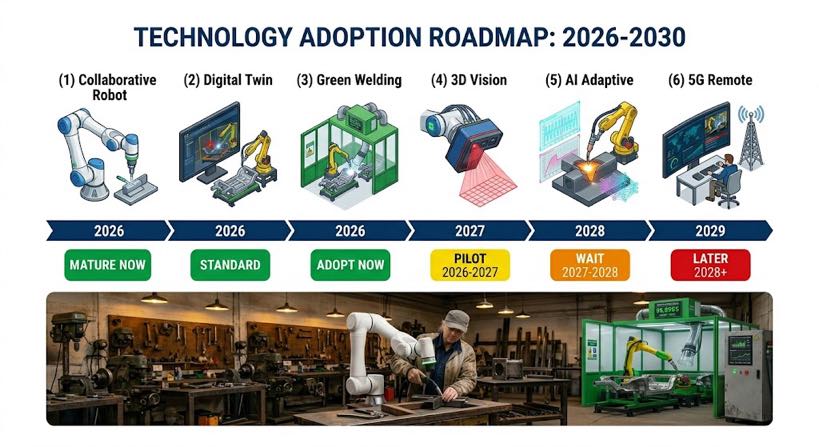
Investment Timing: When to Adopt Each Technology
| Tecnología | Estado actual | Recommended Adoption Timing |
| Collaborative welding robot | Maduro, widely deployed | Now |
| Simulación de gemelos digitales | Maduro, industry standard | Now |
| 3D vision seam tracking | Early mature | 2026-2027 |
| Green welding (efficient power) | Maduro | Now |
| AI adaptive welding | Early commercial | 2027-2028 |
| 5G remote monitoring | Early commercial | 2028 or later |
The core message: Don’t wait for perfect technology. If you have a welding automation need today — whether due to welder shortages, quality inconsistency, or capacity constraints — collaborative robots or standard industrial robots paired with digital twin simulation are mature enough to deliver reliable results with 12-18 month payback periods.
Waiting for next-generation AI or 5G capabilities means continuing to suffer the costs of welder shortages, quality variability, and production delays. The best time to start was yesterday. The second-best time is now.
De 2026 a 2030, robotic welding technology is transitioning from “executor” a “decision-maker.” AI enables thinking. Vision enables seeing. Digital twins enable testing in virtual space before welding real metal. 5G enables connection to the broader factory network.
But for most small-to-medium manufacturers, the most pragmatic choice in 2026 remains collaborative welding robots or standard industrial robots combined with digital twin simulation. AI adaptive welding and 5G connectivity can wait until the technology matures further and prices become more accessible.
Your next step: Assess your shop’s specific welding needs. Identify your biggest pain point — welder shortage? Quality inconsistency? Long changeover times? Then choose the technology with the highest current maturity that directly addresses that pain point.
Fuentes de datos:
- Federación Internacional de Robótica (IFR) – Informe Mundial de Robótica 2025
- Sociedad Americana de Soldadura (AWS) – Datos de la fuerza laboral de soldadura
- Major robot manufacturer technology roadmaps (2025-2026 public releases)
Lectura relacionada
- ¿Cuánto cuesta una celda de soldadura robótica? 2026? Análisis de precios completo
- Cómo calcular el ROI de la celda de soldadura robótica? Plantilla completa
- 8 Errores costosos al implementar una celda de soldadura robótica (Y cómo evitarlos)
- Guía de mantenimiento de celdas de soldadura robótica: Mejores prácticas, Cronograma & Solución de problemas
Identificación del autor
Este artículo está basado en la Federación Internacional de Robótica. (IFR) Informe Mundial de Robótica 2025, Sociedad Americana de Soldadura (AWS) datos de la fuerza laboral, y hojas de ruta tecnológicas de los principales fabricantes.
Autor:
Un experto en integración de sistemas de soldadura robótica con más de 12 años de experiencia en la industria. mi empresa ha terminado 26 años de experiencia profesional, tiene más de 40 tecnologías patentadas, y ha completado con éxito más de 1,500 proyectos en todo el mundo (aproximadamente 70% de los cuales se trataba de células de soldadura robóticas, totalizando más de 1,000 unidades). La empresa cuenta con la certificación CE de la UE. (Certificado No.: M.2026.206.C134866) y cumple con la EN 60204-1:2018 y ENISO 12100:2010 estándares. He ayudado a numerosas empresas manufactureras durante todo el proceso de implementación de estaciones de trabajo de soldadura robótica., desde la selección hasta el lanzamiento de la producción.
Actualizado: Puede 2026
PUBLICACIONES RELACIONADAS
Análisis del ROI de la soldadura láser robótica: ¿Vale la pena la inversión??
Por qué los sistemas de visión son esenciales para la soldadura láser robótica
Dominio de la soldadura láser robótica: 10 Consejos prácticos para obtener el máximo rendimiento y retorno de la inversión
Reacción, Rigidez, y deriva térmica: Las tres especificaciones ocultas que definen el rendimiento del posicionador de soldadura
3Seguimiento de costura láser D Vision explicado:De la nube de puntos a la ruta de soldadura en segundos