Custom Robot Workstations And Laser Systems Manufacturer


Robotic Laser Welding ROI Analysis: Is It Worth the Investment?
Many factory owners considering robotic laser welding have one major question in mind: “How much does the system actually cost? How long will it take to pay back? Is it worth the investment?”
In this article, we’re not going to sugarcoat it. We’ll lay out the real costs clearly — the breakdown of the initial investment, annual operating expenses, and how to calculate the Return on Investment (ROI). At the end, I’ll use a typical small-to-medium manufacturing company case study to show you exactly how long it takes to break even.
1. Initial Investment Breakdown for a Robotic Laser Welding System
A complete robotic laser welding system usually consists of the following components (2026 market prices in USD):
- Laser Source (Fiber Laser): 1,500W–3,000W mainstream power: $22,000 – $62,000 (Price increases significantly above 3,000W)
- Industrial Robot Arm (6-axis): 1,600–2,000mm reach mainstream models: $15,000 – $35,000 (High-precision or collaborative robots cost more)
- Laser Welding Head + Wire Feeder (optional): $4,500 – $11,000
- Seam Tracking System (Laser or Vision): $4,000 – $10,000 (Strongly recommended — it can dramatically reduce defect rates)
- Safety Protection System (Laser enclosure, safety fences, light curtains, interlocks, etc.): $7,000 – $17,000
- System Integration + Fixtures + Positioners: $8,000 – $21,000
- Installation, Commissioning, Training & First-Year Service: $4,000 – $8,000
Total Initial Investment Range (excluding factory renovation):
- Entry-level (around 1,500W): $50,000 – $90,000
- Mid-to-high-end configuration (2,000–3,000W + tracking system): $100,000 – $165,000
- High-end production line level: $180,000+
2. Annual Operating Costs
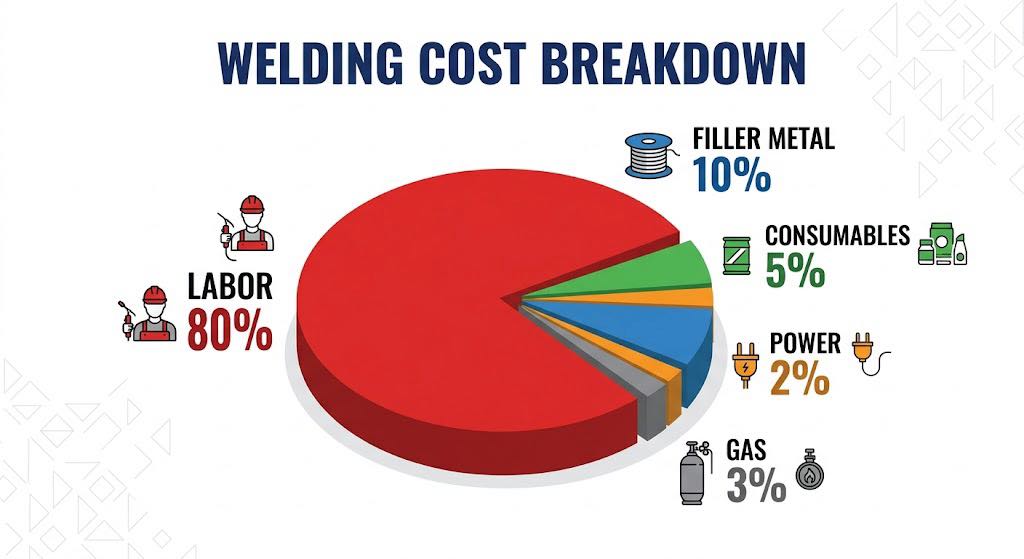
The daily running cost of robotic laser welding is actually much lower than traditional TIG/MIG welding. Main expenses include:
- Electricity: A 3,000W laser running at full power costs about $12–18 per hour (based on industrial electricity rates). Assuming 8 hours per day, annual electricity cost is approximately $5,000 – $8,000.
- Shielding Gas (Argon or Argon-Helium mix): Annual cost: $1,700 – $3,500
- Consumables (Protective lenses, nozzles, etc.): Annual cost: $1,100 – $2,000 (Laser welding consumables are far lower than traditional welding rods and wire)
- Maintenance: Laser systems are relatively easy to maintain. The first year is usually free, then approximately $2,000 – $4,000 per year thereafter (including calibration and lens replacement).
Estimated Total Annual Operating Cost: $10,000 – $18,000 (This is significantly lower than the labor and consumable costs of equivalent traditional welding capacity.)
3. Real Case Study: ROI Calculation for a Small-to-Medium Enterprise
Company Background: A small-to-medium factory producing stainless steel cabinets and equipment enclosures. Previously using manual TIG welding, with an annual welding length of about 150,000 meters, mainly on thin sheets (1–4mm).
After Implementation:
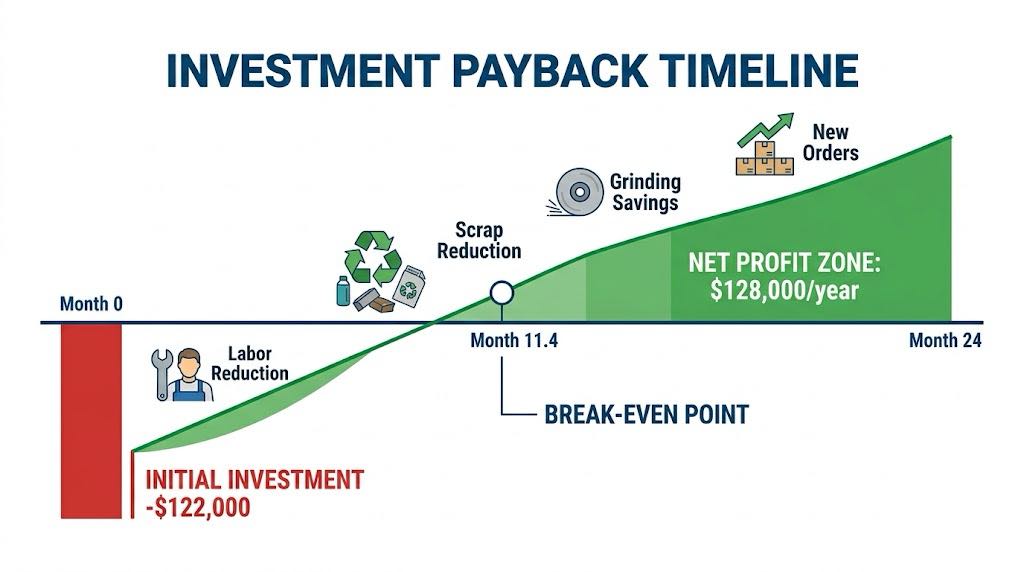
- Purchased a 2,000W robotic laser welding system with a total investment of $122,000 (including installation and basic seam tracking).
- Welding speed increased from 0.4 m/min (manual) to 2.5–3.5 m/min, representing a 6–8 times efficiency improvement.
- Labor reduced from 8 welders to 2 (1 operator + 1 for loading/unloading).
- Defect rate dropped from 8% to under 1.5%.
- Post-weld grinding process greatly reduced, saving approximately $0.11 – $0.17 per meter in grinding costs.
Annual Benefits Calculation:
- Labor cost savings: ~$62,000 per year (6 welders)
- Reduced scrap rate savings: ~$17,000 per year
- Grinding process savings: ~$25,000 per year
- Additional profit from increased capacity: ~$35,000 per year
- Increased electricity & gas costs: ~$11,000 per year
Net Annual Benefit ≈ $62,000 + $17,000 + $25,000 + $35,000 – $11,000 = $128,000
Payback Period Calculation: $122,000 ÷ $128,000 per year ≈ 11.4 months
Even using a more conservative estimate (only counting labor, scrap, and grinding savings), the net annual benefit is still around $70,000, resulting in a payback period of approximately 17–18 months.
In most factories adopting robotic laser welding, the actual payback period falls between 12 to 24 months.
4. Hidden Benefits: Real Profits Begin After Year Two
Once the system pays for itself, the advantages become even more apparent:
- Consistent, high-quality welds improve product appearance and make it easier to win high-end orders
- Stable production takt time allows for multi-shift continuous operation
- Reduced heavy dependence on skilled welders (who are increasingly difficult to recruit)
- Enhanced factory automation image, which builds brand reputation and customer trust
- Easy future expansion into multi-robot lines or flexible manufacturing cells
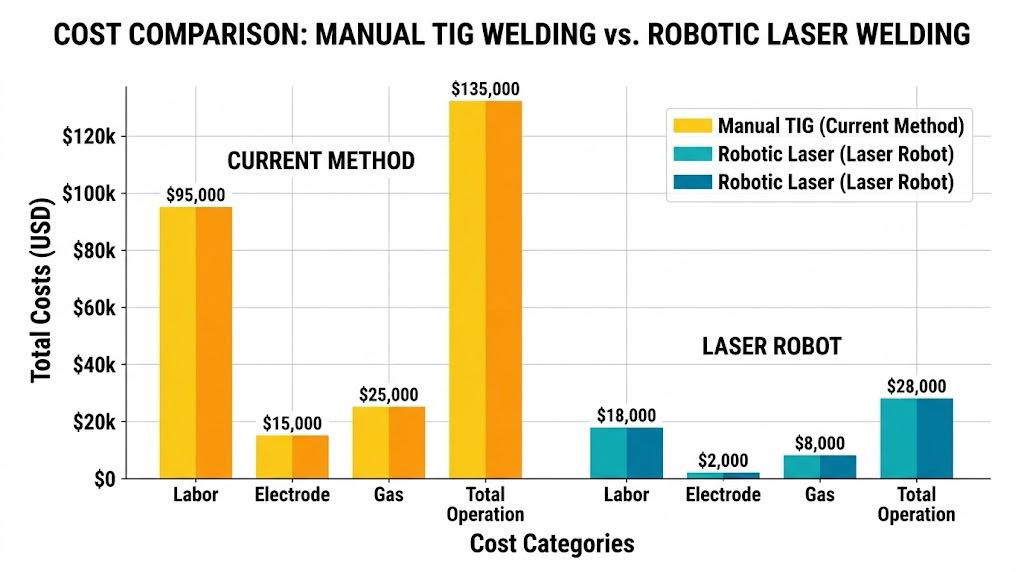
5. Investment Decision Recommendations
- If your annual welding volume is low (<50,000 meters/year): Robotic laser welding may not be cost-effective yet. Consider outsourcing or starting with a smaller manual laser welder.
- If your annual welding volume is medium (80,000–300,000 meters): Robotic laser welding is usually a very worthwhile investment, with most factories breaking even within 18 months.
- If your annual welding volume is high (>300,000 meters): Payback will be even faster. Strongly recommended — multi-station solutions can also be considered.
Although the initial investment for robotic laser welding is higher than traditional welding methods, its real value lies in this: “You recover the difference within the first two years, and from the third year onward, every part you weld generates pure profit.” As long as your welding volume is stable and parts have good repeatability, robotic laser welding is very likely to be a smart and profitable medium-to-long-term investment.
Before making a purchase decision, I strongly recommend having the supplier perform detailed sample welding tests on your actual workpieces and provide a customized ROI calculation based on real data for speed, yield, and consumables.
In the next article, we will move into the practical side: the installation and commissioning process, daily maintenance tips, and how to troubleshoot common issues — helping you use the system effectively and reliably after purchase.
( The above data is based on average 2026 international market levels. Prices may vary depending on brand, configuration, and region. Please base your final investment decision on official supplier quotes and on-site testing.)
Author Identification
An expert in robotic welding system integration with over 12 years of industry experience. My company has over 26 years of professional experience, holds more than 40 patented technologies, and has successfully completed over 1,500 projects worldwide (approximately 70% of which involved robotic welding cells, totaling more than 1,000 units). The company holds EU CE certification (Certificate No.: M.2026.206.C134866) and complies with the EN 60204-1:2018 and EN ISO 12100:2010 standards. I have assisted numerous manufacturing companies throughout the entire process of robotic welding workstation implementation, from selection to production launch.
Updated: May 2026
RELATED POSTS
Scan-to-Weld Technology:How Reverse Modeling Replaces Robot Programming
7th Axis Robot Track System Maintenance & Troubleshooting Guide
Tight Budget, Smart Choice:How Small and Mid-Size Factories Get the Most Value from a Robot Positioner in 2026
1G to 6G Without a Crane: How a Positioner Converts Overhead Welds into Flat-Position Welds
5 Reasons Large Workpiece Welding Is Inefficient — and How a Robot Positioner Solves Each One