Custom Robot Workstations And Laser Systems Manufacturer


Embodied Robot or Industrial Robot: Factory Automation at a Crossroads
As Tesla’s 24-hour humanoid robot livestream grips the world, manufacturers face a pivotal question: double down on proven industrial arms or bet on a new generation of general-purpose embodied intelligence.
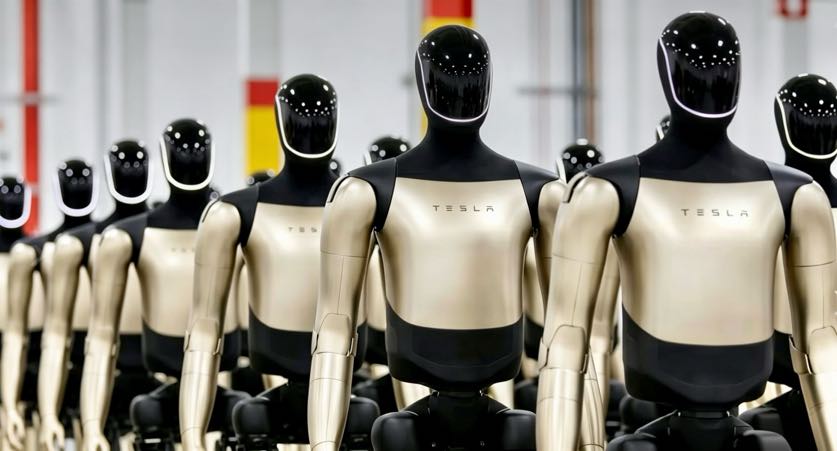
March 2026 — Fremont, California — For a full 24 hours, the world watched. Cameras inside Tesla’s Fremont factory streamed nonstop footage of Optimus humanoid robots sorting components, walking between workstations, and performing repetitive handling tasks—all with minimal human intervention. The livestream wasn’t a polished marketing reel. It was raw, unedited, and boring by entertainment standards. That was exactly the point.
“The boring ones are the real ones,” one X user commented as the stream surpassed 2 million views. Behind the quiet footage, the message was seismic: embodied AI had left the lab.
That same week, a fully autonomous Figure 03 humanoid robot entered the White House alongside First Lady Melania Trump, delivered a speech, and greeted guests in 11 languages before the world’s first spouses sat down to discuss AI in education. “Very soon, artificial intelligence will move from our mobile phones to humanoids that deliver utility,” Melania Trump said.
Manufacturing leaders took notice—not because robots can now give speeches, but because something fundamental is shifting beneath the factory floor.
Two Visions for the Factory Floor
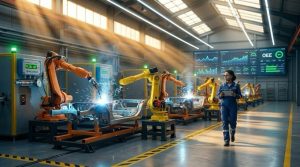
The industrial robot is a masterpiece of specialization. A FANUC arm bolted to a concrete pad, repeating the same 0.02-millimeter-precision weld 2,000 times per hour, delivering ROI that has been bankable for decades. The embodied humanoid, by contrast, is designed for human environments—stairs, door handles, uneven floors, and tools designed for human hands. In theory, a humanoid can go anywhere a human worker can go.
But the trade-offs are stark. Today’s humanoids typically manage 5–20 kilograms per arm, walk at 0.5–2 meters per second (much slower than fixed arms can swing), and operate with ±1–5 millimeters of repeatability—far below industrial precision standards. For high-cycle, high-precision, safety-certified operations, the industrial arm remains untouchable.
“For most factory applications in 2026, traditional industrial robot arms or cobots still offer higher ROI than humanoids: faster cycle times, better certifications, and lower deployment risk,” concludes a recent industry benchmark report. Humanoids shine where traditional automation fails—unstructured logistics, tote handling, batch moves that fixed arms cannot reach. But those are still niche applications.
What Tesla Showed the World
The 24-hour livestream was the product of months of quiet engineering. In late March, Tesla released a behind-the-scenes video that deliberately shifted focus from dancing robots to factory floors—showing miniature high-power inverters, redesigned gearboxes, actuator assembly lines, and rows of parts undergoing automated inspection.
“The focus has shifted from ‘can we do it’ to ‘can we scale it’,” one industry observer noted. Tesla is already running a pilot production line for Optimus in California. Gen 3 lines are planned for 2026, with low-volume production starting this year and mass ramping in 2027. Elon Musk has set a target of 1 million robots annually at approximately $30,000 per unit—a price point that would rival the cost of a skilled worker over multiple shifts. Meanwhile, the company has reportedly begun retooling its Fremont facility, reallocating production capacity from Model S and Model X to robots.
But a livestream is not the same as a production order.
“Humanoid robots may have a lifespan of about 5 years, and after that they could fail miserably. At most, 10 years,” billionaire investor Mark Cuban said in a recent livestream, voicing deep skepticism about the hardware longevity of the humanoid form factor.
Physical AI Becomes Geopolitical
The robo-competition is no longer just between companies—it is now fully embedded in national industrial strategy.
China has elevated embodied intelligence to the core of its 15th Five-Year Plan (2026–2030), positioning AI-powered robots as primary drivers for economic growth. The country already has more than 140 humanoid robot manufacturers and 330 product models. A national standard framework released in March 2026 now covers the entire industrial chain, from foundational technologies to safety ethics. China installed 10 times more robots in its factories than the United States in 2025. In 2025 alone, Chinese makers shipped over 12,000 humanoid units; Agibot delivered its 5,000th unit in December 2025, putting it far ahead of most Western peers.
The United States is taking a different path. While China scales, the U.S. focuses on general-purpose AI-driven humanoids: Tesla’s Optimus, Figure AI’s Figure 03 (which addressed the White House), Agility Robotics’ Digit, Apptronik’s Apollo. U.S. private AI investment reached 109.1billion,dwarfingChina’s109.1billion,dwarfingChina’s9.3 billion, and U.S. models maintain a roughly 7-month technological lead. But production capacity tells another story: Chinese firms already dominate the volume game, and U.S. makers are scrambling to build domestic supply chains. Figure AI recently opened BotQ, a facility capable of producing 12,000 humanoids annually.
Morgan Stanley has noted the once-clear division of labor—U.S. designs the brain, China builds the body—is rapidly dissolving. China is no longer just the assembly line; it is becoming a rival powerhouse across the entire value chain.
Europe, meanwhile, is trying to catch both. At the 2026 Hanover Messe—the world’s largest industrial technology fair, with over 3,000 exhibitors—German Chancellor Friedrich Merz toured the Agile Robots stand and threw his weight behind embedding physical AI into Germany’s industrial base. “AI should be embedded in the key sectors of our industry and especially in small- and medium-sized firms,” Merz said. Agile Robots is focused not on dancing demonstrations but on “value-added tasks for industry”—electronic wiring in cars and phone assembly. A Bitkom survey found 58 percent of German industrial firms believe humanoid robots could help plug critical skilled labor shortages.
“Physical AI has the potential to rewrite the economics of the industry,” according to a recent Citi report. According to the World Economic Forum, AI-powered systems achieve up to 40 percent greater operational efficiency than traditional automation.
The Practical Crossroads
So what should a factory manager do in 2026?
For most applications, the answer remains unchanged. If the task is high-volume, high-precision, and safety-certified, a traditional industrial arm delivers better ROI. The engineering problem of a fixed six-axis arm moving along programmed paths with ±0.02 mm repeatability has been solved for decades.
But the frontier is shifting. The distinction between rigid industrial robots, safe cobots, and experimental AI robots is “becoming less clear-cut,” noted ABB’s recent Hanover debut of the PoWa family, targeting the gap between traditional cobots and industrial robots. Physical AI, according to ABI Research, has now reached “the technological maturity required for widespread adoption,” with robust algorithms in dynamic policy adjustment and emerging robotics foundation models “now capable of delivering on the promise of true adaptive automation”.
Humanoids are currently best suited for unstructured logistics, tote handling, and batch moves that fixed arms cannot reach—situations where the environment is unpredictable and the task changes frequently. That is still a niche, but it is a growing one. Executives widely refer to 2026 as a transitional year for mass production in the sector.
As one industry report put it: “The endgame of industrial embodied intelligence has never been ‘making robots that look and move like humans’—it is about enabling intelligence to truly penetrate the barriers of industrial scenarios and solve manufacturing’s most core, real problems. All technological celebrations detached from the fundamental demands of industry will eventually shatter against the reality of production”.