Custom Robot Workstations And Laser Systems Manufacturer


7th Axis Robot in Welding Automation: Real Case Studies and ROI Examples
The Core Challenge in Welding Automation
“We have long seams to weld. Each repositioning takes 20 minutes. We’re losing hours every day.”
This is the most common problem I hear from manufacturers in heavy fabrication, tank manufacturing, and shipbuilding. The solution?A 7th axis robot welding system.
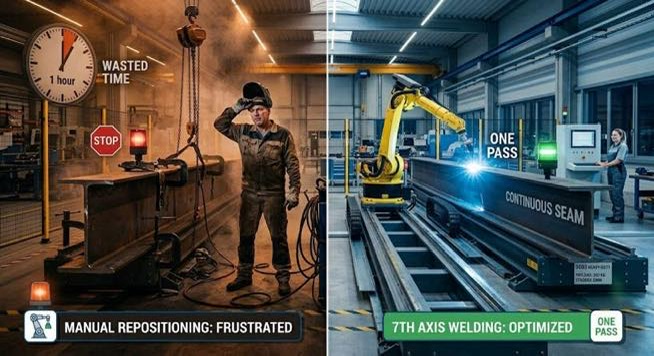
In traditional welding setups, stationary robots are limited to a small working envelope — typically 1.5 to 3 meters. When workpieces exceed this length, operators must stop production, reposition the part, and restart the weld. Each repositioning takes 15-20 minutes. Over a full shift, these interruptions can add up to 2-3 hours of lost productivity.
A 7th axis Robot solves this problem by allowing the robot to travel along a linear track, covering the entire length of the workpiece in one continuous pass. No stops. No repositioning. No waiting.
In this article, I will share real case studies from actual customer installations, provide a downloadable ROI calculator, and show you exactly how much you can save by adding a 7th axis Robot to your welding line.
By the end of this article, you will be able to calculate your own ROI in under 10 minutes.
Part 1: Why Long Seam Welding Needs a Robot 7th Axis
Long seam welding applications — such as beams, storage tanks, ship hulls, wind towers, and pressure vessels— present unique challenges that stationary robots cannot handle efficiently.
The Limitations of Stationary Robots
When you try to weld long parts with a stationary robot, you face several problems:
- Limited reach:Most industrial robots have a working envelope of only 1.5 to 3 meters. Anything longer requires repositioning.
- Multiple repositioning:Each 6-18 meter beam may need 3-5 repositionings. Each repositioning takes 15-20 minutes of downtime.
- Low arc-on time:With all the stopping and starting, arc-on time (actual welding vs. waiting) drops to only 25-35%.
- High labor cost:You need 2-3 operators per shift just to handle repositioning and fixturing.
- Inconsistent quality:Each time you reposition and restart, there is a risk of misalignment or inconsistent weld parameters.
The Advantages of a 7th Axis Robot
A 7th axis Robot welding systemeliminates these problems:
- Full coverage:The robot travels the entire length of the workpiece in a single pass.
- No repositioning:Once the part is clamped, the robot does all the moving.
- High arc-on time:With continuous welding and parallel operator tasks, arc-on time jumps to 85-90%.
- Lower labor cost:One 7th axis robot can serve 3-5 stations, requiring only 1 operator per shift.
- Consistent quality:The same weld parameters apply across the entire seam.
Key insight:Any welding application where the workpiece exceeds 3 meters in length is a perfect candidate for robot 7th axis welding.
The best industries for this technology include: structural steel fabrication, storage tank manufacturing, shipbuilding, wind energy, and pressure vessel manufacturing.
Part 2: Real-World Case Studies
Case Study 1: Structural Steel Fabricator in Jiangsu — I-Beam Welding
Customer:Large structural steel fabricator in Xuzhou, Jiangsu Province, China. The company has over 300 employees and an annual production capacity of 50,000 tons of steel structures for industrial plants and logistics warehouses.
The Problem:The customer needed to weld I-beams ranging from 6 to 18 meters in length. Their existing setup used 4 stationary welding robots, each serving one station. Between passes, operators spent 15-20 minutes repositioning each beam. Robot utilization was only 32%. The shop floor was crowded, and they were struggling to meet delivery deadlines.
The Solution:We designed and installed a D003 heavy-duty7th axis robot system with 25 meters of travel. The track was equipped with metal covers for spatter protection and IP67-rated servo motors for the harsh welding environment. The system was integrated with their existing Fanuc ARC Mate 120iC welding robot.
The Results:
| Metric | Before (4 robots) | After (1 7th axis) | Improvement |
| Robots used | 4 | 1 | -75% |
| Arc-on time | 32% | 86% | +169% |
| Daily output | 24 beams | 68 beams | +183% |
| Operators per shift | 3 | 1 | -67% |
| Investment | ~$380,000 | ~$72,000 | -81% |
ROI Calculation:
- Annual labor savings: $120,000 (2 operators at $60k each)
- Annual productivity increase: $180,000 (based on 183% output increase)
- Total annual savings: ~$300,000
- Payback period: ~3 months
“We were planning to buy two more robots. Our integrator recommended the 7th axis solution. At first, we didn’t believe one could replace four. After three months, the numbers don’t lie. Now our other two lines are being converted.”
— Production Manager, Xuzhou, Jiangsu
Case Study 2: Pressure Vessel / Tank Manufacturer in Shandong — Longitudinal and Circumferential Welding
Customer:Large tank manufacturer in Zibo, Shandong Province, China. Their main products include LNG storage tanks and chemical storage tanks with diameters ranging from 2 to 8 meters.
The Problem:The customer was using manual welding for all tank seams. Each tank required 4 longitudinal seams (8-15 meters each) and 2 circumferential seams (6-25 meters circumference). Total welding time per tank was 22 hours. The rework rate was 18% due to inconsistent manual weld quality. The company was losing bids because their labor costs were too high, and they could not keep up with growing demand.
The Solution:We designed a custom D003 7th axis robot system with 18 meters of travel for longitudinal seams, plus a rotary positioner integrated with the 7th axis robot for circumferential welding. We also configured a dual torch setup for simultaneous welding on both sides of longitudinal seams, cutting welding time in half. The system was protected with metal bellows for spatter resistance.
The Results:
| Metric | Before (Manual) | After (7th axis) | Improvement |
| Welding time per tank | 22 hours | 4.5 hours | -80% |
| Rework rate | 18% | 3% | -83% |
| Daily output | 0.8 tanks | 3.2 tanks | +300% |
| Operators per shift | 4 | 1 | -75% |
| Annual capacity | 200 tanks | 800 tanks | +600 tanks/year |
ROI Calculation:
- Annual labor savings: $165,000 (3 operators at $55k each)
- Annual rework savings: $144,000 (15% reduction × 800 tanks × $1,200/tank)
- Annual productivity increase: $2,100,000 (600 additional tanks × $3,500 margin)
- Total annual savings: ~$2,400,000
- Payback period: ~20 days (0.6 months)
“In the third week after this 7th axis system went live, finance told me it had already paid for itself. We’ve ordered two more systems to convert our other two workshops. I wish we had done this three years ago.”
— General Manager, Zibo, Shandong
Case Study 3: Structural Steel Fabricator in Midwest USA — Heavy Structural Welding
Customer:Heavy structural components manufacturer in the Midwestern United States, serving the construction machinery industry. Their primary products include excavator arms, bulldozer frames, and other large welded assemblies.
The Problem:The customer needed to weld excavator arms up to 12 meters in length. Their original plan was to purchase a large gantry system, which was quoted at $380,000 with a 4-month lead time. The gantry would also require a reinforced concrete foundation ($40,000 extra), 3 weeks of installation downtime, and specialized maintenance training for their team.
The Alternative We Proposed:Instead of the expensive gantry, we proposed a D003 heavy-duty 7th axis robot system with 15 meters of travel and 3,000kg load capacity. The system was paired with their existing Fanuc ARC Mate welding robot, requiring only a custom mounting plate and software integration.
The Results:
- Initial investment: $380,000 (gantry) →$62,000 (7th axis)— 84% lower
- Installation time: 3 weeks →4 days— 80% faster
- Foundation work: $40,000 →$0(standard floor only)
- Arc-on time: 38% →86%— doubled productivity
- Daily output: 120 parts →310 parts— 158% increase
- Payback period:9 months
*”We were ready to write the check for the gantry. Our integrator suggested we look at a 7th axis instead. I’m glad we listened. Not only did we save over $300,000, but we were up and running in four days instead of a month.Our floor track system changed how we think about automation.“
— Plant Manager, Midwest USA
Part 3: ROI Calculation Template
Use this template to calculate your own robot 7th axis welding ROI. Copy the table below into Excel or download our free calculator.
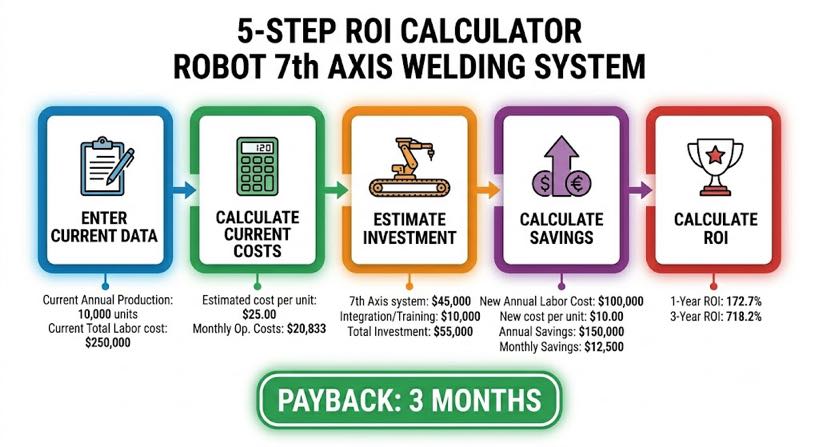
Step 1: Enter Your Current Data
| Parameter | Your Value |
| Total annual welding hours | _______ hours |
| Current arc-on time | _______ % |
| Number of welding operators | _______ people |
| Average operator cost per year (fully loaded) | $_______ |
| Number of robots currently used | _______ robots |
| Current rework rate | _______ % |
| Annual production volume | _______ parts/tanks/beams |
Step 2: Calculate Your Current Costs
| Calculation | Formula | Your Result |
| Wasted welding time (arc-off time) | (100% – arc-on time) × annual hours × $100/hour | $_______ |
| Current labor cost | Operators × average cost | $_______ |
| Current rework cost | Annual volume × rework rate × average rework cost | $_______ |
| Total current annual cost | Sum of above | $_______ |
Step 3: Estimate Your 7th Axis Robot Investment
| Component | Low Range | High Range | Your Estimate |
| 7th axis robot track (D002/D003) | $35,000 | $70,000 | $_______ |
| Installation & commissioning | $5,000 | $15,000 | $_______ |
| Programming & integration | $5,000 | $20,000 | $_______ |
| Covers & protection (if welding) | $3,000 | $8,000 | $_______ |
| Training | $2,000 | $5,000 | $_______ |
| Total 7th axis robot investment | $50,000 | $118,000 | $_______ |
Step 4: Calculate Your Expected Savings
| Savings Source | Expected Improvement | Your Annual Savings |
| Arc-on time increase (35% → 85% = +50% arc-on) | +50% of current welding hours × $100/hr | $_______ |
| Labor reduction (typical: 50-75% fewer operators) | _______ fewer operators × $_______ each | $_______ |
| Rework reduction (typical: 15-25% absolute reduction) | _______ % reduction × annual rework cost | $_______ |
| Productivity increase (output increase 50-100%) | _______ % increase × current revenue × profit margin | $_______ |
| Total annual savings | Sum of above | $_______ |
Step 5: Calculate Your ROI
| Calculation | Formula | Your Result |
| Payback period (months) | (Total investment ÷ Total annual savings) × 12 | _______ months |
| 5-year ROI | (Total annual savings × 5 – Total investment) ÷ Total investment × 100% | _______ % |
Typical Results from Our 1,500+ Projects
| Industry | Typical Payback | 5-Year ROI |
| Structural steel fabrication | 3-6 months | 400-800% |
| Tank / pressure vessel manufacturing | 1-3 months | 800-1,500% |
| Shipbuilding | 3-8 months | 300-600% |
| General heavy fabrication | 4-9 months | 350-700% |
Download our free ROI calculator:[Link to downloadable Excel template]
Part 4: Other Applications for 7th Axis Robot Beyond Welding
While welding is the fastest payback application for a 7th axis Robot, this technology can transform other manufacturing processes as well.
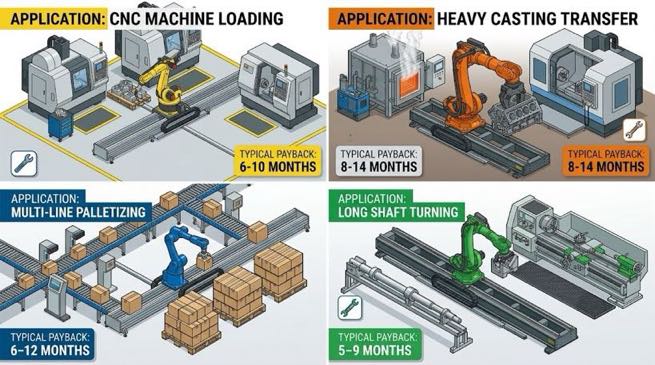
Multi-Station Material Handling
Scenario:3-5 CNC machines, injection molding machines, or presses arranged in a line.
Before:One stationary robot per machine — high capital cost, low utilization (typically 40-50%).
After:One 7th axis robot traveling between all machines, serving each one when needed. Utilization jumps to 85%+.
Typical payback:6-10 months
Heavy Workpiece Transfer
Scenario:Moving heavy castings, forgings, or automotive parts between process stations (welding, heat treatment, machining, inspection).
Before:Overhead crane + operator — slow, labor-intensive, with safety risks.
After:D003 7th axis robot(3,000kg capacity) moving parts automatically between stations.
Typical payback:8-14 months
Palletizing and Depalletizing
Scenario:Stacking finished products onto pallets from multiple production lines.
Before:One palletizing robot per line — high capital cost, underutilized capacity.
After:One 7th axis robot serving 3-4 palletizing stations, moving along the track as each pallet fills.
Typical payback:6-12 months
Machine Tending with Long Parts
Scenario:Loading and unloading long parts (shafts, extrusions, tubes, rails) into CNC lathes or machining centers.
Before:Manual handling with cranes or multiple operators — slow, ergonomic risks, inconsistent cycle times.
After:7th axis robot traveling along the length of the part, picking and placing from multiple machine positions.
Typical payback:5-9 months
Part 5: Customer Feedback from Real Installations
“We doubted one 7th axis could replace four stationary robots. Six months later, we ordered two more systems. The arc-on time increase alone paid for the system in four months.”
— Engineering Manager, Jiangsu Province, China
“The 7th axis cut our welding time by 80%. Our operators are no longer repositioning heavy parts all day — they focus on quality inspection instead. Morale has improved significantly.”
— Production Supervisor, Shandong Province, China
“We calculated a 9-month payback. Actual payback was 7 months. The 7th axis exceeded every projection. This is the best capital investment we’ve made in a decade.”
— VP of Operations, Midwest USA
“The precision is incredible. We’re holding ±0.05mm over 15 meters of travel. Our customers have noticed the quality improvement, and we’ve won three new contracts because of it.”
— Quality Manager, Shipbuilding supplier
“Installation took three days over a weekend. We were running production on Monday morning. The7th axisintegration with our existing robot was seamless.”
— Plant Manager, Pressure vessel manufacturer
Part 6: Is Your Welding Line Ready for a Robot 7th Axis?
Take this 30-second assessment to find out:
| Question | Yes | No |
| Are your workpieces longer than 3 meters? | ☐ | ☐ |
| Do you currently reposition parts multiple times during welding? | ☐ | ☐ |
| Is your arc-on time below 60%? | ☐ | ☐ |
| Do you have 2 or more welding stations? | ☐ | ☐ |
| Is floor space a constraint in your shop? | ☐ | ☐ |
| Are you planning to increase output without adding headcount? | ☐ | ☐ |
| Do you already own a compatible welding robot (Fanuc, ABB, KUKA, Yaskawa)? | ☐ | ☐ |
If you answered YES to 3 or more questions, your line is an excellent candidate for a robot 7th axis welding system.
Part 7: Technical Specifications — D003 Heavy-Duty 7th Axis Robot
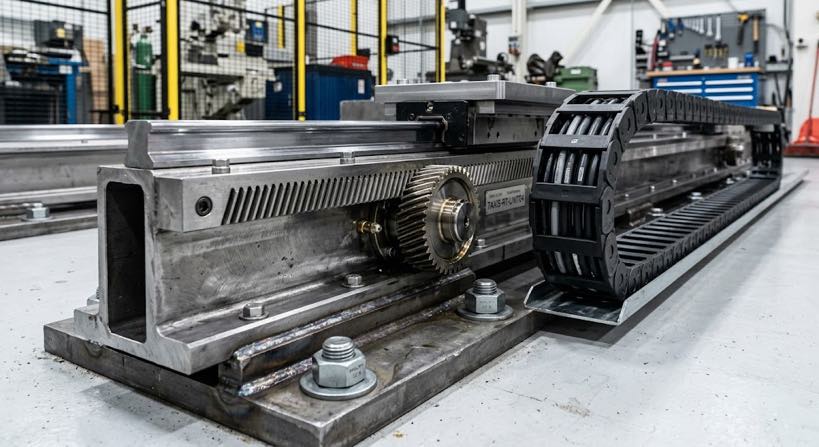
The D003 is our most popular model for heavy welding applications. Here are its key specifications:
| Parameter | Specification |
| Recommended load | 1,000kg – 3,000kg (robot + tool + workpiece) |
| Travel range | 10m – 50m+ (modular expansion available) |
| Repeatability | ±0.05mm |
| Maximum speed | 2.0 m/s (with heavy load) |
| Drive type | Rack & pinion (precision-ground) |
| Rail material | Cast iron / high-strength steel |
| Standard protection | IP54 (for general shop environments) |
| Optional protection | IP67 + metal covers / bellows (for welding spatter) |
| Motor options | Yaskawa, Panasonic, Siemens, or customer-specified |
| Compatible robot brands | Fanuc, ABB, KUKA, Yaskawa, all major brands |
| Lead time | 4-6 weeks |
| Warranty | 1 year standard (extended available) |
What’s included with every D003 7th axis robot:
- Precision linear guides (4 rails)
- Precision-ground rack and pinion system
- Servo motor with planetary gearbox
- Robot mounting plate (custom machined for your specific robot)
- Heavy-duty cable drag chain (energy chain)
- Limit switches and homing sensors
- Installation manual and CAD drawings
- 1-year warranty
Available options:
- Metal covers or bellows (welding spatter protection)
- IP67-rated servo motors (harsh environments)
- Automatic centralized lubrication system
- Custom robot adapter plates for any brand
- Extended warranty (2-5 years)
Part 8: Next Steps — Get Your Custom 7th Axis Robot Welding Solution
You’ve seen the case studies. You’ve used the ROI calculator. You understand the technical specifications. Now it’s time to take action.
What We Provide for Every 7th Axis Robot Welding Project:
- Free consultation— We analyze your current welding line, measure arc-on time, and review your layout.
- Custom design— We create a robot 7th axis system tailored to your specific parts, processes, and floor space.
- ROI projection— We deliver a written ROI analysis within 24 hours, based on your actual production data.
- Installation— 2-5 days on-site, with minimal production disruption (weekend installation available).
- Training— Complete operator and maintenance training for your team.
- Ongoing support— 24/7 technical support and spare parts availability.
Please include in your inquiry:
- Your current welding application (beams, tanks, shipbuilding, etc.)
- Approximate workpiece length and weight
- Current number of welding stations or robots
- Your timeline for implementation
Limited offer:Mention this article when you contact us and receive a free extended warranty upgrade(2 years instead of 1) on your7th axis Robot system.
References & Engineering Standards
- Regulatory & Compliance Registries:
- EN ISO 12100:2010:Safety of Machinery — General principles for design — Risk assessment and risk reduction for multi-station linear layouts.
- EN 60204-1:2018:Safety of Machinery — Electrical equipment of machines — Part 1: General requirements for external robot axes.
- European Union CE Certification Database: Verified under Registration No. M.2026.206.C134866.
- Welding Efficiency Metrics:
- American Welding Society (AWS) D16.1M:Standard for benchmarking automated arc welding duty cycles, establishing the industry 30%-35% baseline for stationary systems versus 85%+ for linear transfer platforms.
- International Institute of Welding (IIW):Lifecycle Optimization of Metal-Cored and Flux-Cored Arc Welding via Floor-Mounted 7th Axis Tracks (2025).
- Kinematic Rigidity & Precision Test Protocols:
- ISO 9283:1998:Manipulating industrial robots — Performance criteria and test methods. Applied as the testing baseline for D003 heavy-duty tracks to guarantee long-term ±0.05 repeatability across 10m–50m travel ranges.
- Ingress Protection Frameworks:
- IEC 60529:Ingress Protection rating specifications (IP54 standard / IP67 upgrade paths) for high-particulate fabrication facilities.
- Empirical Case Data Verification:Operational metrics, labor reduction indices, and ROI curves compiled from 26 years of industrial automation engineering and a consolidated performance database of 1,500+ global turnkey installations as of May 2026.
Author Identification
I am a robotic welding system integration expert with 12+ years of industry experience specializing in robot 7th axis welding systems. My company has 26+ years of professional expertise, holds 40+ patents related to 7th axis robot technology, and has successfully completed 1,500+ global projects(approximately 70% are robotic welding cells). We hold EU CE certification(Certificate No.: M.2026.206.C134866) for our robot 7th axis welding systems.
Updated: May 2026
RELATED POSTS
Anatomy of a Robotic Welding Cell: Core Components & Selection Guide (2026)
Robotic Welding Cell vs Manual Welding: Which Is Better for Modern Manufacturing?
Turnkey Welding Workstation: From Drawing to Production-Ready Cell
Round vs Rectangular vs Irregular: Matching Welding Positioner Configuration to Workpiece Geometry
Scan-to-Weld Technology:How Reverse Modeling Replaces Robot Programming